Sutliff Aimee K, Saint-Cyr Martine, Hendricks Audrey E, Chen Samuel S, Doenges Katrina A, Quinn Kevin, Westcott Jamie, Tang Minghua, Borengasser Sarah J, Reisdorph Richard M, Campbell Wayne W, Krebs Nancy F, Reisdorph Nichole A
Department of Pediatrics, Section of Nutrition, School of Medicine, University of Colorado, Aurora, CO 80045, USA.
Skaggs School of Pharmacy and Pharmaceutical Sciences, University of Colorado, Aurora, CO 80045, USA.
Metabolites. 2021 Apr 14;11(4):241. doi: 10.3390/metabo11040241.
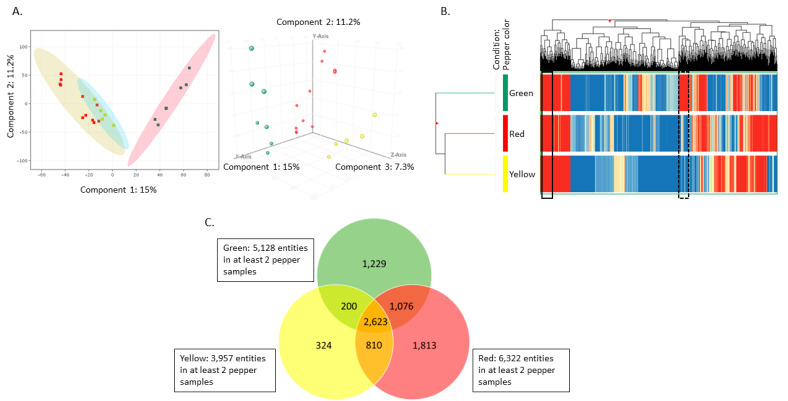
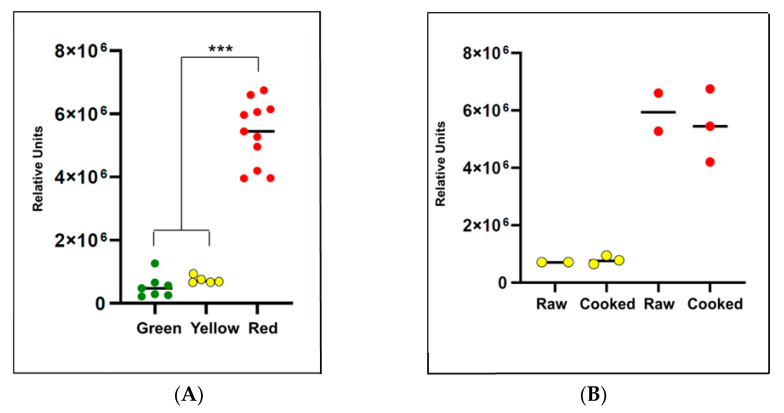
Identifying and annotating the molecular composition of individual foods will improve scientific understanding of how foods impact human health and how much variation exists in the molecular composition of foods of the same species. The complexity of this task includes distinct varieties and variations in natural occurring pigments of foods. Lipidomics, a sub-field of metabolomics, has emerged as an effective tool to help decipher the molecular composition of foods. For this proof-of-principle research, we determined the lipidomic profiles of green, yellow and red bell peppers () using liquid chromatography mass spectrometry and a novel tool for automated annotation of compounds following database searches. Among 23 samples analyzed from 6 peppers (2 green, 1 yellow, and 3 red), over 8000 lipid compounds were detected with 315 compounds (106 annotated) found in all three colors. Assessments of relationships between these compounds and pepper color, using linear mixed effects regression and false discovery rate (<0.05) statistical adjustment, revealed 11 compounds differing by color. The compound most strongly associated with color was the carotenoid, β-cryptoxanthin (-value = 7.4 × 10; FDR adjusted -value = 0.0080). These results support lipidomics as a viable analytical technique to identify molecular compounds that can be used for unique characterization of foods.
识别和标注各类食物的分子组成,将增进对食物如何影响人体健康以及同一物种食物分子组成存在多大差异的科学理解。这项任务的复杂性包括食物天然色素的不同品种和变化。脂质组学作为代谢组学的一个子领域,已成为帮助解读食物分子组成的有效工具。在这项原理验证研究中,我们使用液相色谱质谱联用技术以及一种数据库搜索后自动注释化合物的新工具,测定了青椒、黄椒和红椒的脂质组图谱。在从6个辣椒(2个绿色、1个黄色和3个红色)中分析的23个样本中,检测到8000多种脂质化合物,其中有315种化合物(106种已注释)在所有三种颜色的辣椒中都能找到。使用线性混合效应回归和错误发现率(<0.05)统计调整方法评估这些化合物与辣椒颜色之间的关系,发现有11种化合物因颜色而异。与颜色关联最紧密的化合物是类胡萝卜素β-隐黄质(-值 = 7.4 × 10;错误发现率调整后的-值 = 0.0080)。这些结果支持脂质组学作为一种可行的分析技术,可用于识别可用于食物独特表征的分子化合物。