
根管治疗后磨牙中不同修复材料及高嵌体预备设计的力学行为
Mechanical Behavior of Different Restorative Materials and Onlay Preparation Designs in Endodontically Treated Molars.
作者信息
Gomes de Carvalho Ana Beatriz, de Andrade Guilherme Schmitt, Mendes Tribst João Paulo, Grassi Elisa Donária Aboucauch, Ausiello Pietro, Saavedra Guilherme de Siqueira Ferreira Anzaloni, Bressane Adriano, Marques de Melo Renata, Borges Alexandre Luiz Souto
机构信息
Department of Dental Materials and Prosthodontics, Institute of Science and Technology, São Paulo State University (Unesp), São José dos Campos 12245-000, Brazil.
Graduate Program in Dentistry, Department Dentistry, University of Taubate (UNITAU), Taubate 12020-270, Brazil.
出版信息
Materials (Basel). 2021 Apr 12;14(8):1923. doi: 10.3390/ma14081923.
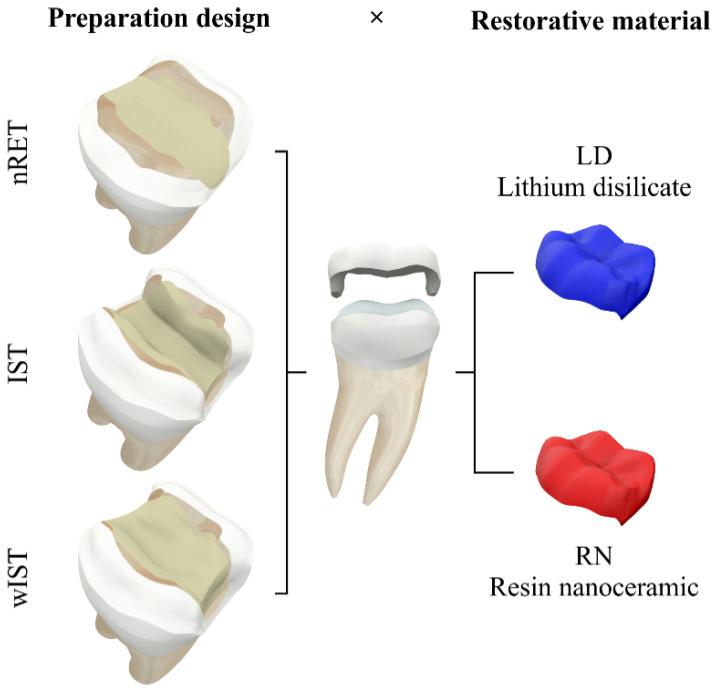
This study evaluated the effect of the combination of three different onlay preparation designs and two restorative materials on the stress distribution, using 3D-finite element analysis. Six models of first lower molars were created according to three preparation designs: non-retentive (nRET), traditional with occlusal isthmus reduction (IST), and traditional without occlusal isthmus reduction (wIST); and according to two restorative materials: lithium-disilicate (LD) and nanoceramic resin (NR). A 600 N axial load was applied at the central fossa. All solids were considered isotropic, homogeneous, and linearly elastic. A static linear analysis was performed, and the Maximum Principal Stress (MPS) criteria were used to evaluate the results and compare the stress in MPa on the restoration, cement layer, and tooth structure (enamel and dentin). A novel statistical approach was used for quantitative analysis of the finite element analysis results. On restoration and cement layer, nRET showed a more homogeneous stress distribution, while the highest stress peaks were calculated for LD onlays (restoration: 69-110; cement layer: 10.2-13.3). On the tooth structure, the material had more influence, with better results for LD (27-38). It can be concluded that nRET design showed the best mechanical behavior compared to IST and wIST, with LD being more advantageous for tooth structure and NR for the restoration and cement layer.
本研究采用三维有限元分析方法,评估了三种不同的高嵌体预备设计与两种修复材料的组合对应力分布的影响。根据三种预备设计创建了六个下颌第一磨牙模型:无固位形(nRET)、传统的有咬合峡部缩减(IST)和传统的无咬合峡部缩减(wIST);并根据两种修复材料:二硅酸锂(LD)和纳米陶瓷树脂(NR)。在中央窝施加600 N轴向载荷。所有实体均被视为各向同性、均匀且线弹性的。进行了静态线性分析,并使用最大主应力(MPS)标准来评估结果,并比较修复体、粘结层和牙体结构(釉质和牙本质)上以MPa为单位的应力。采用一种新颖的统计方法对有限元分析结果进行定量分析。在修复体和粘结层上,nRET显示出更均匀的应力分布,而LD高嵌体的应力峰值最高(修复体:69 - 110;粘结层:10.2 - 13.3)。在牙体结构上,材料的影响更大,LD的结果更好(27 - 38)。可以得出结论,与IST和wIST相比,nRET设计显示出最佳的力学性能,LD对牙体结构更有利,而NR对修复体和粘结层更有利。



 Zotero 插件