Gutiérrez-Tarriño Silvia, Espino Javier, Luna-Giles Francisco, Rodríguez Ana B, Pariente José A, Viñuelas-Zahínos Emilio
Coordination Chemistry Research Group, Department of Organic and Inorganic Chemistry, Faculty of Science, University of Extremadura, 06006 Badajoz, Spain.
Neuroimmunophysiology and Chrononutrition Research Group, Department of Physiology, Faculty of Science, University of Extremadura, 06006 Badajoz, Spain.
Pharmaceuticals (Basel). 2021 Apr 22;14(5):395. doi: 10.3390/ph14050395.
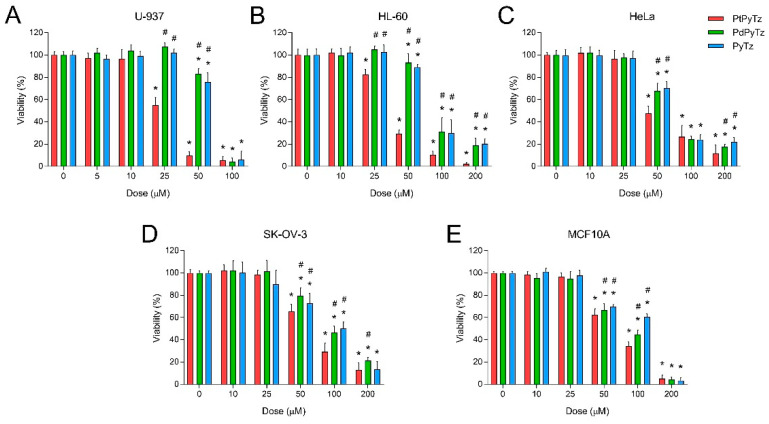
Chemical, pharmacological, and clinical research on anticancer coordination complexes has led to noteworthy anticancer drugs such as cisplatin, carboplatin and oxaliplatin. Although these compounds are effective chemotherapeutic agents in the treatment of different tumors, they are associated with high toxicity and numerous side effects. Several studies have shown that the range of platinum complexes with antitumor activity is not limited to structural analogs of cisplatin. Therefore, the development of convenient anticancer drugs that can be effectively used for the treatment of human tumors has become the main goal of most research groups in this field. In this sense, active platinum complexes without NH groups, transplatinum complexes, multinuclear complexes, cationic complexes, and several classes of palladium(II) complexes have emerged. Herein, the synthesis and characterization of two Pt(II) or Pd(II) complexes with PyTz (2-(2-pyridyl)iminotetrahydro-1,3-thiazine), a thiazine derivative ligand, with the formula [MCl(PyTz)]·CHO (M = Pt(II) or Pd(II)) were reported. The potential anticancer ability of both complexes was evaluated in epithelial cervix carcinoma HeLa, human ovary adenocarcinoma SK-OV-3, human histiocytic lymphoma U-937, and human promyelocytic leukemia HL-60 cell lines. Interestingly, the Pt(II) complex showed great cytotoxic potential against all tumor cell lines tested, whereas the Pd(II) complex displayed slight antitumor actions.
对抗癌配位化合物的化学、药理学及临床研究已催生出了诸如顺铂、卡铂和奥沙利铂等值得关注的抗癌药物。尽管这些化合物在治疗不同肿瘤方面是有效的化疗药物,但它们具有高毒性和众多副作用。多项研究表明,具有抗肿瘤活性的铂配合物范围并不局限于顺铂的结构类似物。因此,开发可有效用于治疗人类肿瘤的便捷抗癌药物已成为该领域大多数研究团队的主要目标。从这个意义上讲,不含氨基的活性铂配合物、反式铂配合物、多核配合物、阳离子配合物以及几类钯(II)配合物应运而生。在此,报道了两种分子式为[MCl(PyTz)]·CHO(M = Pt(II) 或 Pd(II))的、含有噻嗪衍生物配体PyTz(2-(2-吡啶基)亚氨基四氢-1,3-噻嗪)的Pt(II) 或 Pd(II) 配合物的合成与表征。在宫颈上皮癌细胞HeLa、人卵巢腺癌SK-OV-3、人组织细胞淋巴瘤U-937和人早幼粒细胞白血病HL-60细胞系中评估了这两种配合物的潜在抗癌能力。有趣的是,Pt(II) 配合物对所有测试的肿瘤细胞系均显示出巨大的细胞毒性潜力,而Pd(II) 配合物则表现出轻微的抗肿瘤作用。