Liu Hsien-Kuan, Yang Yung-Ning, Tey Shu-Leei, Wu Pei-Ling, Yang San-Nan, Wu Chien-Yi
Department of Pediatrics, E-DA Hospital, Kaohsiung 82445, Taiwan.
School of Medicine, I-Shou University, Kaohsiung 84001, Taiwan.
Children (Basel). 2021 Apr 22;8(5):324. doi: 10.3390/children8050324.
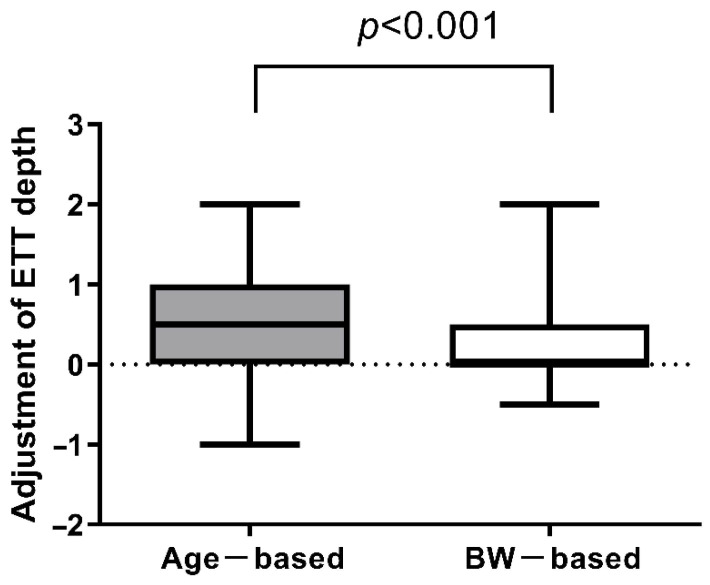
Determining the optimal endotracheal tube (ETT) depth in neonates remains challenging for neonatologists. The guideline for optimal ETT depth is based on the patients' weight or gestational age. However, there is a discrepancy in the suggested ETT depth between these two parameters. The aim of this retrospective study was to compare the recommended weight-based and age-based formulas for optimal ETT depth and obtain the optimal reference before intubation. Participants were assigned to group 1 if the recommended ETT insertion depth based on weight was concordant with the recommended depth based on gestational age, and to group 2 if the weight and age-based depth recommendations were discordant. After exclusion, 180 patients were included in the analysis. Results indicated that the predicted ETT depth suggested by age required more adjustment than by weight ( < 0.05). Furthermore, the required adjustment in the weight-based formula was smaller than the age-based formula ( < 0.05). Multivariate linear regression analysis revealed that weight was the key factor affecting the optimal depth ( < 0.001). These results imply that when there is a discrepancy in ETT depth between the weight-based and age-based recommendation, the weight-based one will be more accurate than the age-based one.
确定新生儿最佳气管插管深度对新生儿科医生来说仍然具有挑战性。最佳气管插管深度的指南是基于患者的体重或胎龄。然而,这两个参数在建议的气管插管深度上存在差异。这项回顾性研究的目的是比较基于体重和基于年龄的最佳气管插管深度推荐公式,并在插管前获得最佳参考值。如果基于体重的推荐气管插管深度与基于胎龄的推荐深度一致,则将参与者分配到第1组;如果基于体重和年龄的深度推荐不一致,则分配到第2组。排除后,180名患者纳入分析。结果表明,与基于体重的预测气管插管深度相比,基于年龄的预测气管插管深度需要更多调整(<0.05)。此外,基于体重的公式所需调整小于基于年龄的公式(<0.05)。多元线性回归分析显示,体重是影响最佳深度的关键因素(<0.001)。这些结果表明,当基于体重和基于年龄的推荐在气管插管深度上存在差异时,基于体重的推荐比基于年龄的推荐更准确。