Santonocito Manuela, Zappulla Cristina, Viola Santa, La Rosa Luca Rosario, Solfato Elena, Abbate Ilenia, Tarallo Valeria, Apicella Ivana, Platania Chiara Bianca Maria, Maugeri Grazia, D'Agata Velia, Bucolo Claudio, De Falco Sandro, Mazzone Maria Grazia, Giuliano Francesco
Research, Preclinical Development and Patents, SIFI S.p.A., Lavinaio-Aci S. Antonio, 95025 Catania, Italy.
Institute of Genetics and Biophysics "Adriano Buzzati-Traverso"-CNR, 80131 Napoli, Italy.
Int J Mol Sci. 2021 Apr 22;22(9):4404. doi: 10.3390/ijms22094404.
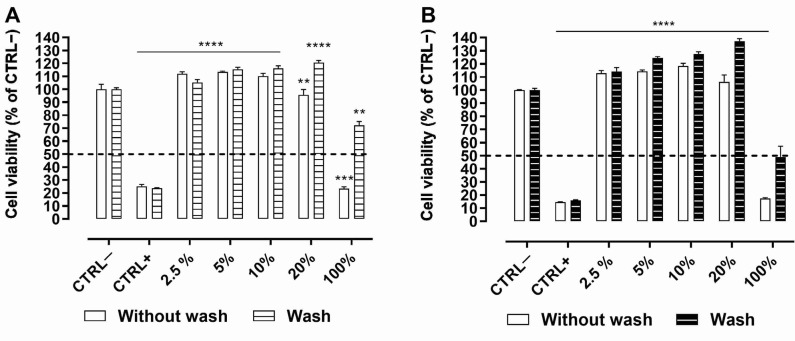
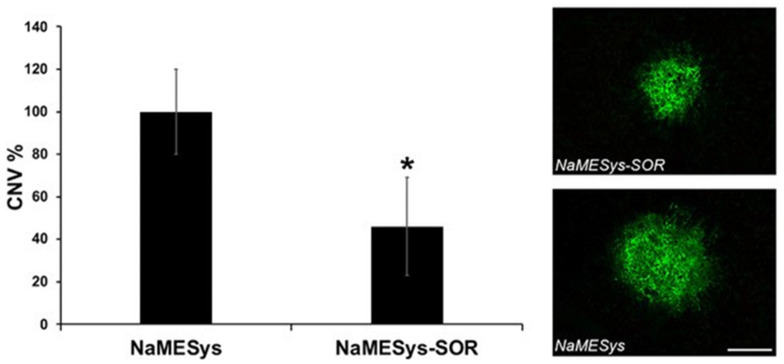
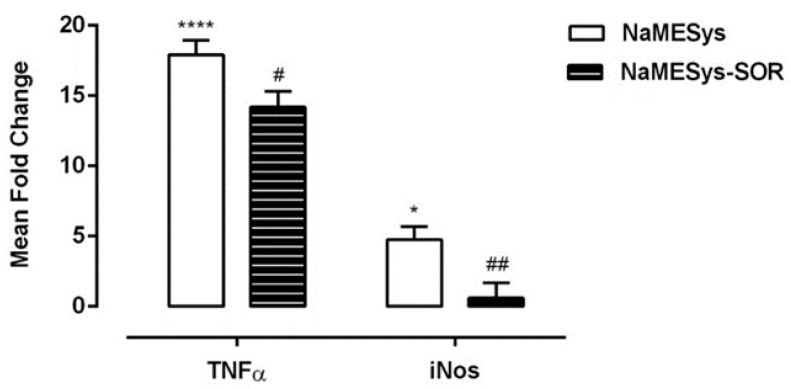
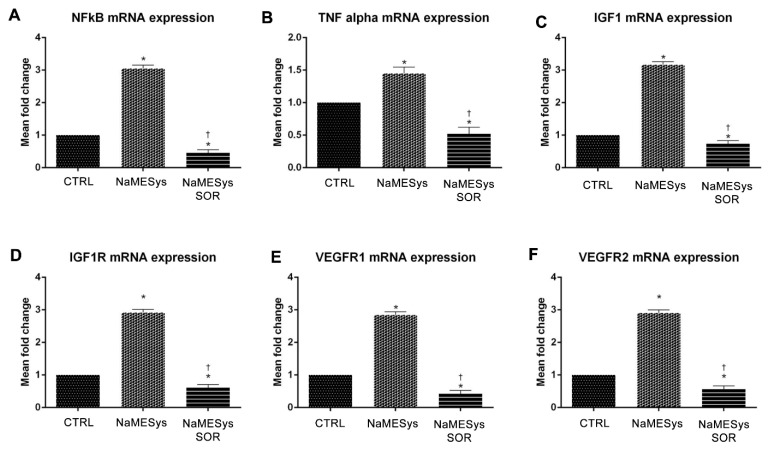
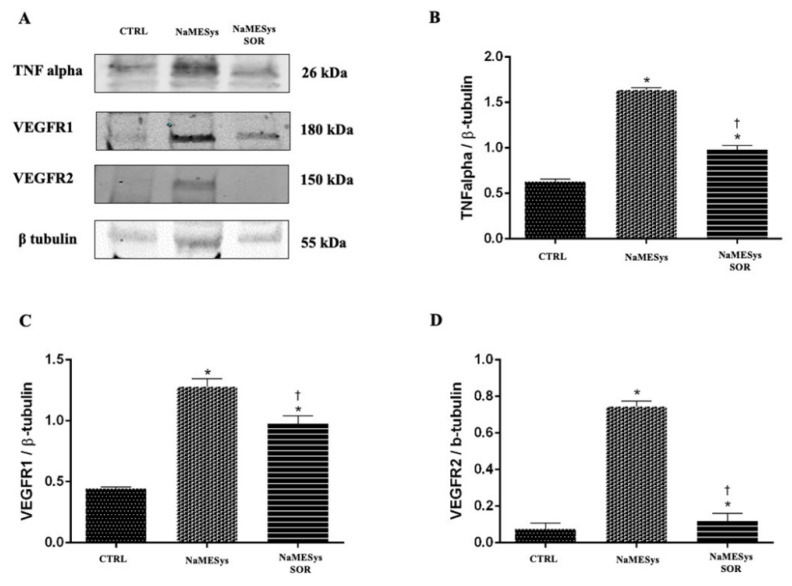
Eye drop formulations allowing topical treatment of retinal pathologies have long been sought as alternatives to intravitreal administration. This study aimed to assess whether a novel nanostructured microemulsions system (NaMESys) could be usefully employed to deliver sorafenib to the retina following topical instillation. NaMESys carrying 0.3% sorafenib (NaMESys-SOR) proved to be cytocompatible in vitro on rabbit corneal cells, and well-tolerated following b.i.d. ocular administration to rabbits during a 3-month study. In rats subject to retinal ischemia-reperfusion, NaMESys-SOR significantly inhibited retinal expression of tumor necrosis factor-alpha (TNFα, 20.7%) and inducible nitric oxide synthase (iNos, 87.3%) mRNAs in comparison to controls. Similarly, in streptozotocin-induced diabetic rats, NaMESys-SOR inhibited retinal expression of nuclear factor kappa B (NFκB), TNFα, insulin like growth factor 1 (IGF1), IGF1 receptor (IGF1R), vascular endothelial growth factor receptor 1 (VEGFR1) and 2 (VEGFR2) mRNAs by three-fold on average compared to controls. Furthermore, a reduction in TNFα, VEGFR1 and VEGFR2 protein expression was observed by western blot. Moreover, in mice subject to laser-induced choroidal neovascularization, NaMESys-SOR significantly inhibited neovascular lesions by 54%. In conclusion, NaMESys-SOR was shown to be a well-tolerated ophthalmic formulation able to deliver effective amounts of sorafenib to the retina, reducing proinflammatory and pro-angiogenic mediators in reliable models of proliferative retinopathies. These findings warrant further investigations on the full therapeutic potential of NaMESys-SOR eye drops, aiming to address unmet needs in the pharmacotherapy of retinal neovascular diseases.
长期以来,人们一直在寻找能够局部治疗视网膜疾病的滴眼液制剂,以替代玻璃体内给药。本研究旨在评估一种新型纳米结构微乳剂系统(NaMESys)在局部滴注后能否有效地将索拉非尼递送至视网膜。携带0.3%索拉非尼的NaMESys(NaMESys-SOR)在体外对兔角膜细胞具有细胞相容性,并且在为期3个月的研究中,每天两次眼部给药于兔子后耐受性良好。在视网膜缺血再灌注的大鼠中,与对照组相比,NaMESys-SOR显著抑制肿瘤坏死因子-α(TNFα,20.7%)和诱导型一氧化氮合酶(iNos,87.3%)mRNA在视网膜中的表达。同样,在链脲佐菌素诱导的糖尿病大鼠中,与对照组相比,NaMESys-SOR平均将核因子κB(NFκB)、TNFα、胰岛素样生长因子1(IGF1)、IGF1受体(IGF1R)、血管内皮生长因子受体1(VEGFR1)和2(VEGFR2)mRNA在视网膜中的表达抑制了三倍。此外,通过蛋白质印迹法观察到TNFα、VEGFR1和VEGFR2蛋白表达降低。此外,在激光诱导脉络膜新生血管形成的小鼠中,NaMESys-SOR显著抑制新生血管病变达54%。总之,NaMESys-SOR被证明是一种耐受性良好的眼科制剂,能够将有效量的索拉非尼递送至视网膜,在增殖性视网膜病变的可靠模型中减少促炎和促血管生成介质。这些发现值得对NaMESys-SOR滴眼液的全部治疗潜力进行进一步研究,旨在满足视网膜新生血管疾病药物治疗中未满足的需求。