Chuleerarux Nipat, Thongkam Achitpol, Manothummetha Kasama, Nematollahi Saman, Dioverti-Prono Veronica, Torvorapanit Pattama, Langsiri Nattapong, Worasilchai Navaporn, Plongla Rongpong, Chindamporn Ariya, Sanguankeo Anawin, Permpalung Nitipong
Department of Physiology, Faculty of Medicine, Chulalongkorn University, Bangkok 10330, Thailand.
Department of Microbiology, Faculty of Medicine, Chulalongkorn University, Bangkok 10330, Thailand.
J Fungi (Basel). 2021 Apr 23;7(5):327. doi: 10.3390/jof7050327.
Cytomegalovirus (CMV) and invasive aspergillosis (IA) cause high morbidity and mortality in solid organ transplant (SOT) recipients. There are conflicting data with respect to the impact of CMV on IA development in SOT recipients.
A literature search was conducted from existence through to 2 April 2021 using MEDLINE, Embase, and ISI Web of Science databases. This review contained observational studies including cross-sectional, prospective cohort, retrospective cohort, and case-control studies that reported SOT recipients with post-transplant CMV (exposure) and without post-transplant CMV (non-exposure) who developed or did not develop subsequent IA. A random-effects model was used to calculate the pooled effect estimate.
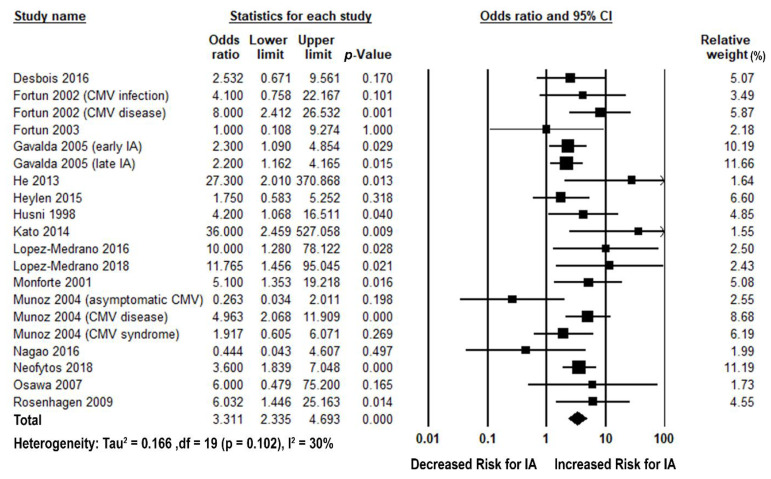
A total of 16 studies were included for systematic review and meta-analysis. There were 5437 SOT patients included in the study, with 449 SOT recipients developing post-transplant IA. Post-transplant CMV significantly increased the risk of subsequent IA with pORs of 3.31 (2.34, 4.69), I = 30%. Subgroup analyses showed that CMV increased the risk of IA development regardless of the study period (before and after 2003), types of organ transplantation (intra-thoracic and intra-abdominal transplantation), and timing after transplant (early vs. late IA development). Further analyses by CMV definitions showed CMV disease/syndrome increased the risk of IA development, but asymptomatic CMV viremia/infection did not increase the risk of IA. Post-transplant CMV, particularly CMV disease/syndrome, significantly increased the risks of IA, which highlights the importance of CMV prevention strategies in SOT recipients. Further studies are needed to understand the impact of programmatic fungal surveillance or antifungal prophylaxis to prevent this fungal-after-viral phenomenon.
巨细胞病毒(CMV)和侵袭性曲霉病(IA)在实体器官移植(SOT)受者中导致高发病率和死亡率。关于CMV对SOT受者IA发生的影响,存在相互矛盾的数据。
使用MEDLINE、Embase和ISI科学网数据库进行了从数据库存在至2021年4月2日的文献检索。本综述纳入了观察性研究,包括横断面研究、前瞻性队列研究、回顾性队列研究和病例对照研究,这些研究报告了发生或未发生后续IA的移植后CMV(暴露)和未发生移植后CMV(非暴露)的SOT受者。采用随机效应模型计算合并效应估计值。
共纳入16项研究进行系统评价和荟萃分析。研究纳入了5437例SOT患者,其中449例SOT受者发生了移植后IA。移植后CMV显著增加了后续IA的风险,比值比为3.31(2.34,4.69),I² = 30%。亚组分析表明,无论研究时期(2003年之前和之后)、器官移植类型(胸内和腹内移植)以及移植后的时间(早期与晚期IA发生)如何,CMV都会增加IA发生的风险。根据CMV定义进行的进一步分析表明,CMV疾病/综合征会增加IA发生的风险,但无症状CMV病毒血症/感染不会增加IA的风险。移植后CMV,特别是CMV疾病/综合征,显著增加了IA的风险,这突出了CMV预防策略在SOT受者中的重要性。需要进一步研究以了解计划性真菌监测或抗真菌预防对预防这种病毒后真菌现象的影响。