Centre for Tropical Medicine and Global Health, University of Oxford, Oxford OX1 3SY, UK.
International Centre for Evidence in Disability, London School of Hygiene and Tropical Medicine, London WC1E 7HT, UK.
Int J Environ Res Public Health. 2021 Apr 28;18(9):4692. doi: 10.3390/ijerph18094692.
Rehabilitation services aim to optimise individuals' functioning and reduce disability. However, people with disabilities, who represent a key population of users of rehabilitation services, continue to have unmet needs for rehabilitation services that include the provision of assistive devices. This paper examines the availability and accessibility of rehabilitation services in a rural district of South Africa in order to explore why unmet needs for rehabilitation services persist.
All nine district hospitals in a rural district of South Africa were included in the study. Rehabilitation services capacity was assessed by examining the available assistive devices, consumables and human resources at the level of the health facility. Data collection was conducted using the Global Co-operative Assistive Technology [GATE] Assistive Products List, AT2030's ATScale priority list and the South African National Catalogue of Commodities for Primary Health Care Facilities. Descriptive statistics were then used for the analysis. For the qualitative component, semi-structured interviews were conducted with adults with physical disabilities at household level to explore barriers to accessing assistive device inclusive rehabilitation services and the consequences thereof in the same rural district. An interview guide based on the WHO health system building blocks was used. Thematic content analysis guided the analysis of the interview transcripts.
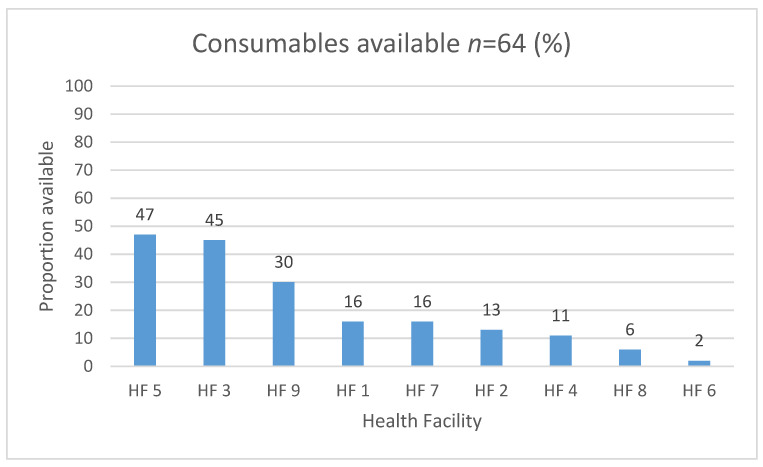
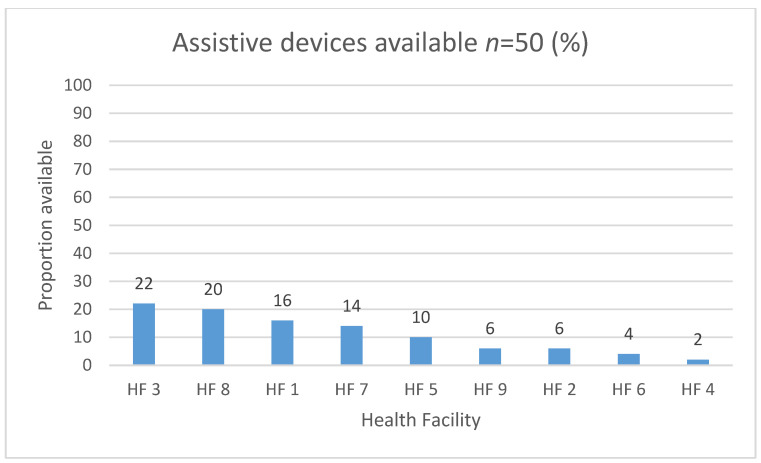
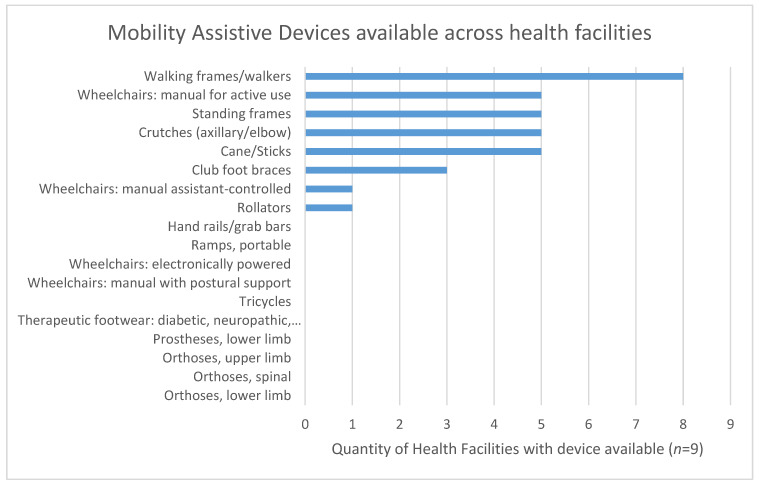
The findings of the research demonstrate that rehabilitation service capacity in the district was constrained as a result of low availability of assistive devices [2-22%] and consumables [2-47%], as well as, possibly, a shortage of rehabilitation providers [ = 30] with an unequal distribution across health facilities [ = 9]. In addition, people with physical disabilities reported poor referral pathways, financial constraints, transport and road consideration and equipment unavailability as barriers to accessing rehabilitation services. Moreover, these barriers to access predisposed individuals to finance-, health- and person-related harm.
Rehabilitation service availability is constrained by a lack of service capacity in rural South Africa. In addition, the rehabilitation services in district hospitals are not adequately accessible because of existing barriers to enable key populations to achieve optimised functioning.
康复服务旨在优化个人功能并减少残疾。然而,残疾人作为康复服务的主要使用者之一,他们对康复服务的需求仍未得到满足,其中包括提供辅助器具。本文旨在研究南非农村地区康复服务的可及性和可及性,以探讨为什么康复服务的需求仍然得不到满足。
本研究纳入了南非农村地区的 9 家地区医院。通过检查医疗机构层面的现有辅助器具、耗材和人力资源来评估康复服务能力。使用全球合作辅助技术[GATE]辅助产品清单、AT2030 的 ATScale 优先级清单和南非初级卫生保健设施商品国家目录进行数据收集。然后使用描述性统计进行分析。对于定性部分,在家庭层面上对身体残疾的成年人进行半结构化访谈,以探讨获取包含辅助器具的康复服务的障碍及其在同一农村地区的后果。使用基于世界卫生组织卫生系统构建模块的访谈指南。主题内容分析指导访谈记录的分析。
研究结果表明,由于辅助器具[2-22%]和耗材[2-47%]的可用性低,以及康复提供者[=30]可能短缺,且分布不均[=9],导致该地区的康复服务能力受到限制。此外,身体残疾人士报告说,获得康复服务的障碍包括转诊途径差、经济拮据、交通和道路考虑因素以及设备不可用。此外,这些获取障碍使个人容易受到财务、健康和人身伤害的影响。
南非农村地区康复服务的可用性受到服务能力不足的限制。此外,由于存在使关键人群实现最佳功能的障碍,区医院的康复服务无法充分获得。