GIG Research Institute, 40-166 Katowice, Poland.
Department of Temporomandibular Disorders, Medical University of Silesia, 41-800 Zabrze, Poland.
Sensors (Basel). 2021 Apr 28;21(9):3070. doi: 10.3390/s21093070.
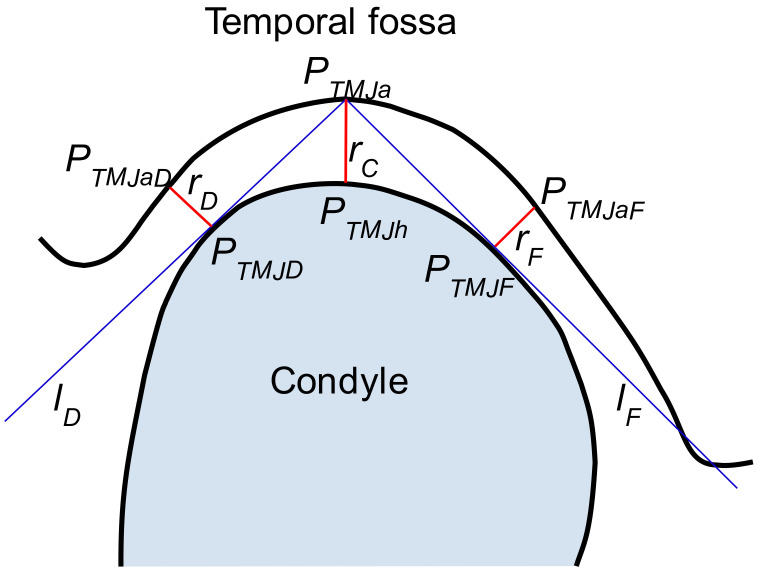
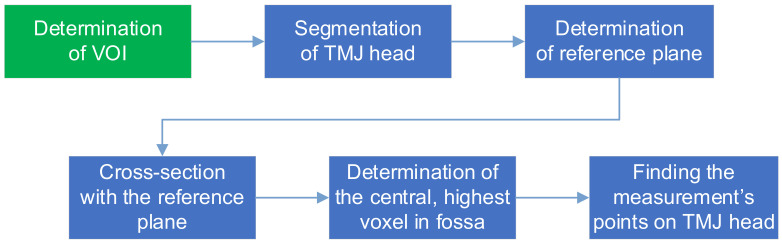
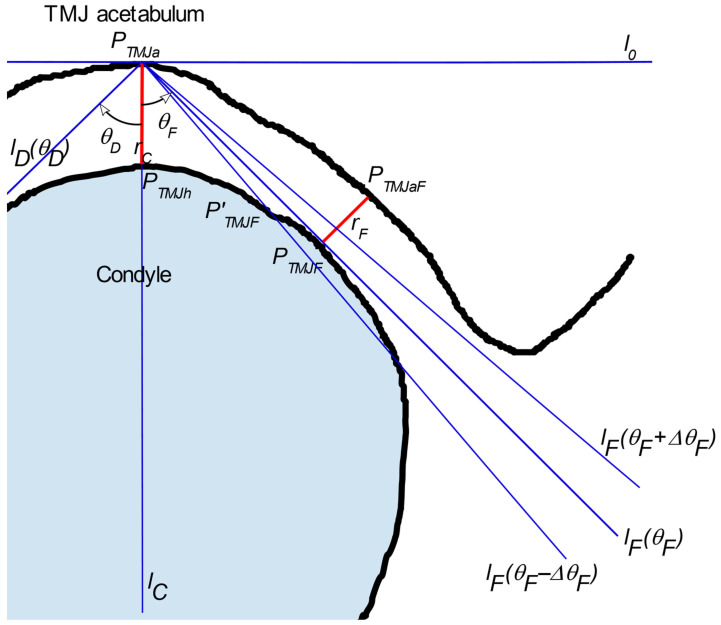
Modern dentistry commonly uses a variety of imaging methods to support diagnosis and treatment. Among them, cone beam computed tomography (CBCT) is particularly useful in presenting head structures, such as the temporomandibular joint (TMJ). The determination of the morphology of the joint is an important part of the diagnosis as well as the monitoring of the treatment results. It can be accomplished by measurement of the TMJ gap width at three selected places, taken at a specific cross-section. This study presents a new approach to these measurements. First, the CBCT images are denoised using curvilinear methods, and the volume of interest is determined. Then, the orientation of the vertical cross-section plane is computed based on segmented axial sections of the TMJ head. Finally, the cross-section plane is used to determine the standardized locations, at which the width of the gap between condyle and fossa is measured. The elaborated method was tested on selected TMJ CBCT scans with satisfactory results. The proposed solution lays the basis for the development of an autonomous method of TMJ index identification.
现代牙科通常使用多种成像方法来支持诊断和治疗。其中,锥形束计算机断层扫描(CBCT)在呈现头部结构方面特别有用,例如颞下颌关节(TMJ)。关节形态的确定是诊断和监测治疗结果的重要部分。可以通过在特定横截面上取三个选定位置测量 TMJ 间隙宽度来完成。本研究提出了一种新的测量方法。首先,使用曲线方法对 CBCT 图像进行去噪,并确定感兴趣的体积。然后,根据 TMJ 头部的分段轴位图像计算垂直横截平面的方向。最后,使用横截面平面确定测量髁突和窝之间间隙宽度的标准化位置。该详细方法在选定的 TMJ CBCT 扫描上进行了测试,结果令人满意。所提出的解决方案为开发自主的 TMJ 指数识别方法奠定了基础。