School of Medicine, National Yang Ming Chiao Tung University, Taipei 11221, Taiwan.
Department of Medical Research, Taipei Veterans General Hospital, Taipei 11217, Taiwan.
Int J Mol Sci. 2021 Apr 26;22(9):4534. doi: 10.3390/ijms22094534.
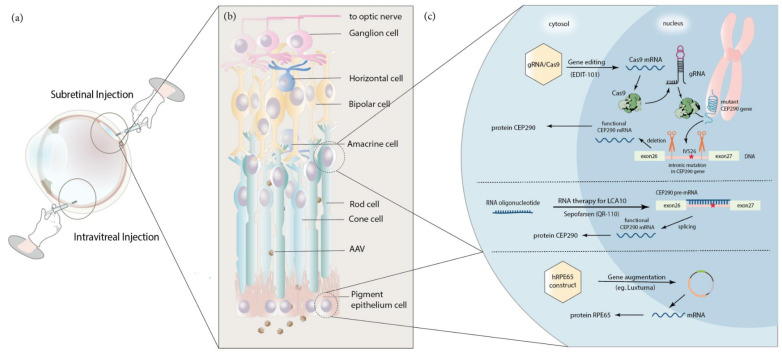
Inherited retinal dystrophies (IRDs) are a group of rare eye diseases caused by gene mutations that result in the degradation of cone and rod photoreceptors or the retinal pigment epithelium. Retinal degradation progress is often irreversible, with clinical manifestations including color or night blindness, peripheral visual defects and subsequent vision loss. Thus, gene therapies that restore functional retinal proteins by either replenishing unmutated genes or truncating mutated genes are needed. Coincidentally, the eye's accessibility and immune-privileged status along with major advances in gene identification and gene delivery systems heralded gene therapies for IRDs. Among these clinical trials, voretigene neparvovec-rzyl (Luxturna), an adeno-associated virus vector-based gene therapy drug, was approved by the FDA for treating patients with confirmed biallelic mutation-associated Leber Congenital Amaurosis (LCA) in 2017. This review includes current IRD gene therapy clinical trials and further summarizes preclinical studies and therapeutic strategies for LCA, including adeno-associated virus-based gene augmentation therapy, 11-cis-retinal replacement, RNA-based antisense oligonucleotide therapy and CRISPR-Cas9 gene-editing therapy. Understanding the gene therapy development for LCA may accelerate and predict the potential hurdles of future therapeutics translation. It may also serve as the template for the research and development of treatment for other IRDs.
遗传性视网膜营养不良(IRDs)是一组由基因突变引起的罕见眼病,导致视锥细胞和视杆细胞或视网膜色素上皮退化。视网膜退化的进展通常是不可逆转的,临床表现包括色觉或夜盲、周边视觉缺陷以及随后的视力丧失。因此,需要通过补充未突变基因或截断突变基因来恢复功能性视网膜蛋白的基因治疗。巧合的是,眼睛的可及性和免疫特权状态,以及基因鉴定和基因传递系统的重大进展,为 IRDs 的基因治疗带来了曙光。在这些临床试验中,基于腺相关病毒载体的基因治疗药物 voretigene neparvovec-rzyl(Luxturna)于 2017 年被 FDA 批准用于治疗经证实存在双等位基因突变相关莱伯先天性黑矇(LCA)的患者。本综述包括当前的 IRD 基因治疗临床试验,并进一步总结了 LCA 的临床前研究和治疗策略,包括基于腺相关病毒的基因增强治疗、11-顺式视黄醛替代、基于 RNA 的反义寡核苷酸治疗和 CRISPR-Cas9 基因编辑治疗。了解 LCA 的基因治疗进展可能会加速和预测未来治疗转化的潜在障碍。它也可以作为其他 IRD 治疗研究和开发的模板。