Department of Pediatrics, Fu Jen Catholic University Hospital, Fu Jen Catholic University, New Taipei City, Taiwan.
Department of Pediatrics, New Taipei City Hospital, New Taipei City, Taiwan.
Pediatr Rheumatol Online J. 2021 Apr 29;19(1):60. doi: 10.1186/s12969-021-00550-0.
Musculoskeletal ultrasound (MSUS) has been used worldwide in adult patients with rheumatoid arthritis (RA) but is beginning to play an increasing role in patients with juvenile idiopathic arthritis (JIA). The aim of this study was to investigate the application of MSUS findings of a single indicator joint in JIA to assess the disease activity and classify disease subtype.
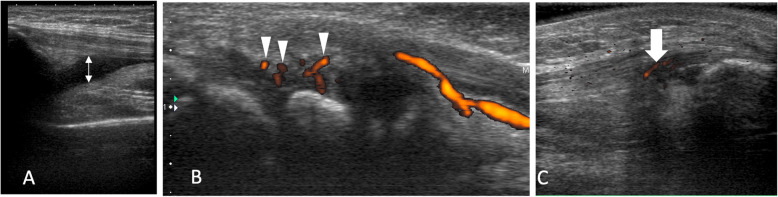
Thirty-five non-systemic JIA patients with a total of 62 visits were retrospectively recruited in this study. Among the involved joints, the joint with highest value of grey-scale (GS) plus power Doppler (PD) (=GSPD) was selected as the indicator joint at each visit. The correlations between each MSUS parameter (GS, PD, GSPD) of indicator joints and the Physician Global Assessment (PGA) score, the Childhood Health Assessment Questionnaire-disability index (CHAQ-DI), and laboratory data were analyzed. The ultrasound features in different subtypes of JIA were also compared.
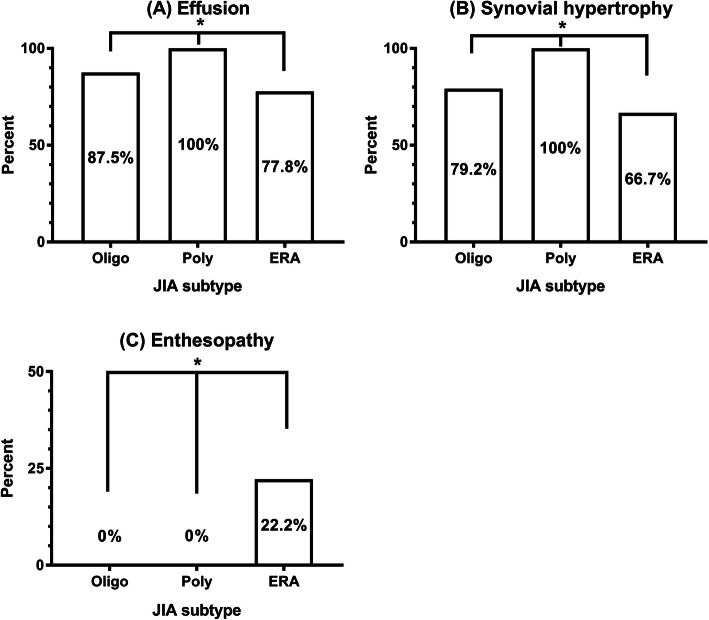
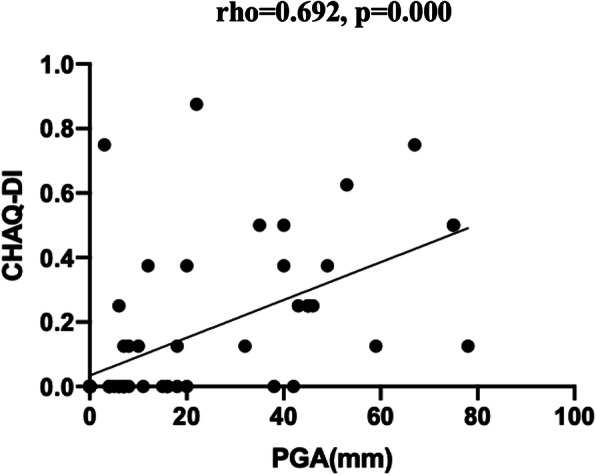
PD was weakly correlated with the PGA score (rho = 0.323, p = 0.010), while both GS and GSPD were moderately correlated with the PGA score (rho = 0.405, p = 0.001; rho = 0.434, p = 0.000). On the other hand, GS, PD, and GSPD were weakly correlated with CHAQ-DI. Although erythrocyte sedimentation rate (ESR) and C-reactive protein (CRP) had a weak correlation with PGA, they were not statistically correlated with GS, PD, or GSPD. The proportions of effusion, synovial hypertrophy, and enthesopathy in three different subtypes, showed significant differences (Fisher's exact test, p = 0.037; p = 0.004; p = 0.019). Enthesopathy was only seen in joints of enthesitis-related arthritis (ERA), but not in joints of polyarthritis and oligoarthritis.
MSUS is an acceptable non-invasive tool for the patients with JIA, particularly for those with non-systemic JIA, that might assist disease classification, and whose parameters of the indicator joints may potentially contribute to the evaluation of disease activity.
肌肉骨骼超声(MSUS)已在全球范围内用于类风湿关节炎(RA)的成年患者,但在幼年特发性关节炎(JIA)患者中的应用正逐渐增加。本研究的目的是探讨 JIA 中单关节 MSUS 指标的应用,以评估疾病活动度并对疾病亚型进行分类。
本研究回顾性招募了 35 名非系统性 JIA 患者,共 62 次就诊。在受累关节中,每个就诊时选择灰度(GS)加功率多普勒(PD)值最高的关节作为指标关节。分析指标关节的每个 MSUS 参数(GS、PD、GSPD)与医生总体评估(PGA)评分、儿童健康评估问卷残疾指数(CHAQ-DI)和实验室数据之间的相关性。还比较了不同 JIA 亚型的超声特征。
PD 与 PGA 评分呈弱相关(rho=0.323,p=0.010),而 GS 和 GSPD 与 PGA 评分呈中度相关(rho=0.405,p=0.001;rho=0.434,p=0.000)。另一方面,GS、PD 和 GSPD 与 CHAQ-DI 呈弱相关。虽然红细胞沉降率(ESR)和 C 反应蛋白(CRP)与 PGA 有弱相关,但与 GS、PD 或 GSPD 无统计学相关性。三种不同亚型的积液、滑膜肥厚和附着病的比例有显著差异(Fisher 确切检验,p=0.037;p=0.004;p=0.019)。附着病仅见于附着点相关关节炎(ERA)关节,而不在多关节炎和少关节炎关节中。
MSUS 是 JIA 患者的一种可接受的非侵入性工具,尤其适用于非系统性 JIA 患者,它可能有助于疾病分类,其指标关节的参数可能有助于评估疾病活动度。