
界面诱导扩散
Interface induced diffusion.
作者信息
Gurbán S, Sulyok A, Menyhárd Miklos, Baradács E, Parditka B, Cserháti C, Langer G A, Erdélyi Z
机构信息
Thin Film Department, Centre for Energy Research, Institute for Technical Physics and Materials Science, P.O.B. 49, Budapest, 1525, Hungary.
Department of Solid State Physics, Faculty of Sciences and Technology, University of Debrecen, P.O. Box 400, Debrecen, 4002, Hungary.
出版信息
Sci Rep. 2021 Apr 29;11(1):9308. doi: 10.1038/s41598-021-88808-1.
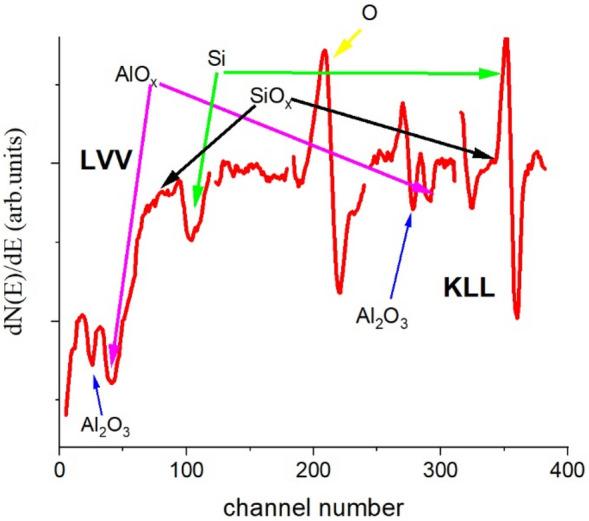
Interface induced diffusion had been identified in a thin film system damaged by electron bombardment. This new phenomenon was observed in AlO (some nm thick)/Si substrate system, which was subjected to low energy (5 keV) electron bombardment producing defects in the AlO layer. The defects produced partially relaxed. The rate of relaxation is, however, was different in the vicinity of the interface and in the "bulk" parts of the AlO layer. This difference creates an oxygen concentration gradient and consequently oxygen diffusion, resulting in an altered layer which grows from the AlO/Si substrate interface. The relative rate of the diffusion and relaxation is strongly temperature dependent, resulting in various altered layer compositions, SiO (at room temperature), AlO + AlO + Si (at 500 °C), AlO + Si (at 700 °C), as the temperature during irradiation varies. Utilizing this finding it is possible to produce area selective interface patterning.
界面诱导扩散已在受电子轰击损伤的薄膜系统中被识别出来。这种新现象在AlO(几纳米厚)/Si衬底系统中被观察到,该系统受到低能(5 keV)电子轰击,在AlO层中产生缺陷。产生的缺陷部分弛豫。然而,在界面附近和AlO层的“体”部分,弛豫速率是不同的。这种差异产生了氧浓度梯度,进而导致氧扩散,从而形成了一个从AlO/Si衬底界面生长的变化层。扩散和弛豫的相对速率强烈依赖于温度,随着辐照期间温度的变化,会产生各种不同的变化层组成,如SiO(在室温下)、AlO + AlO + Si(在500°C时)、AlO + Si(在700°C时)。利用这一发现,可以实现区域选择性界面图案化。




 Zotero 插件