Ueland Grethe Å, Kellmann Ralf, Jørstad Davidsen Melissa, Viste Kristin, Husebye Eystein S, Almås Bjørg, Storr Helen L, Sagen Jørn V, Mellgren Gunnar, Júlíusson Petur B, Methlie Paal
Hormone Laboratory, Department of Medical Biochemistry and Pharmacology, Haukeland University Hospital, 5021 Bergen, Norway.
Department of Medicine, Haukeland University Hospital, 5021 Bergen, Norway.
J Endocr Soc. 2021 Mar 4;5(5):bvab033. doi: 10.1210/jendso/bvab033. eCollection 2021 May 1.
Diagnosing Cushing syndrome (CS) can be challenging. The 24-hour urine free cortisol (UFC) measurement is considered gold standard. This is a laborious test, dependent on correct urine collection. Late-night salivary cortisol is easier and is used as a screening test for CS in adults, but has not been validated for use in children.
To define liquid chromatography tandem mass spectrometry (LC-MS/MS)-based cutoff values for bedtime and morning salivary cortisol and cortisone in children, and validate the results in children with and without CS.
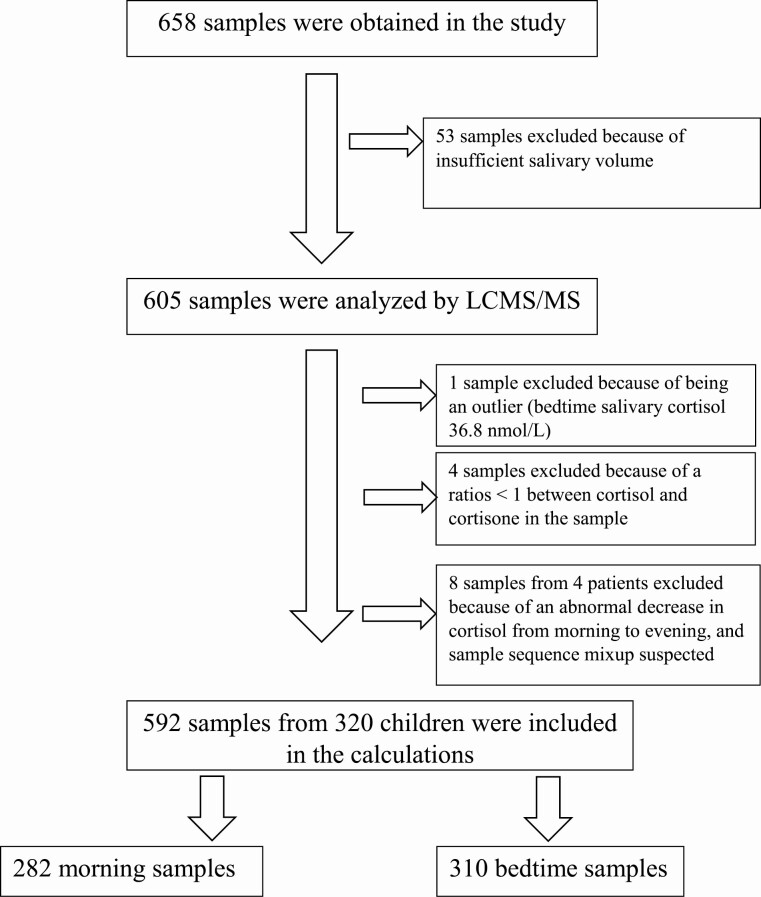
Bedtime and morning salivary samples were collected from 320 healthy children aged 4 to 16 years. Fifty-four patients from the children's outpatient obesity clinic and 3 children with pituitary CS were used for validation. Steroid hormones were assayed by LC-MS/MS. Cutoff levels for bedtime salivary cortisol and cortisone were defined by the 97.5% percentile in healthy subjects.
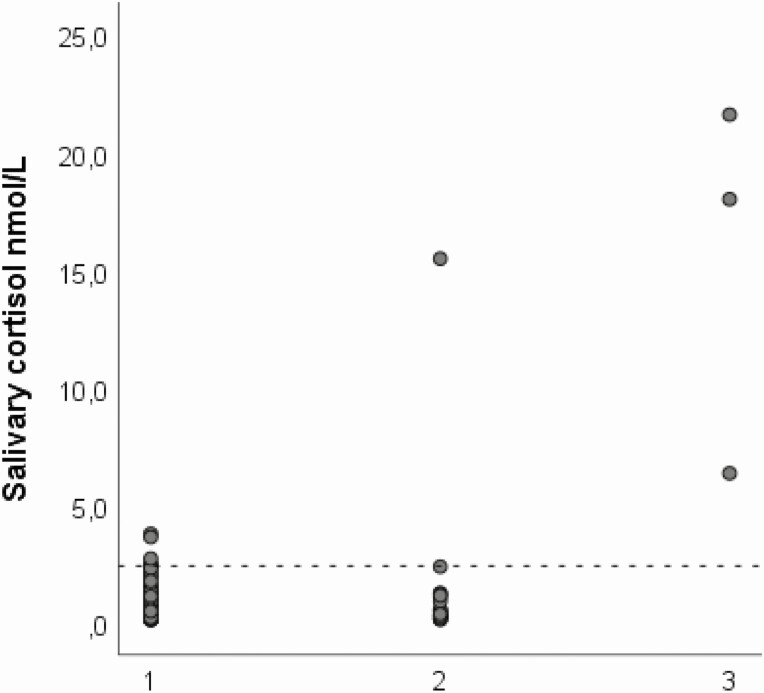
Bedtime cutoff levels for cortisol and cortisone were 2.4 and 12.0 nmol/L, respectively. Applying these cutoff levels on the verification cohort, 1 child from the obesity clinic had bedtime salivary cortisol exceeding the defined cutoff level, but normal salivary cortisone. All 3 children with pituitary CS had salivary cortisol and cortisone far above the defined bedtime cutoff levels. Healthy subjects showed a significant decrease in salivary cortisol from early morning to bedtime.
We propose that bedtime salivary cortisol measured by LC-MS/MS with a diagnostic threshold above 2.4 nmol/L can be applied as a screening test for CS in children. Age- and gender-specific cutoff levels are not needed.
诊断库欣综合征(CS)具有挑战性。24小时尿游离皮质醇(UFC)测定被视为金标准。这是一项繁琐的检测,依赖于正确的尿液收集。深夜唾液皮质醇检测更简便,被用作成人CS的筛查试验,但尚未在儿童中得到验证。
确定基于液相色谱串联质谱(LC-MS/MS)的儿童睡前和清晨唾液皮质醇及可的松的临界值,并在患有和未患有CS的儿童中验证结果。
收集了320名4至16岁健康儿童的睡前和清晨唾液样本。来自儿童门诊肥胖诊所的54名患者和3名垂体性CS患儿用于验证。采用LC-MS/MS测定类固醇激素。健康受试者中睡前唾液皮质醇和可的松的临界水平由第97.5百分位数确定。
皮质醇和可的松的睡前临界水平分别为2.4和12.0 nmol/L。将这些临界水平应用于验证队列,肥胖诊所的1名儿童睡前唾液皮质醇超过了规定的临界水平,但唾液可的松正常。所有3名垂体性CS患儿的唾液皮质醇和可的松均远高于规定的睡前临界水平。健康受试者的唾液皮质醇从清晨到睡前显著下降。
我们建议,通过LC-MS/MS测定的睡前唾液皮质醇,诊断阈值高于2.4 nmol/L,可作为儿童CS的筛查试验。不需要按年龄和性别区分的临界水平。