State Key Laboratory of Molecular Reaction Dynamics and Dalian Coherent Light Source, Dalian Institute of Chemical Physics, Chinese Academy of Sciences, Dalian, China.
Key Laboratory of Mesoscopic Chemistry, School of Chemistry and Chemical Engineering, Institute of Theoretical and Computational Chemistry, Nanjing University, Nanjing, China.
Nat Commun. 2021 Apr 30;12(1):2476. doi: 10.1038/s41467-021-22824-7.
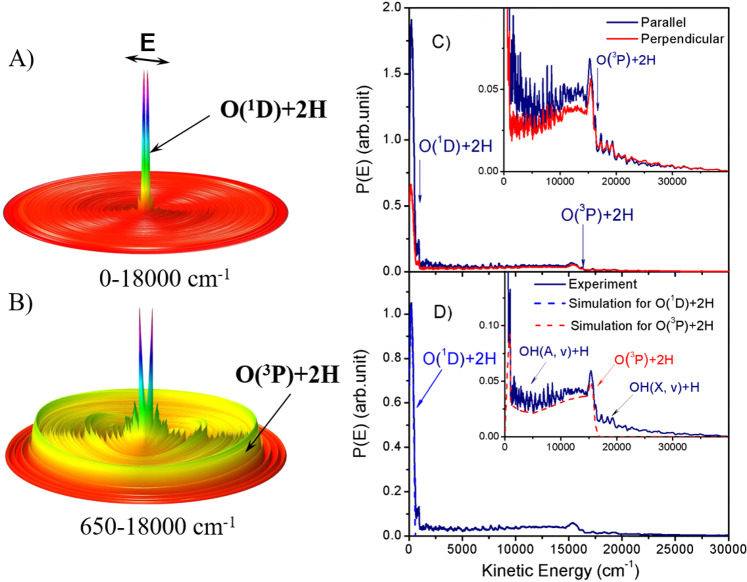
The provenance of oxygen on the Earth and other planets in the Solar System is a fundamental issue. It has been widely accepted that the only prebiotic pathway to produce oxygen in the Earth's primitive atmosphere was via vacuum ultraviolet (VUV) photodissociation of CO and subsequent two O atom recombination. Here, we provide experimental evidence of three-body dissociation (TBD) of HO to produce O atoms in both D and P states upon VUV excitation using a tunable VUV free electron laser. Experimental results show that the TBD is the dominant pathway in the VUV HO photochemistry at wavelengths between 90 and 107.4 nm. The relative abundance of water in the interstellar space with its exposure to the intense VUV radiation suggests that the TBD of HO and subsequent O atom recombination should be an important prebiotic O-production, which may need to be incorporated into interstellar photochemical models.
地球上和太阳系其他行星上氧气的起源是一个基本问题。人们普遍认为,在地球原始大气中产生氧气的唯一前生物途径是通过真空紫外 (VUV) 光解 CO 并随后进行两个 O 原子的重组。在这里,我们使用可调谐 VUV 自由电子激光提供了在 VUV 激发下 HO 通过三体解离 (TBD) 产生 D 和 P 态 O 原子的实验证据。实验结果表明,在 90 到 107.4nm 的波长范围内,TBD 是 VUV HO 光化学反应的主要途径。星际空间中水的相对丰度及其暴露于强烈的 VUV 辐射表明,HO 的 TBD 和随后的 O 原子重组应该是一种重要的前生物氧气产生途径,这可能需要纳入星际光化学模型中。