Department of Clinical Immunology and Rheumatology, Sanjay Gandhi Postgraduate Institute of Medical Sciences (SGPGIMS), -226014, Lucknow, India.
School of Telemedicine, Sanjay Gandhi Postgraduate Institute of Medical Sciences (SGPGIMS), -226014, Lucknow, India.
Clin Rheumatol. 2021 Nov;40(11):4391-4416. doi: 10.1007/s10067-021-05743-2. Epub 2021 May 1.
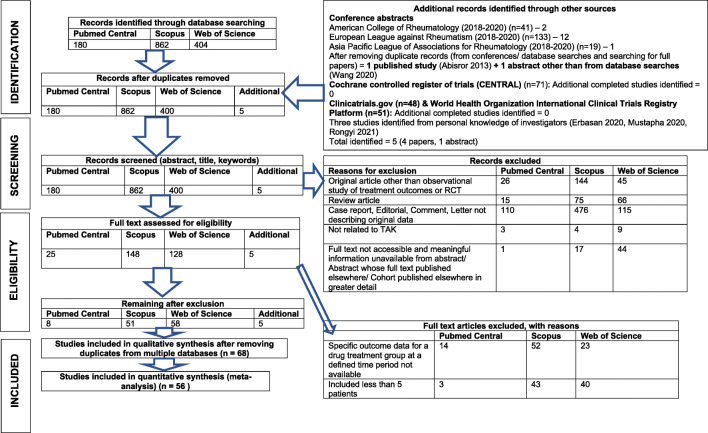
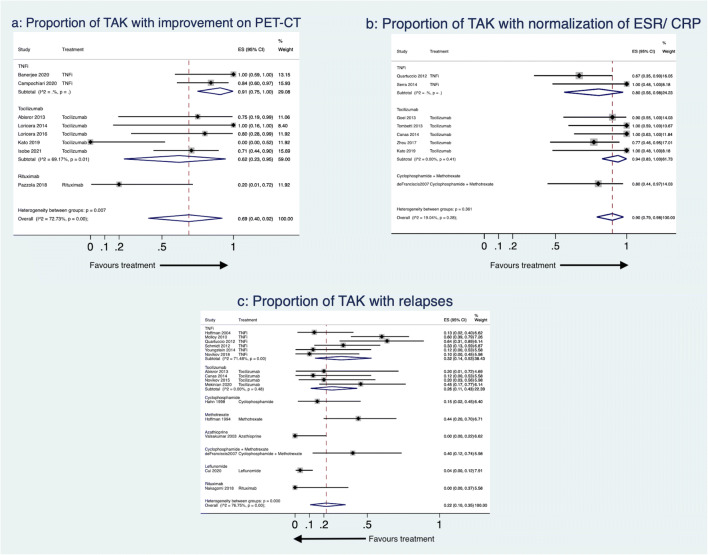
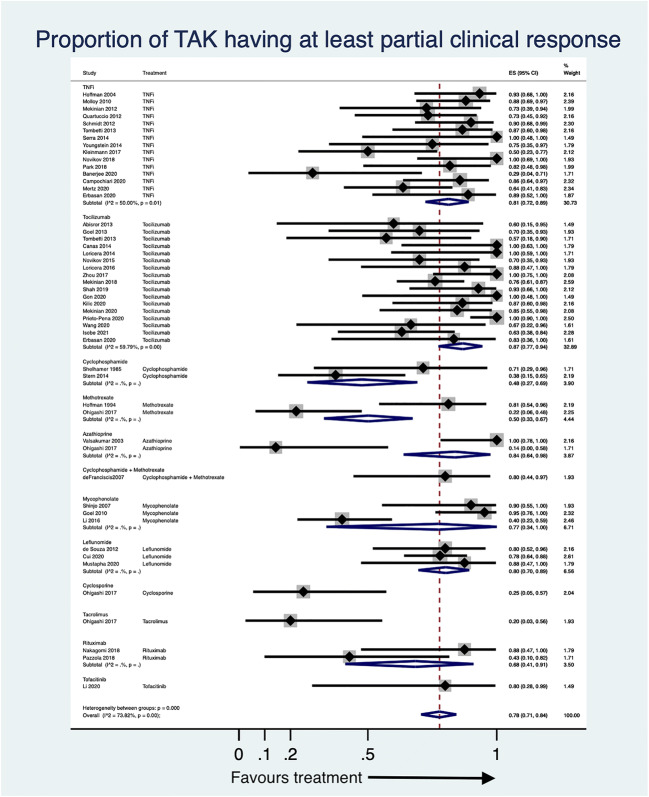
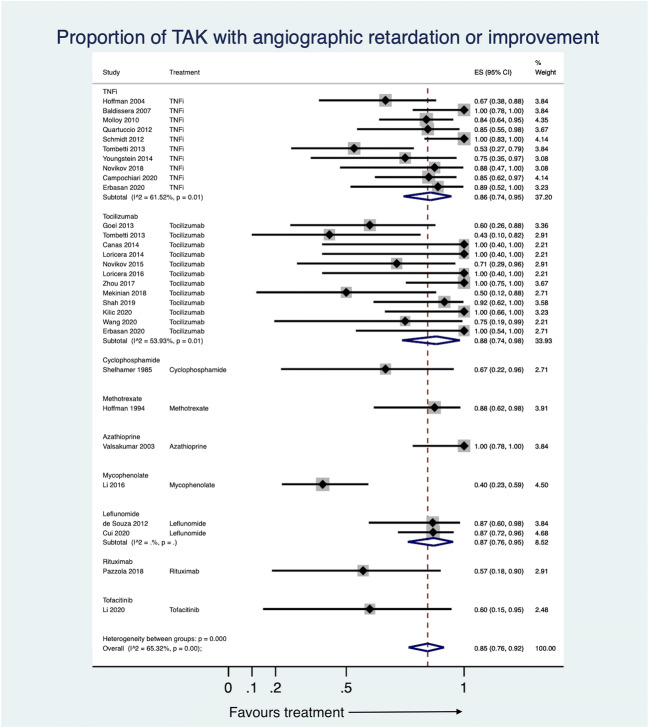
The pharmacotherapy of Takayasu arteritis (TAK) with disease-modifying anti-rheumatic drugs (DMARDs) is an evolving area. A systematic review of Scopus, Web of Science, Pubmed Central, clinical trial databases and recent international rheumatology conferences for interventional and observational studies reporting the effectiveness of DMARDs in TAK identified four randomized controlled trials (RCTs, with another longer-term follow-up of one RCT) and 63 observational studies. The identified trials had some concern or high risk of bias. Most observational studies were downgraded on the Newcastle-Ottawa scale due to lack of appropriate comparator groups. Studies used heterogenous outcomes of clinical responses, angiographic stabilization, normalization of inflammatory markers, reduction in vascular uptake on positron emission tomography, reduction in prednisolone doses and relapses. Tocilizumab showed benefit in a RCT compared to placebo in a secondary per-protocol analysis but not the primary intention-to-treat analysis. Abatacept failed to demonstrate benefit compared to placebo for preventing relapses in another RCT. Pooled data from uncontrolled observational studies demonstrated beneficial clinical responses and angiographic stabilization in nearly 80% patients treated with tumour necrosis factor alpha inhibitors, tocilizumab or leflunomide. Certainty of evidence for outcomes from RCTs ranged from moderate to very low and was low to very low for all observational studies. There is a paucity of high-quality evidence to guide the pharmacotherapy of TAK. Future observational studies should attempt to include appropriate comparator arms. Multicentric, adequately powered RCTs assessing both clinical and angiographic responses are necessary in TAK.
Takayasu 动脉炎(TAK)的药物治疗(DMARDs)是一个不断发展的领域。对 Scopus、Web of Science、Pubmed Central、临床试验数据库以及最近的国际风湿病会议进行系统评价,以检索报告 DMARDs 在 TAK 中有效性的干预性和观察性研究,共确定了 4 项随机对照试验(RCT,其中一项 RCT 有更长的随访期)和 63 项观察性研究。这些确定的试验存在一些关注或高偏倚风险。由于缺乏适当的对照组,大多数观察性研究在纽卡斯尔-渥太华量表上被降级。研究采用了临床反应、血管造影稳定、炎症标志物正常化、正电子发射断层扫描上血管摄取减少、泼尼松剂量减少和复发等不同的结局。在一项次要方案分析中,与安慰剂相比,托珠单抗在 RCT 中显示出益处,但在主要意向治疗分析中没有显示益处。在另一项 RCT 中,阿巴西普未能显示出与安慰剂相比在预防复发方面的益处。来自未对照观察性研究的汇总数据表明,在接受肿瘤坏死因子-α抑制剂、托珠单抗或来氟米特治疗的近 80%患者中,可观察到有益的临床反应和血管造影稳定。RCT 结果的证据确定性为中度至非常低,所有观察性研究的证据确定性均为低至非常低。缺乏高质量证据来指导 TAK 的药物治疗。未来的观察性研究应尝试纳入适当的对照组。TAK 中需要进行多中心、充分有力的 RCT,以评估临床和血管造影反应。