Dutch Institute for Rational Use of Medicine, Utrecht, the Netherlands.
Department of PharmacoTherapy, -Epidemiology and -Economics (PTEE, Groningen Research Institute of Pharmacy, Faculty of Science and Engineering, University of Groningen, Groningen, the Netherlands.
Pharmacol Res Perspect. 2021 May;9(3):e00750. doi: 10.1002/prp2.750.
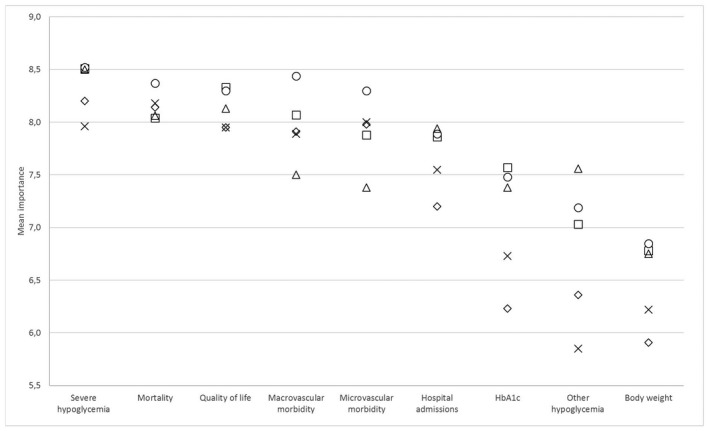
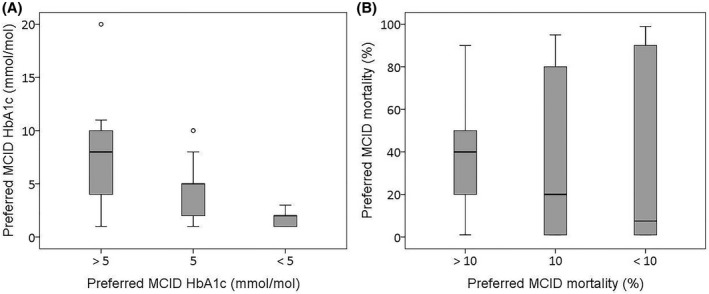
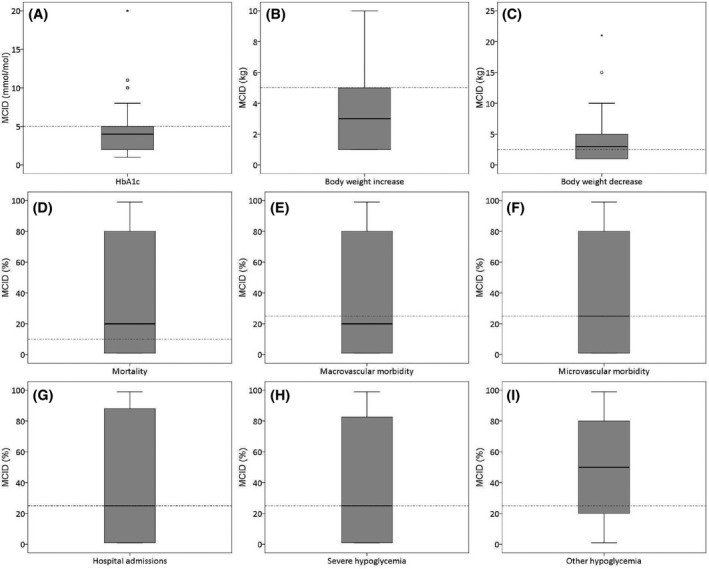
To evaluate the clinical benefit of new medicines for type 2 diabetes mellitus (T2DM), the Dutch guideline committee T2DM in primary care established the importance of outcomes and minimal clinically important differences (MCIDs). The present study used an online questionnaire to investigate healthcare professionals' opinions about the importance of outcomes and preferences for MCIDs. A total of 211 physicians, pharmacists, practice nurses, diabetes nurses, nurse practitioners and physician assistants evaluated the importance of mortality, macro- and microvascular morbidity, HbA1c, body weight, quality of life, (overall) hospital admissions and severe and other hypoglycemia on a 9-point scale. All outcomes were considered critical (mean scores 7-9), except for body weight and other hypoglycemia (mean scores 4-6). Only HbA1c and hospital admissions were valued differently by the guideline committee (not critical). Other relevant outcomes according to the respondents were adverse events, ease of use and costs. Median MCIDs were 4 mmol/mol for HbA1c (guideline: 5 mmol/mol) and 3 kg for body weight (guideline: 5 kg weight gain and 2,5 kg weight loss). Healthcare professionals preferred relative risk reductions of 20% for mortality (guideline: 10%) and macrovascular morbidity (guideline: 25%) and 50% for other hypoglycaemia (guideline: 25%). The MCID of 25% for microvascular morbidity, hospital admissions and severe hypoglycaemia corresponded to the guideline-MCID. Healthcare professionals' preferences were thus comparable to the views of the guideline committee. However, healthcare professionals had a stricter view on the importance of HbA1c and hospital admissions and the MCIDs for mortality and other hypoglycemia.
为了评估 2 型糖尿病(T2DM)新药的临床获益,荷兰初级保健 T2DM 指南委员会确定了结局和最小临床重要差异(MCID)的重要性。本研究使用在线问卷调查了医疗保健专业人员对结局重要性的看法以及对 MCID 的偏好。共有 211 名医生、药剂师、执业护士、糖尿病护士、执业护师和医师助理使用 9 分制对死亡率、大血管和微血管并发症、HbA1c、体重、生活质量、(总体)住院和严重及其他低血糖的重要性进行了评估。除了体重和其他低血糖(平均得分 4-6)外,所有结局均被认为是关键的(平均得分 7-9)。根据指南委员会的意见,只有 HbA1c 和住院治疗被认为是重要的(不重要)。根据受访者的其他相关结局为不良事件、使用便利性和成本。HbA1c 的 MCID 中位数为 4mmol/mol(指南:5mmol/mol),体重为 3kg(指南:体重增加 5kg 和减少 2.5kg)。医疗保健专业人员倾向于将死亡率(指南:10%)和大血管并发症(指南:25%)和其他低血糖(指南:25%)的相对风险降低 20%作为 MCID。微血管并发症、住院和严重低血糖的 25%MCID 与指南-MCID 相对应。因此,医疗保健专业人员的偏好与指南委员会的观点相似。然而,医疗保健专业人员对 HbA1c 和住院治疗的重要性以及死亡率和其他低血糖的 MCID 持更为严格的观点。