Betz Marian E, Omeragic Faris, Meador Lauren, DiGuiseppi Carolyn G, Fowler Nicole R, Han S Duke, Hill Linda, Johnson Rachel L, Knoepke Christopher E, Matlock Daniel D, Moran Ryan
Department of Emergency Medicine, School of Medicine, University of Colorado Anschutz Medical Campus, Aurora, CO, USA.
VA Eastern Colorado Geriatric Research Education and Clinical Center, Aurora, CO, USA.
Inj Epidemiol. 2021 May 3;8(1):23. doi: 10.1186/s40621-021-00310-4.
Decision-making about when to stop driving for older adults involves assessment of driving risk, availability of support or resources, and strong emotions about loss of independence. Although the risk of being involved in a fatal crash increases with age, driving cessation can negatively impact an older adult's health and well-being. Decision aids can enhance the decision-making process by increasing knowledge of the risks and benefits of driving cessation and improve decision quality. The impact of decision aids regarding driving cessation for older adults is unknown.
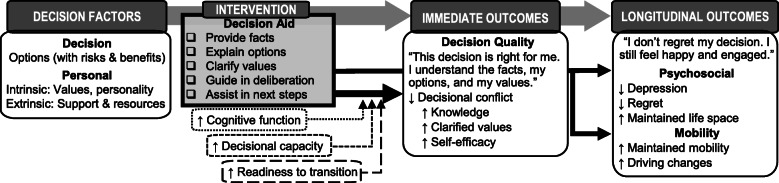
The Advancing Understanding of Transportation Options (AUTO) study is a multi-site, two-armed randomized controlled trial that will test the impact of a decision aid on older adults' decisions about changes in driving behaviors and cessation. AUTO will enroll 300 drivers age ≥ 70 years with a study partner (identified by each driver); the dyads will be randomized into two groups (n = 150/group). The decision aid group will view the web-based decision aid created by Healthwise at baseline and the control group will review information about driving that does not include evidence-based elements on risks and benefits and values clarification about driving decisions. The AUTO trial will compare the effect of the decision aid, versus control, on a) immediate decision quality (measured by the Decisional Conflict Scale; primary outcome); b) longitudinal psychosocial outcomes at 12 and 24 months (secondary outcomes); and c) longitudinal driving behaviors (including reduction or cessation) at 12 and 24 months (secondary outcomes). Planned stratified analyses will examine the effects in subgroups defined by cognitive function, decisional capacity, and readiness to stop driving.
The AUTO study is the first large-scale randomized trial of a driving decision aid for older adults. Results from this study will directly inform clinical practice about how best to support older adults in decision-making about driving.
ClinicalTrials.gov : NCT04141891 . Registered on October 28, 2019. Located at https://clinicaltrials.gov/ct2/show/NCT04141891.
对于老年人而言,决定何时停止驾车需要评估驾驶风险、支持或资源的可用性,以及对失去独立性的强烈情绪。尽管发生致命车祸的风险会随着年龄增长而增加,但停止驾车可能会对老年人的健康和幸福感产生负面影响。决策辅助工具可以通过增加对停止驾车的风险和益处的了解来加强决策过程,并提高决策质量。决策辅助工具对老年人停止驾车的影响尚不清楚。
“推进交通选择理解”(AUTO)研究是一项多中心、双臂随机对照试验,将测试一种决策辅助工具对老年人驾驶行为变化和停止驾车决策的影响。AUTO将招募300名年龄≥70岁的驾驶员及其研究伙伴(由每位驾驶员确定);这些二元组将被随机分为两组(每组n = 150)。决策辅助工具组将在基线时查看由Healthwise创建的基于网络的决策辅助工具,而对照组将查看关于驾驶的信息,其中不包括基于证据的风险和益处要素以及关于驾驶决策的价值观澄清。AUTO试验将比较决策辅助工具与对照组在以下方面的效果:a)即时决策质量(通过决策冲突量表衡量;主要结果);b)12个月和24个月时的纵向心理社会结果(次要结果);c)12个月和24个月时的纵向驾驶行为(包括减少或停止驾驶)(次要结果)。计划进行的分层分析将研究在由认知功能、决策能力和停止驾车意愿定义的亚组中的效果。
AUTO研究是第一项针对老年人驾驶决策辅助工具的大规模随机试验。这项研究的结果将直接为临床实践提供信息,说明如何最好地支持老年人进行驾驶决策。
ClinicalTrials.gov:NCT04141891。于2019年10月28日注册。位于https://clinicaltrials.gov/ct2/show/NCT04141891。