Xu Qianru, Ye Chaoxiong, Hämäläinen Jarmo A, Ruohonen Elisa M, Li Xueqiao, Astikainen Piia
Institute of Brain and Psychological Sciences, Sichuan Normal University, Chengdu, China.
Jyväskylä Centre for Interdisciplinary Brain Research, Department of Psychology, Faculty of Education and Psychology, University of Jyväskylä, Jyväskylä, Finland.
Front Hum Neurosci. 2021 Apr 14;15:641273. doi: 10.3389/fnhum.2021.641273. eCollection 2021.
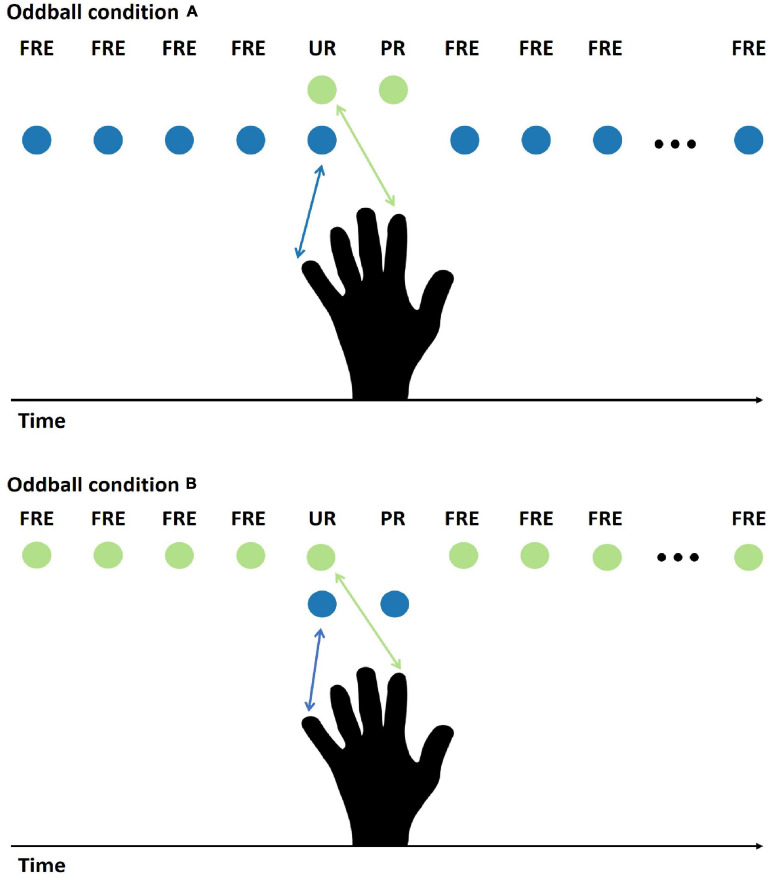
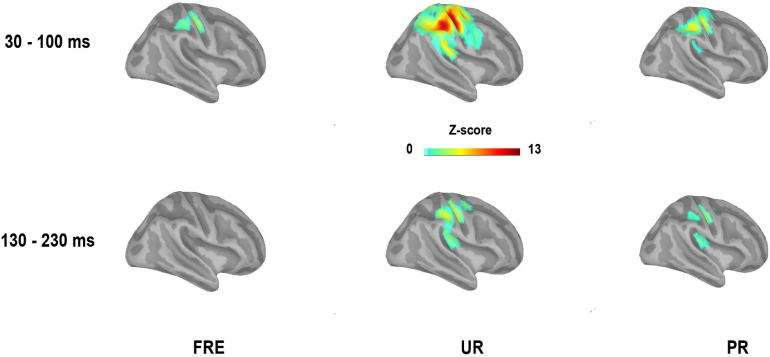
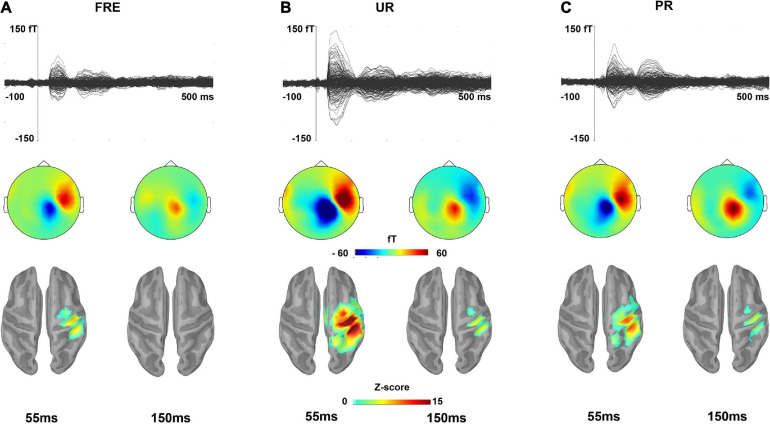
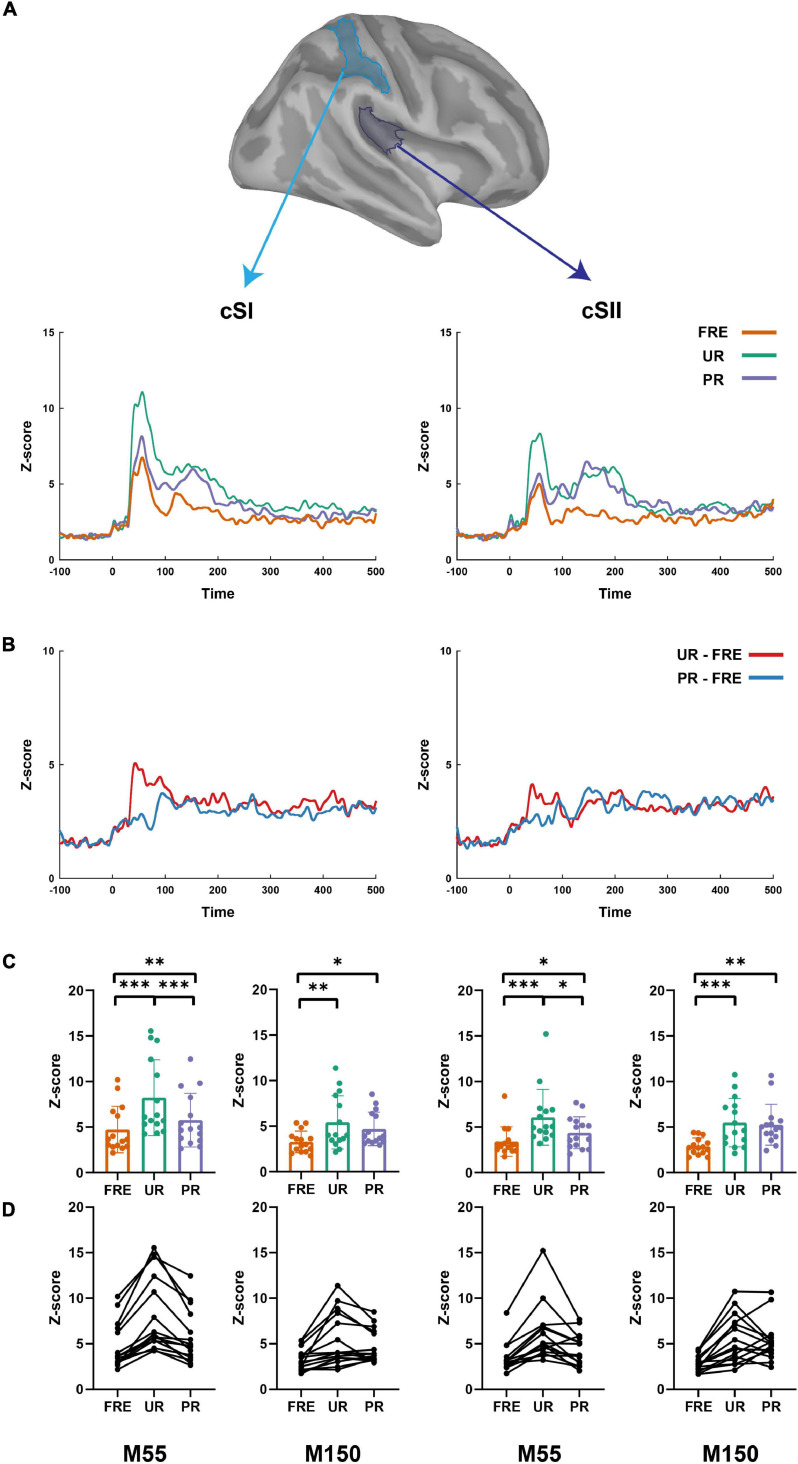
Mismatch brain responses to unpredicted rare stimuli are suggested to be a neural indicator of prediction error, but this has rarely been studied in the somatosensory modality. Here, we investigated how the brain responds to unpredictable and predictable rare events. Magnetoencephalography responses were measured in adults frequently presented with somatosensory stimuli (FRE) that were occasionally replaced by two consecutively presented rare stimuli [unpredictable rare stimulus (UR) and predictable rare stimulus (PR); = 0.1 for each]. The FRE and PR were electrical stimulations administered to either the little finger or the forefinger in a counterbalanced manner between the two conditions. The UR was a simultaneous electrical stimulation to both the forefinger and the little finger (for a smaller subgroup, the UR and FRE were counterbalanced for the stimulus properties). The grand-averaged responses were characterized by two main components: one at 30-100 ms (M55) and the other at 130-230 ms (M150) latency. Source-level analysis was conducted for the primary somatosensory cortex (SI) and the secondary somatosensory cortex (SII). The M55 responses were larger for the UR and PR than for the FRE in both the SI and the SII areas and were larger for the UR than for the PR. For M150, both investigated areas showed increased activity for the UR and the PR compared to the FRE. Interestingly, although the UR was larger in stimulus energy (stimulation of two fingers at the same time) and had a larger prediction error potential than the PR, the M150 responses to these two rare stimuli did not differ in source strength in either the SI or the SII area. The results suggest that M55, but not M150, can possibly be associated with prediction error signals. These findings highlight the need for disentangling prediction error and rareness-related effects in future studies investigating prediction error signals.
大脑对不可预测的罕见刺激的失配反应被认为是预测误差的神经指标,但这在体感模态中很少被研究。在这里,我们研究了大脑如何对不可预测和可预测的罕见事件做出反应。在经常接受体感刺激(FRE)的成年人中测量脑磁图反应,这些刺激偶尔会被两个连续呈现的罕见刺激所取代[不可预测的罕见刺激(UR)和可预测的罕见刺激(PR);每种的概率 = 0.1]。FRE和PR是以两种条件之间平衡的方式施加到小指或食指上的电刺激。UR是同时对食指和小指进行电刺激(对于一个较小的亚组,UR和FRE在刺激特性上是平衡的)。总体平均反应的特征是有两个主要成分:一个在30 - 100毫秒(M55)潜伏期,另一个在130 - 230毫秒(M150)潜伏期。对初级体感皮层(SI)和次级体感皮层(SII)进行了源水平分析。在SI和SII区域,M55对UR和PR的反应比对FRE的反应更大,并且对UR的反应比对PR的反应更大。对于M150,与FRE相比,两个研究区域对UR和PR的活动都增加。有趣的是,尽管UR在刺激能量上更大(同时刺激两个手指)并且比PR具有更大的预测误差潜力,但在SI或SII区域,对这两种罕见刺激的M150反应在源强度上没有差异。结果表明,M55而不是M150可能与预测误差信号相关。这些发现强调了在未来研究预测误差信号时需要区分预测误差和与稀有性相关的效应。