Beierl Esther T, Murray Hannah, Wiedemann Milan, Warnock-Parkes Emma, Wild Jennifer, Stott Richard, Grey Nick, Clark David M, Ehlers Anke
Department of Experimental Psychology, University of Oxford, Oxford, United Kingdom.
Oxford Health NHS Foundation Trust, Oxford, United Kingdom.
Front Psychiatry. 2021 Apr 16;12:602648. doi: 10.3389/fpsyt.2021.602648. eCollection 2021.
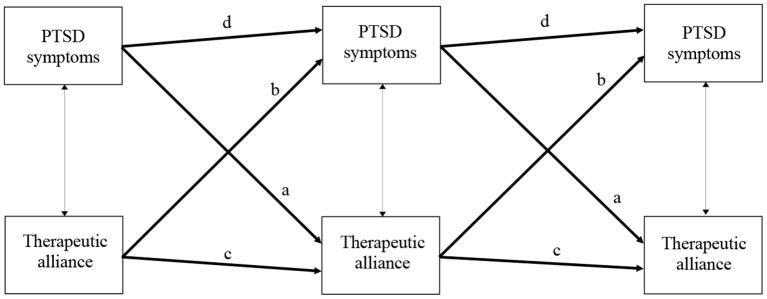
Working alliance has been shown to predict outcome of psychological treatments in multiple studies. Conversely, changes in outcome scores have also been found to predict working alliance ratings. To assess the temporal relationships between working alliance and outcome in 230 patients receiving trauma-focused cognitive behavioral treatment for posttraumatic stress disorder (PTSD). Ratings of working alliance were made by both the patient and therapist after sessions 1, 3, and 5 of a course of Cognitive Therapy for PTSD (CT-PTSD). Autoregressive, cross-lagged panel models were used to examine whether working alliance predicted PTSD symptom severity at the next assessment point and vice versa. Linear regressions tested the relationship between alliance and treatment outcome. Both patients' and therapists' working alliance ratings after session 1 predicted PTSD symptom scores at the end of treatment, controlling for baseline scores. At each assessment point, higher therapist working alliance was associated with lower PTSD symptoms. Crossed-lagged associations were found for therapist-rated alliance, but not for patient-rated alliance: higher therapists' alliance ratings predicted lower PTSD symptom scores at the next assessment point. Similarly, lower PTSD symptoms predicted higher therapist working alliance ratings at the next assessment point. Ruminative thinking was negatively related to therapists' alliance ratings. Working alliance at the start of treatment predicted treatment outcome in patients receiving CT-PTSD and may be an important factor in setting the necessary conditions for effective treatment. For therapists, there was a reciprocal relationship between working alliance and PTSD symptom change in their patients during treatment, suggesting that their alliance ratings predicted symptom change, but were also influenced by patients' symptom change.
在多项研究中,工作联盟已被证明可预测心理治疗的结果。相反,结果分数的变化也被发现可预测工作联盟评分。为了评估230名接受创伤聚焦认知行为疗法治疗创伤后应激障碍(PTSD)患者的工作联盟与治疗结果之间的时间关系。在创伤后应激障碍认知疗法(CT-PTSD)疗程的第1、3和5次治疗后,由患者和治疗师对工作联盟进行评分。使用自回归交叉滞后面板模型来检验工作联盟是否能预测下一个评估点的PTSD症状严重程度,反之亦然。线性回归测试了联盟与治疗结果之间的关系。在控制基线分数的情况下,第1次治疗后患者和治疗师的工作联盟评分均能预测治疗结束时的PTSD症状分数。在每个评估点,治疗师更高的工作联盟与更低的PTSD症状相关。发现治疗师评定的联盟存在交叉滞后关联,但患者评定的联盟不存在:更高的治疗师联盟评分预测下一个评估点的PTSD症状分数更低。同样,更低的PTSD症状预测下一个评估点治疗师更高的工作联盟评分。反刍思维与治疗师的联盟评分呈负相关。治疗开始时的工作联盟可预测接受CT-PTSD治疗患者的治疗结果,并且可能是为有效治疗设定必要条件的一个重要因素。对于治疗师而言,治疗期间工作联盟与患者PTSD症状变化之间存在相互关系,这表明他们的联盟评分可预测症状变化,但也受到患者症状变化的影响。