Yang Yuan, Li Yue, An Ying, Zhao Yan-Jie, Zhang Ling, Cheung Teris, Hall Brian J, Ungvari Gabor S, An Feng-Rong, Xiang Yu-Tao
Unit of Psychiatry, Department of Public Health and Medicinal Administration, Faculty of Health Sciences, Institute of Translational Medicine, University of Macau, Macao, China.
Center for Cognition and Brain Sciences, University of Macau, Macao, China.
Front Psychiatry. 2021 Apr 15;12:649989. doi: 10.3389/fpsyt.2021.649989. eCollection 2021.
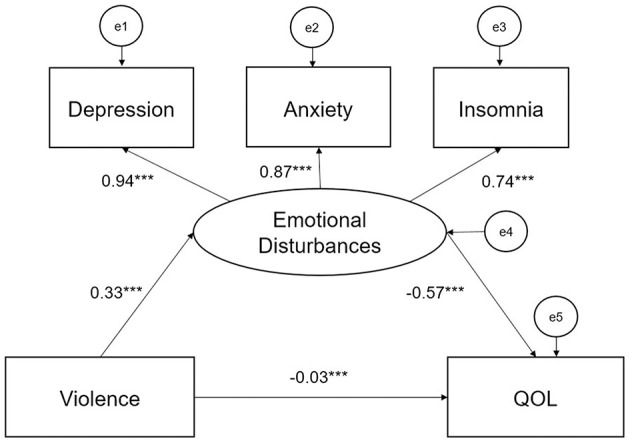
Workplace violence is a major concern for clinicians worldwide. There has been little data on the epidemiology of workplace violence against frontline clinicians during the COVID-19 pandemic. This study examined the pattern of workplace violence and its association with quality of life (QOL) against frontline clinicians during the outbreak of COVID-19 pandemic in China. A cross-sectional online study was conducted in China between March 15 and March 20, 2020. Frontline clinicians' experience with workplace violence was measured with six standardized questions derived from the Workplace Violence Scale, while anxiety, depressive, and insomnia symptoms, and QOL were measured using the General Anxiety Disorder Questionnaire, the Patient Health Questionnaire, the Insomnia Severity Index, and the World Health Organization Quality of Life Questionnaire, respectively. Univariate analyses, multivariable logistic regression analyses, and structural equation modeling (SEM) were conducted. A total of 15,531 clinicians completed the assessment; 2,878 (18.5, 95% CI = 17.92-19.14%) reported workplace violence during the outbreak of the COVID-19 pandemic (verbal violence: 16.1%; physical violence: 6.9%). According to multivariable models, key correlates of workplace violence were male gender, longer work experience, higher education level, smoking, working in the psychiatry or emergency department, working in tertiary hospitals, being involved in direct care of infected patients, having infected family/ friends/ colleagues, and frequently using social communication programs. Clinicians working in inpatient departments were less likely to report workplace violence compared to those working in outpatient departments. SEM analysis revealed that both violence and emotional disturbances (anxiety, depression, and insomnia) directly affected QOL (standardized direct effect = -0.031, and -0.566, respectively, < 0.05), while emotional disturbances partly mediated the association between work violence and QOL (standardized indirect effect = -0.184, < 0.05). Frontline clinicians were vulnerable to workplace violence during the COVID-19 pandemic. Due to the negative impact of workplace violence on quality of care and clinicians' QOL, health authorities and policymakers should take effective measures to reduce workplace violence against clinicians.
工作场所暴力是全球临床医生主要关注的问题。关于新冠疫情期间针对一线临床医生的工作场所暴力的流行病学数据很少。本研究调查了中国新冠疫情爆发期间一线临床医生遭受工作场所暴力的模式及其与生活质量(QOL)的关联。2020年3月15日至3月20日在中国进行了一项横断面在线研究。一线临床医生遭受工作场所暴力的经历通过从工作场所暴力量表中提取的六个标准化问题进行衡量,而焦虑、抑郁和失眠症状以及生活质量分别使用广泛性焦虑障碍问卷、患者健康问卷、失眠严重程度指数和世界卫生组织生活质量问卷进行测量。进行了单因素分析、多变量逻辑回归分析和结构方程模型(SEM)分析。共有15531名临床医生完成了评估;2878名(18.5%,95%CI = 17.92 - 19.14%)报告在新冠疫情爆发期间遭受了工作场所暴力(言语暴力:16.1%;身体暴力:6.9%)。根据多变量模型,工作场所暴力的关键相关因素包括男性、工作经验较长、教育水平较高、吸烟、在精神科或急诊科工作、在三级医院工作、参与感染患者的直接护理、有感染的家人/朋友/同事以及频繁使用社交通讯程序。与在门诊部门工作的临床医生相比,在住院部门工作的临床医生报告遭受工作场所暴力的可能性较小。结构方程模型分析表明,暴力和情绪障碍(焦虑、抑郁和失眠)均直接影响生活质量(标准化直接效应分别为 -0.031和 -0.566,P < 0.05),而情绪障碍部分介导了工作场所暴力与生活质量之间的关联(标准化间接效应 = -0.184,P < 0.05)。在新冠疫情期间,一线临床医生易遭受工作场所暴力。由于工作场所暴力对医疗质量和临床医生生活质量有负面影响,卫生当局和政策制定者应采取有效措施减少针对临床医生的工作场所暴力。