Yu Yang, Liang Siquan, Wang Yue, Zhao Yanan, Zhao Jiaojiao, Li Haitao, Wu Jingchao, Cheng Yuanyuan, Wu Fan, Wu Jialing
Department of Neurological Rehabilitation, Tianjin Huanhu Hosptial, Tianjin, China.
Department of Neurosurgery, Tianjin Huanhu Hosptial, Tianjin, China.
Parkinsons Dis. 2021 Apr 13;2021:5681870. doi: 10.1155/2021/5681870. eCollection 2021.
Postural instability is commonly observed in Parkinson's disease, leading to an increasing risk of falling and worsening as the disease progresses. We found that limit of stability can be applied to reflect the dynamic evolution of postural instability in patients with Parkinson's disease.
Forty-three patients (9 of Hoehn and Yahr stage I, 12 of stage II, 14 of stage III, and 8 of stage IV) met the criteria for the diagnosis of idiopathic Parkinson's disease and could stand independently for at least 10 minutes. Twelve healthy controls with no sign of parkinsonism were also recruited. Postural instability was assessed by posturography in different directions (forward, backward, right, left, forward-right, forward-left, backward-right, and backward-left). This study trial was registered with the Chinese Clinical Trial Registry (no. ChiCTR1900022715).
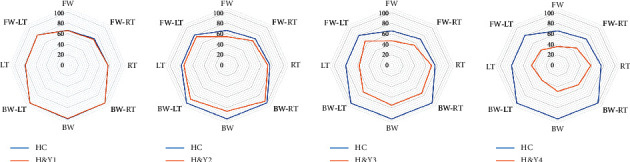
All participants were able to complete the limit of stability tasks without any complications. Patients in stages II to IV exhibited smaller end point excursion and slower time to complete than controls, suggesting an impaired limit of stability. The patients in stage II exhibited a remarkable decline in most directions compared to controls, except for right and left, and forward and backward decline occurred the earliest. For patients in stage III, right was the only direction with no significant difference from controls. In stage IV patients, the limit of stability declined significantly in all directions ( < 0.05).
The postural abnormalities of Parkinson's disease can occur at early stages, and the pattern of decline is more severe in the forward-backward direction. This trial is registered with ChiCTR1900022715.
姿势不稳在帕金森病中很常见,随着疾病进展,跌倒风险增加且病情恶化。我们发现,稳定极限可用于反映帕金森病患者姿势不稳的动态演变。
43例患者(Hoehn和Yahr分期I期9例、II期12例、III期14例、IV期8例)符合特发性帕金森病诊断标准,且能够独立站立至少10分钟。还招募了12名无帕金森病迹象的健康对照者。通过姿势描记法在不同方向(前、后、右、左、前右、前左、后右、后左)评估姿势不稳情况。本研究试验已在中国临床试验注册中心注册(注册号:ChiCTR1900022715)。
所有参与者均能完成稳定极限任务,无任何并发症。II至IV期患者的终点偏移较小,完成时间比对照组慢,提示稳定极限受损。与对照组相比,II期患者在大多数方向上均有明显下降,除了左右方向,前后方向下降最早。对于III期患者,右侧是唯一与对照组无显著差异的方向。IV期患者在所有方向上的稳定极限均显著下降(<0.05)。
帕金森病的姿势异常可在疾病早期出现,且前后方向的下降模式更为严重。本试验已在中国临床试验注册中心注册,注册号为ChiCTR1900022715。