Sprague Sheila, Bhandari Mohit, Bzovsky Sofia, Scott Taryn, Thabane Lehana, Heels-Ansdell Diane, O'Toole Robert V, Howe Andrea, Gaski Greg E, Hill Lauren C, Brown Krista M, Viskontas Darius, Zomar Mauri, Della Rocca Gregory J, Slobogean Gerard P
Division of Orthopaedic Surgery, Department of Surgery.
Department of Health Research Methods, Evidence, and Impact, McMaster University, Hamilton, Ontario, Canada.
OTA Int. 2020 May 21;3(2):e066. doi: 10.1097/OI9.0000000000000066. eCollection 2020 Jun.
To conduct a pilot trial for the Fixation using Alternative Implants for the Treatment of Hip Fractures (FAITH-2) protocol to assess feasibility of a definitive trial.
Pilot trial.
Twenty-five clinical sites across North America and Australia were initiated, but enrolment occurred in only 15 North American sites.
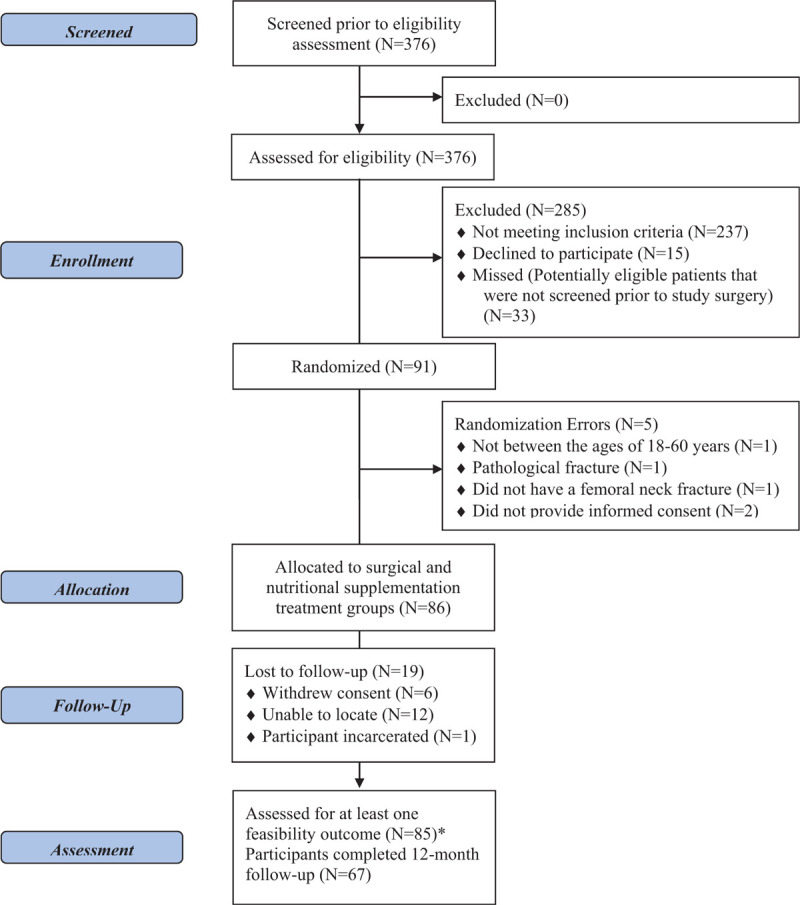
PATIENTS/PARTICIPANTS: Ninety-one randomized adults aged 18 to 60 years with a femoral neck fracture requiring surgical fixation.
Eligible patients were randomized to receive surgical treatment (sliding hip screw or cancellous screws) AND nutritional supplementation (4000 IU of vitamin D or placebo) for 6 months postfracture.
Feasibility outcomes included: clinical site initiation, participant enrolment rate, proportion of participants with complete 12-month follow-up, level of data quality, and rate of protocol adherence (number of randomization errors, crossovers between treatment groups, and daily supplementation adherence).
Eighty-six of 91 participants randomized into the pilot trial from 15 North American hospitals were deemed eligible. Four of five primary feasibility criteria were not achieved as we were unable to initiate clinical sites outside of North America and Australia due to feasibility constraints, slow participant enrolment (60 participants recruited over 36 mo), low adherence with daily nutritional supplementation at the 6-week (72.1%), 3-month (60.5%), and 6-month (54.7%) follow-up visits, and a high loss to follow-up rate of 22.1% at 12 months.
Despite not meeting key feasibility criteria, we increased our knowledge on the logistics and anticipated barriers when conducting vitamin D supplementation trials in this trauma population, which can be used to inform the design and conduct of future trials on this topic.
对使用替代植入物治疗髋部骨折的固定术(FAITH-2)方案进行一项试点试验,以评估确定性试验的可行性。
试点试验。
北美和澳大利亚的25个临床地点启动,但仅15个北美地点进行了入组。
患者/参与者:91名年龄在18至60岁之间、因股骨颈骨折需要手术固定的随机分组成年人。
符合条件的患者被随机分配接受手术治疗(滑动髋螺钉或松质骨螺钉)以及骨折后6个月的营养补充(4000国际单位维生素D或安慰剂)。
可行性结果包括:临床地点启动、参与者入组率、完成12个月随访的参与者比例、数据质量水平以及方案依从率(随机化错误数量、治疗组之间的交叉情况以及每日补充的依从性)。
从15家北美医院随机纳入试点试验的91名参与者中,86名被认为符合条件。五项主要可行性标准中有四项未达成,原因包括:由于可行性限制,我们无法在北美和澳大利亚以外启动临床地点;参与者入组缓慢(36个月内招募了60名参与者);在6周(72.1%)、3个月(60.5%)和6个月(54.7%)随访时,每日营养补充的依从性较低;以及在12个月时随访失访率高达22.1%。
尽管未达到关键的可行性标准,但我们增加了对在该创伤人群中进行维生素D补充试验时的后勤保障和预期障碍的了解,这可用于为该主题未来试验的设计和实施提供参考。