Departamento de Medicina, Serviço de Endocrinologia, Instituto Nacional do Câncer (Inca), Rio de Janeiro, RJ, Brasil.
Departamento de Medicina, Serviço de Endocrinologia, Hospital Universitário Clementino Fraga Filho, Universidade Federal do Rio de Janeiro, Rio de Janeiro, RJ, Brasil.
Arch Endocrinol Metab. 2021 Nov 3;65(4):411-420. doi: 10.20945/2359-3997000000364. Epub 2021 Apr 29.
The aim of this study was to describe the real-world experience multikinase inhibitors (MKI) in the treatment advanced differentiated thyroid carcinoma (DTC) refractory to radioactive iodine (RAIR) therapy.
We reviewed the records of all patients with MKI-treated DTC from 2010 to 2018. Progression free survival (PFS), response rates (RR) and adverse events (AE) profiles were assessed. Clinical parameters were compared between groups with different outcomes (disease progression and death) to identify possible prognostic factors and benefit from treatment.
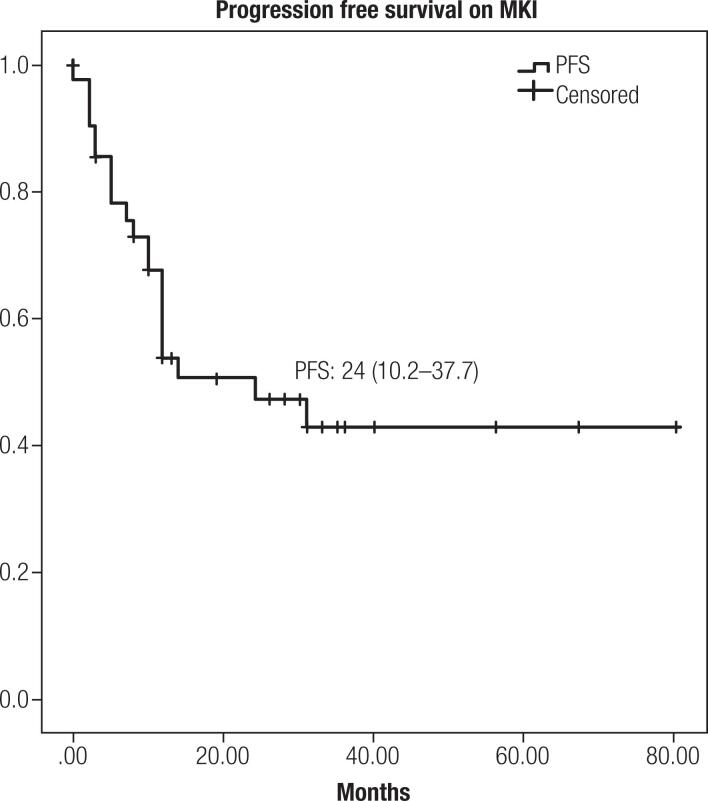
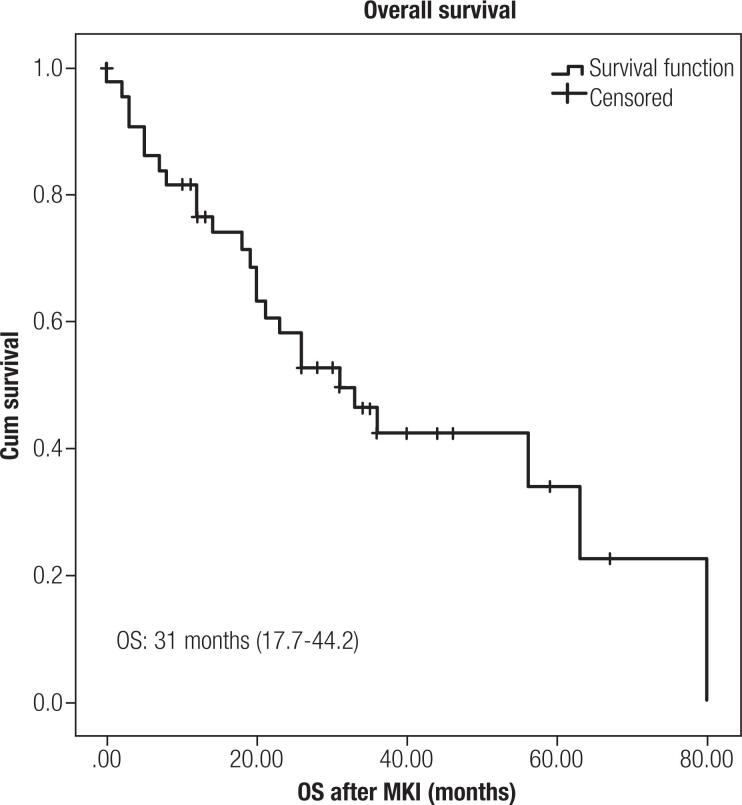
Forty-four patients received MKI for progressive RAIR DTC. Median PFS was 24 months (10.2-37.7) and median overall survival (OS) was 31 months. Best overall response was complete response in one patient (4.5%), partial response in nine (20.4%), stable disease in twenty-two (50%), and progressive disease (PD) in twelve (27.3%). Seventy-two point 7 percent patients had clinical benefit and AE were mild in most cases (82.7%). Progressive patients were more likely to have FDG positive target lesion than those who did not progress (p = 0.033) and higher maximum SUV on target lesions (p = 0.042). Presence of lung-only metastasis and lower thyroglobulin (Tg) during treatment was associated with stable disease (p = 0.015 and 0,049, respectively). Patients with shorter survival had larger primary tumor size (p = 0.015) and higher maximum SUV on target lesions (p = 0.023).
Our findings demonstrate safety and effectiveness of MKI in patients with advanced RAIR DTC. We were able to identify as possible prognostic markers of better outcomes: absence of FDG uptake on target lesions, lower maximum SUV on PET-CT, presence of lung-only metastasis and lower Tg during treatment.
本研究旨在描述多激酶抑制剂(MKI)在治疗对放射性碘(RAIR)治疗耐药的晚期分化型甲状腺癌(DTC)中的真实世界经验。
我们回顾了 2010 年至 2018 年所有接受 MKI 治疗的 DTC 患者的记录。评估无进展生存期(PFS)、反应率(RR)和不良事件(AE)谱。比较不同结局(疾病进展和死亡)患者的临床参数,以确定可能的预后因素和治疗获益。
44 例患者因 RAIR 进展的 DTC 接受 MKI 治疗。中位 PFS 为 24 个月(10.2-37.7),中位总生存期(OS)为 31 个月。最佳总体反应为 1 例(4.5%)完全缓解,9 例(20.4%)部分缓解,22 例(50%)疾病稳定,12 例(27.3%)疾病进展。72.7%的患者有临床获益,AE 在大多数情况下较轻(82.7%)。进展患者的 FDG 阳性靶病灶较未进展患者更常见(p=0.033),且靶病灶的最大 SUV 值更高(p=0.042)。仅存在肺转移和治疗期间较低的甲状腺球蛋白(Tg)与疾病稳定相关(p=0.015 和 0.049)。生存期较短的患者的原发肿瘤较大(p=0.015),且靶病灶的最大 SUV 值较高(p=0.023)。
我们的研究结果表明 MKI 在治疗晚期 RAIR DTC 患者中是安全有效的。我们能够确定更好结局的可能预后标志物:靶病灶无 FDG 摄取、PET-CT 最大 SUV 值较低、仅存在肺转移和治疗期间较低的 Tg。