Department of Medicine, Renal-Electrolyte Division, University of Pittsburgh, Pittsburgh, Pennsylvania, USA.
Department of Surgery, Thomas E. Starzl Transplantation Institute, University of Pittsburgh, Pittsburgh, Pennsylvania, USA.
Kidney Int. 2021 Sep;100(3):660-671. doi: 10.1016/j.kint.2021.04.020. Epub 2021 Apr 30.
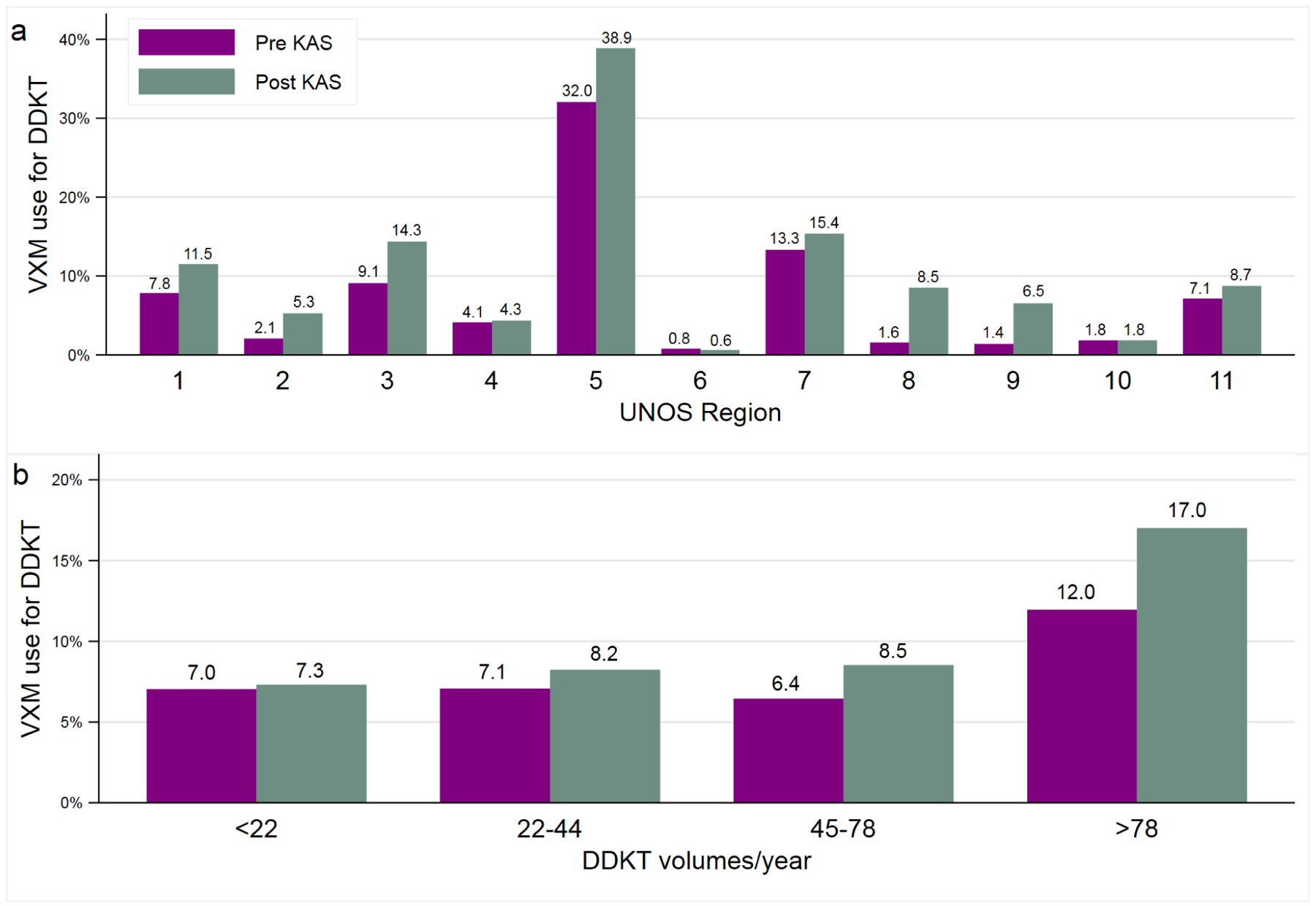
For assessing human leukocyte antigen compatibility in deceased donor kidney transplantation, virtual crossmatch is used as an alternative to physical crossmatch and has potential to reduce cold ischemia time. The 2014 United States kidney allocation system prioritized highly sensitized candidates but led to increased shipping of kidneys. Using data from the Scientific Registry of Transplant Recipients, we evaluated changes in virtual crossmatch use with the new allocation policy and the impact of virtual crossmatch use on cold ischemia time and transplant outcomes. This was a retrospective cohort study of adult deceased donor kidney recipients in the United States (2011-2018) transplanted with either 9,632 virtual or 71,839 physical crossmatches. Before allocation change, only 9% of transplants were performed relying on a virtual crossmatch. After the 2014 allocation change, this increased by 2.4%/year so that 18% transplants in 2018 were performed with just a virtual crossmatch. There was significant variation in virtual crossmatch use among transplant regions (range 0.7-36%) and higher use was noted among large volume centers. Compared to physical crossmatches, virtual crossmatches were significantly associated with shorter cold ischemia times (mean 15.0 vs 16.5 hours) and similar death-censored graft loss and mortality (both hazard ratios HR 0.99) at a median follow-up of 2.9 years. Thus, our results show that virtual crossmatch is an attractive strategy for shortening cold ischemia time without negatively impacting transplant outcomes. Hence, strategies to optimize use and reduce practice variation may allow for maximizing benefits from virtual crossmatch.
在评估已故供体肾移植中的人类白细胞抗原相容性时,虚拟交叉配型被用作物理交叉配型的替代方法,并有潜力减少冷缺血时间。2014 年美国肾脏分配系统优先考虑高度敏感的候选人,但导致更多的肾脏运输。利用移植受者科学登记处的数据,我们评估了新分配政策下虚拟交叉配型使用的变化及其对冷缺血时间和移植结果的影响。这是一项在美国(2011-2018 年)接受成人已故供体肾移植的回顾性队列研究,其中 9632 例接受虚拟交叉配型,71839 例接受物理交叉配型。在分配变更之前,只有 9%的移植是依赖于虚拟交叉配型的。在 2014 年分配变更后,这一比例每年增加 2.4%,以至于 2018 年有 18%的移植只进行了虚拟交叉配型。移植区域之间的虚拟交叉配型使用率存在显著差异(范围为 0.7-36%),大体积中心的使用率更高。与物理交叉配型相比,虚拟交叉配型与更短的冷缺血时间显著相关(平均 15.0 小时对 16.5 小时),并且在 2.9 年的中位随访中死亡相关移植物丢失和死亡率(两者的危险比 HR 均为 0.99)相似。因此,我们的结果表明,虚拟交叉配型是一种有吸引力的策略,可以缩短冷缺血时间,而不会对移植结果产生负面影响。因此,优化使用和减少实践差异的策略可能会最大限度地发挥虚拟交叉配型的益处。