Department of Sciences and Technologies, University Parthenope of Naples, Centro Direzionale Isola C4, I-80143 Naples, Italy.
Kaust Catalysis Center, Physical Sciences and Engineering Division, King Abdullah University of Science and Technology (KAUST), Thuwal 23955-6900, Saudi Arabia.
Molecules. 2021 Apr 30;26(9):2622. doi: 10.3390/molecules26092622.
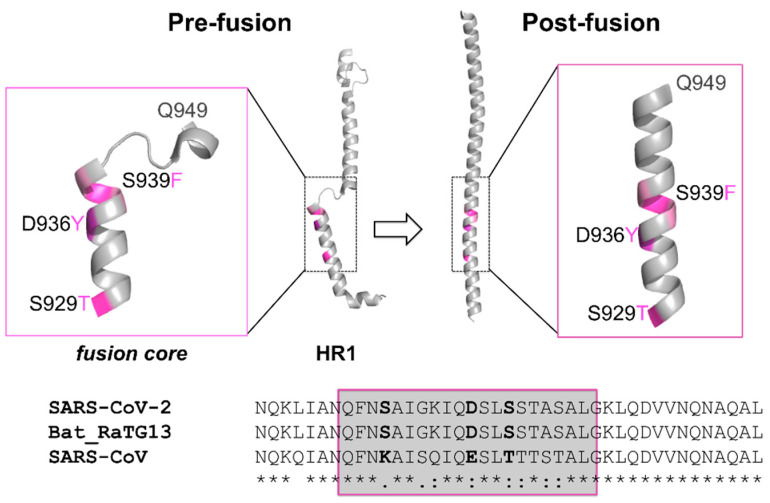
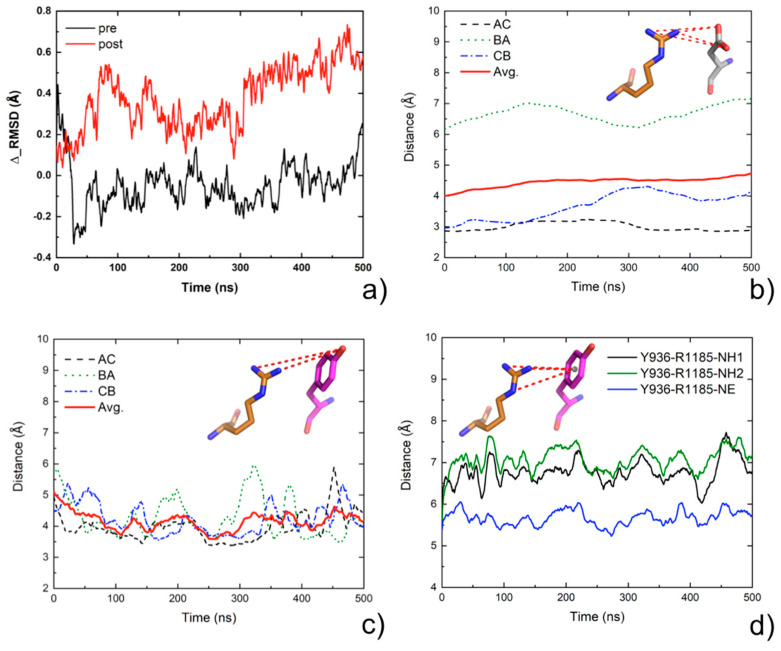
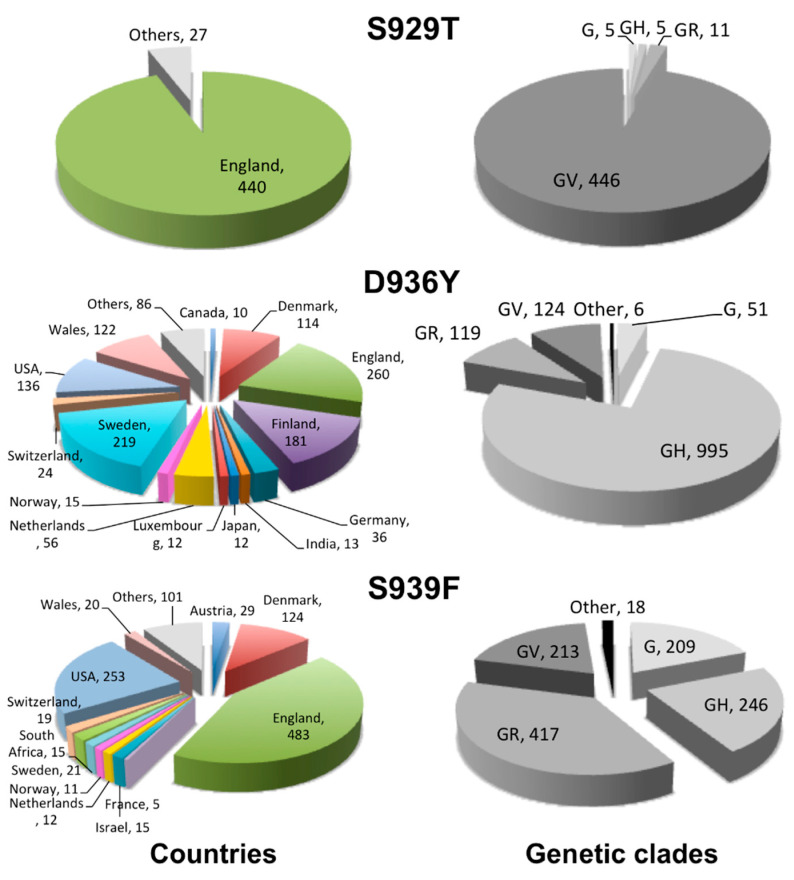
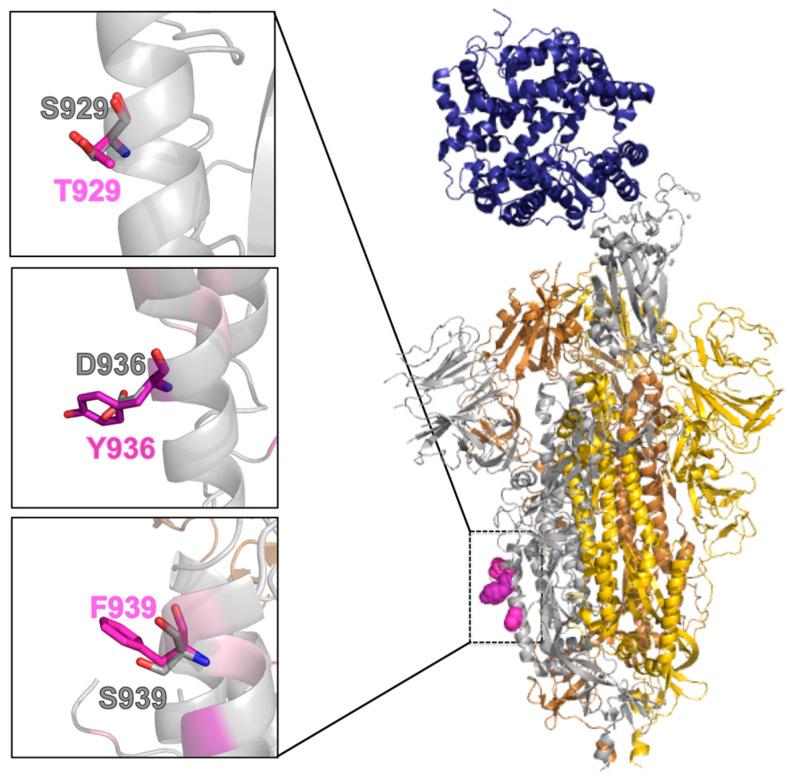
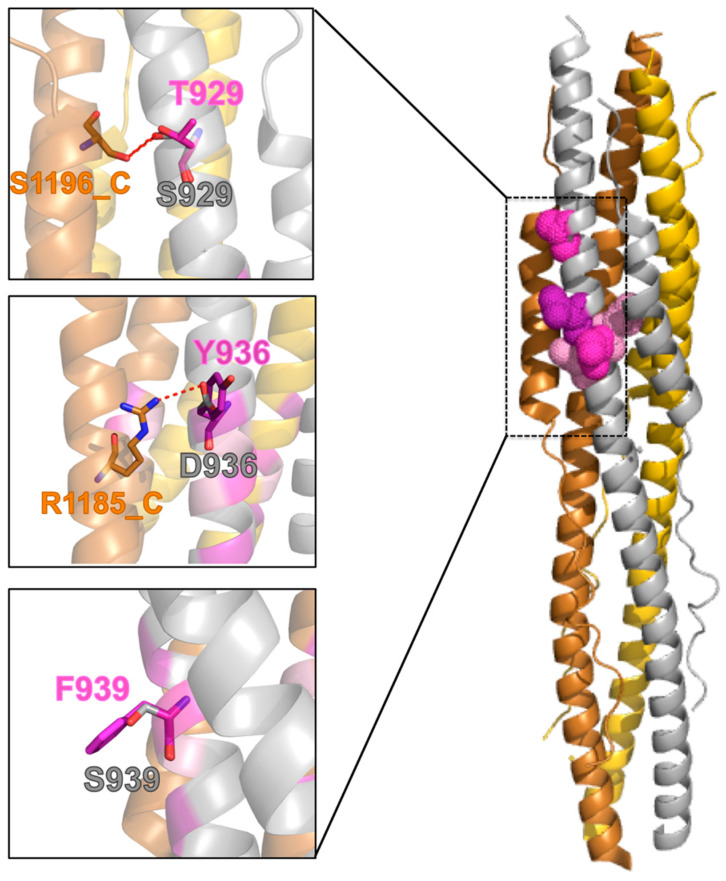
The crown of the severe acute respiratory syndrome coronavirus 2 (SARS-CoV-2) is constituted by its spike (S) glycoprotein. S protein mediates the SARS-CoV-2 entry into the host cells. The "fusion core" of the heptad repeat 1 (HR1) on S plays a crucial role in the virus infectivity, as it is part of a key membrane fusion architecture. While SARS-CoV-2 was becoming a global threat, scientists have been accumulating data on the virus at an impressive pace, both in terms of genomic sequences and of three-dimensional structures. On 15 February 2021, from the SARS-CoV-2 genomic sequences in the GISAID resource, we collected 415,673 complete S protein sequences and identified all the mutations occurring in the HR1 fusion core. This is a 21-residue segment, which, in the post-fusion conformation of the protein, gives many strong interactions with the heptad repeat 2, bringing viral and cellular membranes in proximity for fusion. We investigated the frequency and structural effect of novel mutations accumulated over time in such a crucial region for the virus infectivity. Three mutations were quite frequent, occurring in over 0.1% of the total sequences. These were S929T, D936Y, and S949F, all in the N-terminal half of the HR1 fusion core segment and particularly spread in Europe and USA. The most frequent of them, D936Y, was present in 17% of sequences from Finland and 12% of sequences from Sweden. In the post-fusion conformation of the unmutated S protein, D936 is involved in an inter-monomer salt bridge with R1185. We investigated the effect of the D936Y mutation on the pre-fusion and post-fusion state of the protein by using molecular dynamics, showing how it especially affects the latter one.
严重急性呼吸综合征冠状病毒 2(SARS-CoV-2)的冠状结构由其刺突(S)糖蛋白构成。S 蛋白介导 SARS-CoV-2 进入宿主细胞。S 上的七肽重复 1(HR1)的“融合核心”在病毒感染力中起着至关重要的作用,因为它是关键膜融合结构的一部分。当 SARS-CoV-2 成为全球威胁时,科学家们以惊人的速度积累了有关该病毒的大量数据,无论是在基因组序列方面还是在三维结构方面。2021 年 2 月 15 日,我们从 GISAID 资源中的 SARS-CoV-2 基因组序列中收集了 415,673 个完整的 S 蛋白序列,并确定了 HR1 融合核心中发生的所有突变。这是一个 21 个残基的片段,在蛋白的融合后构象中,与七肽重复 2 形成许多强相互作用,使病毒和细胞膜接近融合。我们研究了在如此重要的病毒感染性区域中随时间积累的新型突变的频率和结构效应。有三个突变非常频繁,发生在超过总序列的 0.1%。这些突变是 S929T、D936Y 和 S949F,均位于 HR1 融合核心片段的 N 端,特别在欧洲和美国传播。其中最常见的突变,D936Y,出现在芬兰序列的 17%和瑞典序列的 12%中。在未突变的 S 蛋白的融合后构象中,D936 与 R1185 形成单体间盐桥。我们通过使用分子动力学研究了 D936Y 突变对蛋白的预融合和融合后状态的影响,结果表明它特别影响后者。