Liu Hilary Y, Gale Jenna R, Reynolds Ian J, Weiss John H, Aizenman Elias
Department of Neurobiology and Pittsburgh Institute for Neurodegenerative Diseases, University of Pittsburgh School of Medicine, Pittsburgh, PA 15261, USA.
YaghPenn Consulting, BV, 3061 Leefdaal, Belgium.
Biomedicines. 2021 Apr 29;9(5):489. doi: 10.3390/biomedicines9050489.
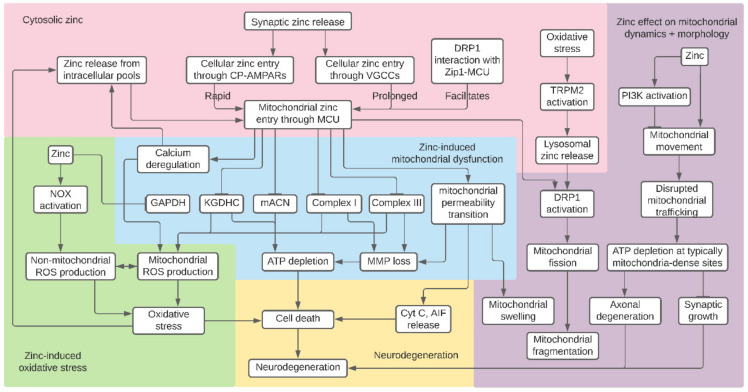
Zinc is a highly abundant cation in the brain, essential for cellular functions, including transcription, enzymatic activity, and cell signaling. However, zinc can also trigger injurious cascades in neurons, contributing to the pathology of neurodegenerative diseases. Mitochondria, critical for meeting the high energy demands of the central nervous system (CNS), are a principal target of the deleterious actions of zinc. An increasing body of work suggests that intracellular zinc can, under certain circumstances, contribute to neuronal damage by inhibiting mitochondrial energy processes, including dissipation of the mitochondrial membrane potential (MMP), leading to ATP depletion. Additional consequences of zinc-mediated mitochondrial damage include reactive oxygen species (ROS) generation, mitochondrial permeability transition, and excitotoxic calcium deregulation. Zinc can also induce mitochondrial fission, resulting in mitochondrial fragmentation, as well as inhibition of mitochondrial motility. Here, we review the known mechanisms responsible for the deleterious actions of zinc on the organelle, within the context of neuronal injury associated with neurodegenerative processes. Elucidating the critical contributions of zinc-induced mitochondrial defects to neurotoxicity and neurodegeneration may provide insight into novel therapeutic targets in the clinical setting.
锌是大脑中含量丰富的阳离子,对细胞功能至关重要,包括转录、酶活性和细胞信号传导。然而,锌也会引发神经元中的有害级联反应,导致神经退行性疾病的病理变化。线粒体对于满足中枢神经系统(CNS)的高能量需求至关重要,是锌有害作用的主要靶点。越来越多的研究表明,在某些情况下,细胞内锌可通过抑制线粒体能量过程,包括线粒体膜电位(MMP)的耗散,导致ATP耗竭,从而造成神经元损伤。锌介导的线粒体损伤的其他后果包括活性氧(ROS)生成、线粒体通透性转换和兴奋性毒性钙失调。锌还可诱导线粒体分裂,导致线粒体碎片化,以及抑制线粒体运动。在此,我们在与神经退行性过程相关的神经元损伤背景下,综述锌对该细胞器有害作用的已知机制。阐明锌诱导的线粒体缺陷对神经毒性和神经退行性变的关键作用,可能为临床环境中的新型治疗靶点提供见解。