Skidmore Adam, Aarts Edo O
Department of General Surgery, Victorian Obesity Surgery Centre, Localized in Warringal Hospital and Knox Private Hospital, 5 Burgundy Street, Heidelberg, Melbourne, VIC, 3084, Australia.
WeightWorks Clinics, Surgical weight Loss Clinic, Amersfoort, The Netherlands.
BMC Surg. 2021 May 4;21(1):236. doi: 10.1186/s12893-021-01197-0.
Internal hernias occur after Roux-en-Y gastric bypass surgery (RYGB) when small bowel herniates into the intermesenteric spaces that have been created. The closure technique used is related to the internal hernia risks outcomes. Using a non-resorbable double layered suture, this risk can be significantly reduced from 8.9 to 2.5% in the first three postoperative years. By closing over a BIO mesh, the risk might be reduced even more.
Two large private hospitals specialized in bariatric surgery.
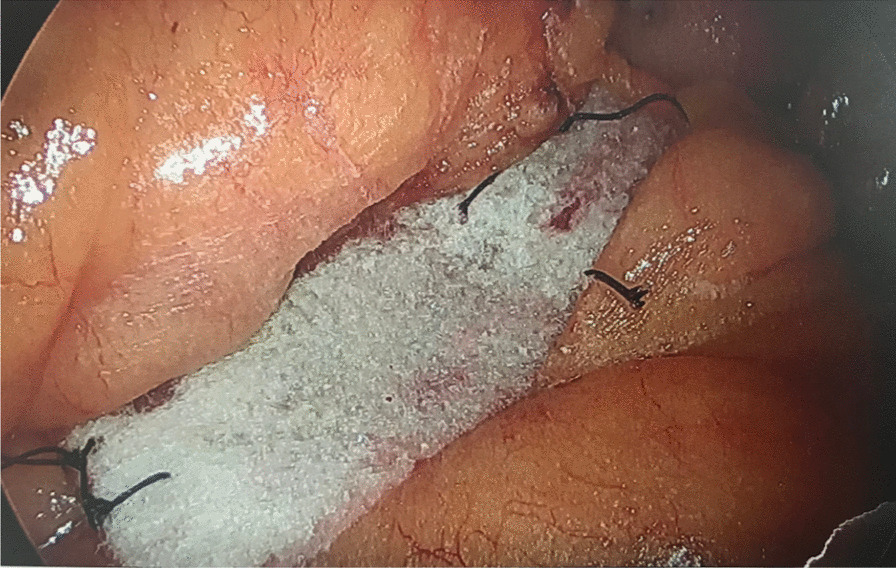
All patients receiving a RYGB for (morbid) obesity between 2014 and 2018 were included in this retrospective study. In all patients, the entero-enterostomy (EE) was closed using a double layered non-absorbable suture. In 2014, Peterson's space was closed exclusively using glue, the years hereafter in a similar fashion as the EE, combined with a piece of glued BIO Mesh.
The glued RYGB patients showed 25% of patients with an internal hernia (14%) or open Peterson's space compared to 0.5% of patients (p < 0.001) who had a combined sutured and BIO Mesh Closure of their Peterson's space defect. Although this was an ideal technique for Peterson's space, it led to 1% of entero-enterostomy kinking due to the firm adhesion formation.
Gluing the intermesenteric spaces is not beneficial but placing a BIO Mesh in Peterson's space is a promising new technique to induce local adhesions. It is above all safe, effective and led to an almost complete reduction of Peterson's internal herniations. In the future, a randomized controlled trial comparing this technique to a double layered, non-absorbable suture should give more insights into which is the optimal closure technique.
在Roux-en-Y胃旁路手术(RYGB)后,当小肠疝入所形成的肠系膜间隙时,会发生内疝。所使用的闭合技术与内疝风险结果相关。使用不可吸收的双层缝合线,在前三年术后,这种风险可从8.9%显著降低至2.5%。通过在生物补片上进行闭合,风险可能会进一步降低。
两家专门从事减肥手术的大型私立医院。
本回顾性研究纳入了2014年至2018年间所有接受RYGB治疗(病态)肥胖症的患者。所有患者的肠肠吻合术(EE)均使用双层不可吸收缝合线进行闭合。2014年,仅使用胶水闭合彼得森间隙,此后几年采用与EE类似的方式,同时结合一块粘贴的生物补片。
与采用缝合和生物补片联合闭合彼得森间隙缺损的患者中0.5%相比,采用胶水闭合RYGB手术的患者中有25%发生内疝(14%)或彼得森间隙开放(p<0.001)。尽管这是闭合彼得森间隙的理想技术,但由于形成牢固粘连,导致1%的肠肠吻合术扭结。
粘合肠系膜间隙并无益处,但在彼得森间隙放置生物补片是诱导局部粘连的一种有前景的新技术。它首先是安全、有效的,并且几乎完全减少了彼得森内疝的发生。未来,一项将该技术与双层不可吸收缝合线进行比较的随机对照试验应能更深入了解哪种是最佳闭合技术。