Castro-Calvo J, Cervigón-Carrasco V, Ballester-Arnal R, Giménez-García C
Department of Personality, Assessment, and Psychological Treatments, Faculty of Psychology, University of Valencia, Spain.
Department of Basic and Clinical Psychology and Psychobiology, Universitat Jaume I, Spain.
Addict Behav Rep. 2021 Apr 7;13:100345. doi: 10.1016/j.abrep.2021.100345. eCollection 2021 Jun.
Some people experience symptoms and negative outcomes derived from their persistent, excessive, and problematic engagement in pornography viewing (i.e., Problematic Pornography Use, PPU). Recent theoretical models have turned to different cognitive processes (e.g., inhibitory control, decision making, attentional bias, etc.) to explain the development and maintenance of PPU, but empirical evidence derived from experimental studies is still limited. In this context, the present systematic review aimed to review and compile the evidence around cognitive processes related to PPU.
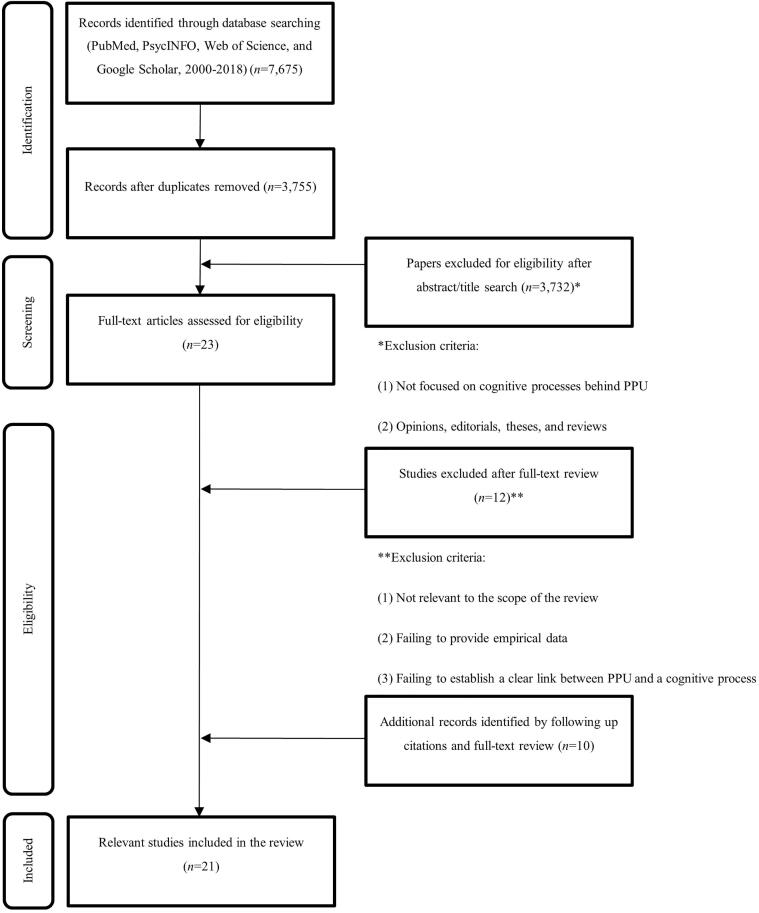
A systematic review was performed in accordance with PRISMA guidelines to compile evidence regarding cognitive processes related to PPU. We retained and analyzed 21 experimental studies addressing this topic.
Studies were focused on four cognitive processes: attentional bias, inhibitory control, working memory, and decision making. In brief, PPU is related to (a) attentional biases toward sexual stimuli, (b) deficient inhibitory control (in particular, to problems with motor response inhibition and to shift attention away from irrelevant stimuli), (c) worse performance in tasks assessing working memory, and (d) decision making impairments (in particular, to preferences for short-term small gains rather than long-term large gains, more impulsive choice patterns than non-erotica users, approach tendencies toward sexual stimuli, and inaccuracies when judging the probability and magnitude of potential outcomes under ambiguity).
This systematic review offers a comprehensive overview of the current state of knowledge regarding the cognitive features related to PPU, and points out new areas that warrants further research.
一些人因持续、过度且成问题地沉迷于观看色情内容(即问题性色情使用,PPU)而出现症状和负面后果。最近的理论模型已转向不同的认知过程(如抑制控制、决策、注意偏向等)来解释PPU的发展和维持,但来自实验研究的实证证据仍然有限。在此背景下,本系统综述旨在回顾和汇总与PPU相关的认知过程的证据。
按照PRISMA指南进行系统综述,以汇总与PPU相关的认知过程的证据。我们保留并分析了21项针对该主题的实验研究。
研究集中在四个认知过程:注意偏向、抑制控制、工作记忆和决策。简而言之,PPU与以下方面有关:(a)对性刺激的注意偏向;(b)抑制控制不足(特别是在运动反应抑制以及将注意力从无关刺激上转移方面存在问题);(c)在评估工作记忆的任务中表现更差;(d)决策受损(特别是倾向于短期小收益而非长期大收益、比非色情内容使用者更冲动的选择模式、对性刺激的趋近倾向以及在模糊情况下判断潜在结果的概率和大小不准确)。
本系统综述全面概述了与PPU相关的认知特征的当前知识状态,并指出了值得进一步研究的新领域。