
C(P) + O(Σ) → CO ↔ CO(Σ) + O(D)/O(P)反应:15 K至20000 K的热弛豫率和振动弛豫率
The C(P) + O(Σ) → CO ↔ CO(Σ) + O(D)/O(P) reaction: thermal and vibrational relaxation rates from 15 K to 20 000 K.
作者信息
San Vicente Veliz Juan Carlos, Koner Debasish, Schwilk Max, Bemish Raymond J, Meuwly Markus
机构信息
Department of Chemistry, University of Basel, Klingelbergstrasse 80, CH-4056 Basel, Switzerland.
Air Force Research Laboratory, Space Vehicles Directorate, Kirtland AFB, New Mexico 87117, USA.
出版信息
Phys Chem Chem Phys. 2021 May 19;23(19):11251-11263. doi: 10.1039/d1cp01101d.
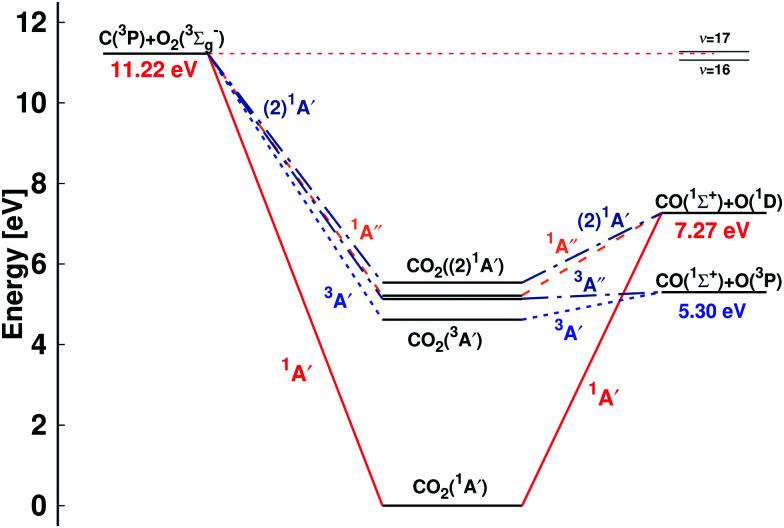
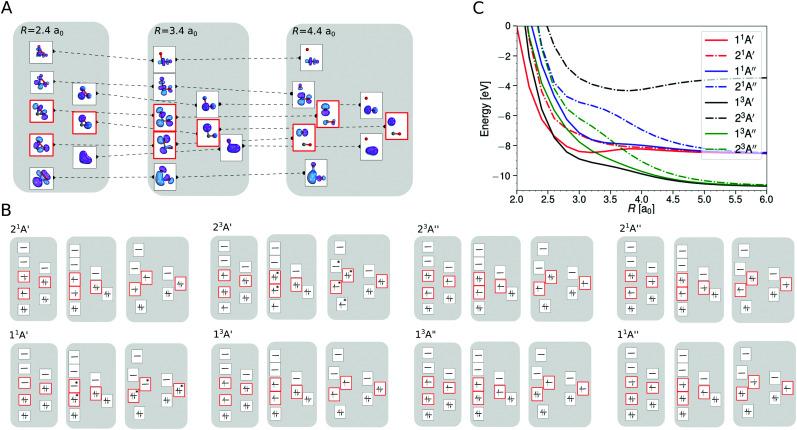
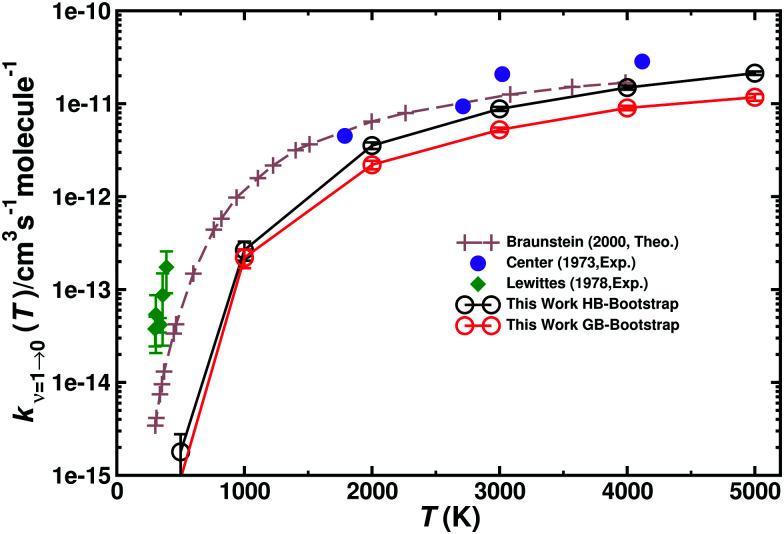
Thermal rates for the C(3P) + O2(3Σg-) ↔ CO(1Σ+)+ O(1D)/O(3P) reaction are investigated over a wide temperature range based on quasi classical trajectory (QCT) simulations on 3-dimensional, reactive potential energy surfaces (PESs) for the 1A', (2)1A', 1A'', 3A' and 3A'' states. These five states are the energetically low-lying states of CO2 and their PESs are computed at the MRCISD+Q/aug-cc-pVTZ level of theory using a state-average CASSCF reference wave function. Analysis of the different electronic states for the CO2 → CO + O dissociation channel rationalizes the topography of this region of the PESs. The forward rates from QCT simulations match measurements between 15 K and 295 K whereas the equilibrium constant determined from the forward and reverse rates is consistent with that derived from statistical mechanics at high temperature. Vibrational relaxation, O + CO(ν = 1,2) → O + CO(ν = 0), is found to involve both, non-reactive and reactive processes. The contact time required for vibrational relaxation to take place is τ ≥ 150 fs for non-reacting and τ ≥ 330 fs for reacting (oxygen atom exchange) trajectories and the two processes are shown to probe different parts of the global potential energy surface. In agreement with experiments, low collision energy reactions for the C(3P) + O2(3Σg-, ν = 0) → CO(1Σ+) + O(1D) lead to CO(1Σ+, ν' = 17) with an onset at Ec ∼ 0.15 eV, dominated by the 1A' surface with contributions from the 3A' surface. Finally, the barrier for the COA(1Σ+) + OB(3P) → COB(1Σ+) + OA(3P) atom exchange reaction on the 3A' PES yields a barrier of ∼7 kcal mol-1 (0.300 eV), consistent with an experimentally reported value of 6.9 kcal mol-1 (0.299 eV).
基于对1A'、(2)1A'、1A''、3A'和3A''态的三维反应势能面(PES)进行的准经典轨迹(QCT)模拟,在很宽的温度范围内研究了C(3P) + O2(3Σg-) ↔ CO(1Σ+)+ O(1D)/O(3P)反应的热速率。这五个态是CO2的能量较低的态,它们的PES在理论的MRCISD+Q/aug-cc-pVTZ水平上,使用态平均CASSCF参考波函数进行计算。对CO2 → CO + O解离通道不同电子态的分析解释了PES该区域的形貌。QCT模拟得到的正向速率与15 K至295 K之间的测量结果相符,而由正向和反向速率确定的平衡常数与高温下统计力学得出的结果一致。发现振动弛豫O + CO(ν = 1,2) → O + CO(ν = 0)涉及非反应性和反应性过程。对于非反应性轨迹,振动弛豫发生所需的接触时间为τ ≥ 150 fs,对于反应性(氧原子交换)轨迹为τ ≥ 330 fs,并且这两个过程显示探测全局势能面的不同部分。与实验一致,C(3P) + O2(3Σg-, ν = 0) → CO(1Σ+) + O(1D)的低碰撞能反应导致生成CO(1Σ+, ν' = 17),起始能量Ec ∼ 0.15 eV,主要由1A'面主导,3A'面也有贡献。最后,3A' PES上COA(1Σ+) + OB(3P) → COB(1Σ+) + OA(3P)原子交换反应的势垒约为7 kcal mol-1(0.300 eV),与实验报道的6.9 kcal mol-1(0.299 eV)值一致。





 Zotero 插件