Psychology, University of California Los Angeles, Los Angeles, California, USA.
Neurocardiology Research Center of Excellence, Cardiac Arrhythmia Center, University of California Los Angeles, Los Angeles, California, USA.
BMJ Open. 2021 May 5;11(5):e043060. doi: 10.1136/bmjopen-2020-043060.
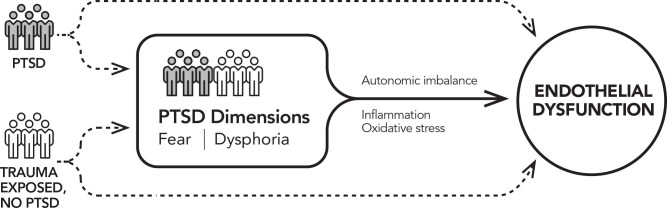
Both trauma exposure and post-traumatic stress disorder (PTSD) are associated with increased risk of cardiovascular disease (CVD), the leading cause of death in the USA. Endothelial dysfunction, a modifiable, early marker of CVD risk, may represent a physiological mechanism underlying this association. This mechanism-focused cohort study aims to investigate the relationship between PTSD (both in terms of diagnosis and underlying symptom dimensions) and endothelial dysfunction in a diverse, community-based sample of adult men and women.
Using a cohort design, 160 trauma-exposed participants without a history of CVD are designated to the PTSD group (n=80) or trauma-exposed matched control group (n=80) after a baseline diagnostic interview assessment. Participants in the PTSD group have a current (past month) diagnosis of PTSD, whereas those in the control group have a history of trauma but no current or past psychiatric diagnoses. Endothelial dysfunction is assessed via flow-mediated vasodilation of the brachial artery and circulating levels of endothelial cell-derived microparticles. Two higher order symptom dimensions of PTSD-fear and dysphoria-are measured objectively with a fear conditioning paradigm and attention allocation task, respectively. Autonomic imbalance, inflammation, and oxidative stress are additionally assessed and will be examined as potential pathway variables linking PTSD and its dimensions with endothelial dysfunction. Participants are invited to return for a 2-year follow-up visit to reassess PTSD and its dimensions and endothelial dysfunction in order to investigate longitudinal associations.
This study is conducted in compliance with the Helsinki Declaration and University of California, Los Angeles Institutional Review Board. The results of this study will be disseminated via articles in peer-reviewed journals and presentations at academic conferences and to community partners.
NCT03778307; pre-results.
创伤暴露和创伤后应激障碍(PTSD)都与心血管疾病(CVD)风险增加有关,而 CVD 是美国的主要死因。内皮功能障碍是 CVD 风险的一个可改变的早期标志物,它可能代表了这种关联的生理机制。这项以机制为重点的队列研究旨在调查 PTSD(无论是在诊断方面还是在潜在的症状维度方面)与成年男女的多样化、基于社区的样本中的内皮功能障碍之间的关系。
使用队列设计,在基线诊断访谈评估后,将 160 名无 CVD 病史的创伤暴露参与者指定为 PTSD 组(n=80)或创伤暴露匹配对照组(n=80)。PTSD 组的参与者目前(过去一个月)患有 PTSD,而对照组的参与者有创伤史,但没有当前或过去的精神科诊断。内皮功能障碍通过肱动脉血流介导的血管扩张和循环内皮细胞衍生的微颗粒来评估。PTSD 的两个更高阶的症状维度——恐惧和抑郁——分别通过恐惧条件反射范式和注意力分配任务客观地测量。自主神经失衡、炎症和氧化应激也被评估,并将作为 PTSD 及其维度与内皮功能障碍相关的潜在途径变量进行研究。邀请参与者返回进行 2 年的随访,以重新评估 PTSD 及其维度和内皮功能障碍,以调查纵向关联。
本研究符合赫尔辛基宣言和加利福尼亚大学洛杉矶分校机构审查委员会的规定。本研究的结果将通过同行评议期刊上的文章和学术会议上的演讲以及向社区合作伙伴进行传播。
NCT03778307;预结果。