Lydia Becker Institute of Immunology and Inflammation, Manchester Collaborative Centre for Inflammation Research, Faculty of Biology, Medicine and Health, Manchester Academic Health Science Centre, University of Manchester, Manchester, United Kingdom.
MRC Centre for Medical Mycology, University of Exeter, Exeter, United Kingdom.
Front Immunol. 2021 Apr 19;12:635513. doi: 10.3389/fimmu.2021.635513. eCollection 2021.
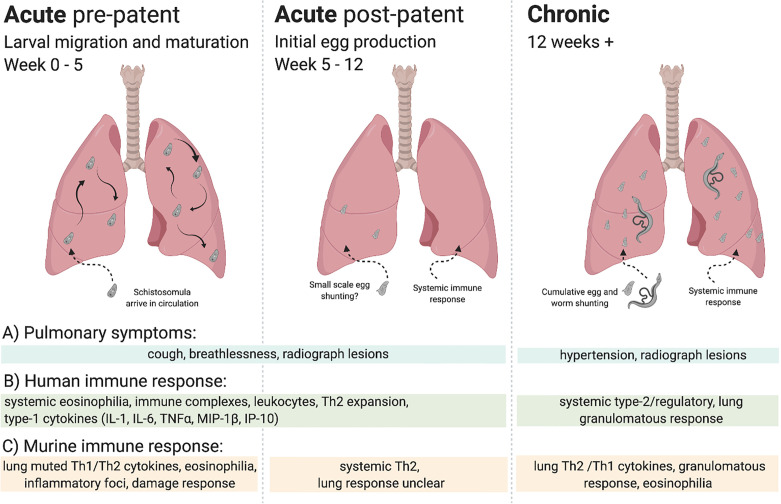
Schistosome infection is a major cause of global morbidity, particularly in sub-Saharan Africa. However, there is no effective vaccine for this major neglected tropical disease, and re-infection routinely occurs after chemotherapeutic treatment. Following invasion through the skin, larval schistosomula enter the circulatory system and migrate through the lung before maturing to adulthood in the mesenteric or urogenital vasculature. Eggs released from adult worms can become trapped in various tissues, with resultant inflammatory responses leading to hepato-splenic, intestinal, or urogenital disease - processes that have been extensively studied in recent years. In contrast, although lung pathology can occur in both the acute and chronic phases of schistosomiasis, the mechanisms underlying pulmonary disease are particularly poorly understood. In chronic infection, egg-mediated fibrosis and vascular destruction can lead to the formation of portosystemic shunts through which eggs can embolise to the lungs, where they can trigger granulomatous disease. Acute schistosomiasis, or Katayama syndrome, which is primarily evident in non-endemic individuals, occurs during pulmonary larval migration, maturation, and initial egg-production, often involving fever and a cough with an accompanying immune cell infiltrate into the lung. Importantly, lung migrating larvae are not just a cause of inflammation and pathology but are a key target for future vaccine design. However, vaccine efforts are hindered by a limited understanding of what constitutes a protective immune response to larvae. In this review, we explore the current understanding of pulmonary immune responses and inflammatory pathology in schistosomiasis, highlighting important unanswered questions and areas for future research.
血吸虫感染是全球发病率的主要原因,特别是在撒哈拉以南非洲地区。然而,对于这种主要的被忽视热带病,目前还没有有效的疫苗,并且在化学治疗后经常会再次感染。幼虫血吸虫在皮肤入侵后,进入循环系统并通过肺部迁移,然后在肠系膜或泌尿生殖道血管中成熟为成虫。从成虫释放的卵可以被困在各种组织中,由此产生的炎症反应导致肝脾、肠道或泌尿生殖道疾病——近年来这些过程已得到广泛研究。相比之下,尽管肺部病理学可能发生在血吸虫病的急性和慢性阶段,但肺部疾病的机制尤其知之甚少。在慢性感染中,卵介导的纤维化和血管破坏可导致门脉系统分流的形成,卵可通过该分流栓塞到肺部,在肺部引发肉芽肿疾病。急性血吸虫病,或加藤氏综合征,主要发生在非流行地区的个体中,发生在肺幼虫迁移、成熟和最初产卵期间,常伴有发热和咳嗽,伴有免疫细胞浸润肺部。重要的是,肺部移行幼虫不仅是炎症和病理学的原因,也是未来疫苗设计的关键靶标。然而,疫苗的努力受到对幼虫保护性免疫反应的有限理解的阻碍。在这篇综述中,我们探讨了目前对血吸虫病肺部免疫反应和炎症病理学的理解,强调了重要的未解决问题和未来研究的领域。