Kakadiya Ghanshyam, Saindane Kalpesh, Soni Yogesh, Gohil Kushal, Shakya Akash, Attar Mohhamad Umair
Department of Orthopaedics, Topiwala National Medical College and B.Y.L. Nair Hospital, Mumbai, India.
Department of Orthopaedics, Shri Shankaracharya Institute of Medical Science, Bhilai, India.
Asian Spine J. 2022 Jun;16(3):326-333. doi: 10.31616/asj.2020.0566. Epub 2021 May 7.
Retrospective study.
To assess the relationship between the severity of lumbar canal stenosis (LCS) and type-II diabetes mellitus (DM).
DM is a multiorgan disorder that has an effect on all types of connective tissues. LCS is a narrowing of the spinal canal with nerve root impingement that causes neurological claudication and radiculopathy. Identification of the risk factors of LCS is key in the prevention of its onset or progression.
LCS patients were divided into three groups as per DM status: group A without DM (n=150); group B patients with well-controlled DM; and group C patients with uncontrolled DM. Groups B and C were subdivided into group B1: patients with DM with a duration of ≤10 years (n=76), group B2: DM with duration of >10 years (n=68), group-C1 DM duration ≤10 years (n=56), and group C2 DM duration >10 years (n=48). The severity of LCS was evaluated using the Swiss Spinal Stenosis Scale (SSSS) and Modified Oswestry Disability score (MODS). Operated patients ligamentum flavum sent for histological staining and quantitative immunofluorescence analysis.
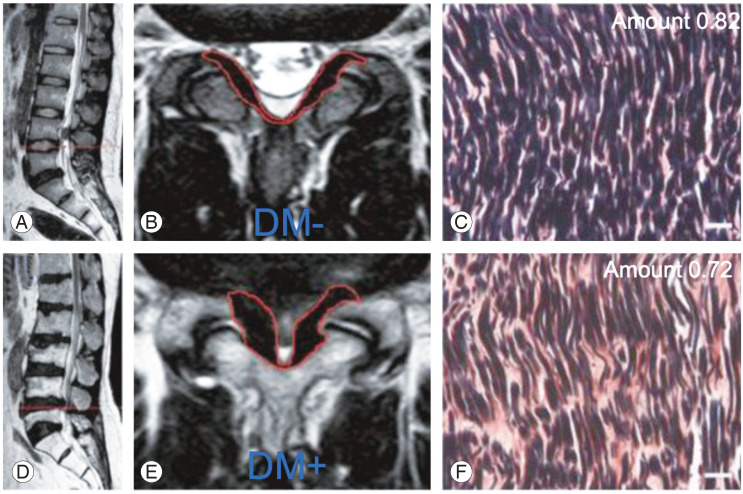
The demographic data of groups did not show any difference except in age. There was no difference between the mean SSSS and MODS of groups A and B1. Groups B2, C1, and C2 had higher average SSSS and MODS than group A (p<0.05). Groups B2 and C2 had higher SSSS and MODS than groups B1 and C1. Groups C1 and C2 had higher scores than groups B1 and B2 (p<0.05). The severity of LCS was significantly related to the duration of DM in groups B and C (p<0.05). Uncontrolled and longer duration of DM had significant elastin fibers loss and also higher rate of disk apoptosis, high matrix aggrecan fragmentation, and high disk glycosaminoglycan content.
Longer duration and uncontrolled diabetes were risk factors for LCS and directly correlate with the severity of LCS.
回顾性研究。
评估腰椎管狭窄症(LCS)的严重程度与2型糖尿病(DM)之间的关系。
DM是一种多器官疾病,对所有类型的结缔组织均有影响。LCS是椎管狭窄并伴有神经根受压,可导致神经源性间歇性跛行和神经根病。识别LCS的危险因素是预防其发病或进展的关键。
根据DM状态将LCS患者分为三组:A组无DM(n = 150);B组为DM控制良好的患者;C组为DM控制不佳的患者。B组和C组再细分为:B1组:DM病程≤10年的患者(n = 76),B2组:DM病程> 10年的患者(n = 68),C1组DM病程≤10年(n = 56),C2组DM病程> 10年(n = 48)。使用瑞士脊柱狭窄量表(SSSS)和改良Oswestry残疾评分(MODS)评估LCS的严重程度。对接受手术的患者的黄韧带进行组织学染色和定量免疫荧光分析。
除年龄外,各组的人口统计学数据无差异。A组和B1组的平均SSSS和MODS无差异。B2组、C1组和C2组的平均SSSS和MODS高于A组(p < 0.05)。B2组和C2组的SSSS和MODS高于B1组和C1组。C1组和C2组的评分高于B1组和B2组(p < 0.05)。B组和C组中,LCS的严重程度与DM病程显著相关(p < 0.05)。DM控制不佳和病程较长会导致弹性纤维显著丢失,椎间盘凋亡率升高、基质聚集蛋白聚糖碎片化程度高以及椎间盘糖胺聚糖含量高。
糖尿病病程较长和控制不佳是LCS的危险因素,且与LCS的严重程度直接相关。