Rheumatology, National Hospital Organisation Kumamoto Saishun Medical Center, Koshi, Japan
Rheumatology, Tsugaru General Hospital United Municipalities of Tsugaru, Goshogawara, Japan.
RMD Open. 2021 May;7(2). doi: 10.1136/rmdopen-2021-001601.
To compare effectiveness between tofacitinib and tocilizumab treatments for biological disease-modifying antirheumatic drug (bDMARD)-naïve patients or previous bDMARD-failure patients with active rheumatoid arthritis (RA) refractory to methotrexate (MTX).
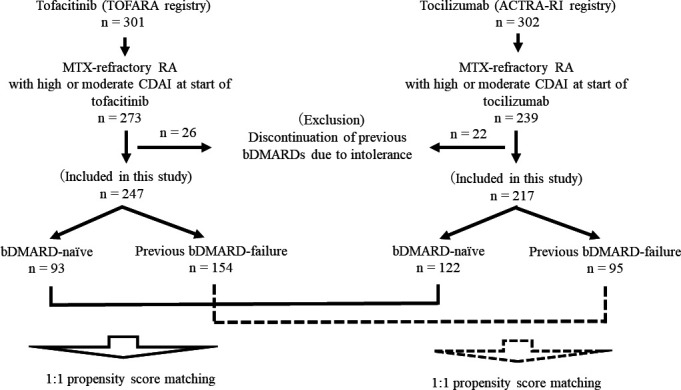
We used two ongoing real-world registries of patients with RA who had first started tofacitinib or tocilizumab between August 2013 and February 2019 at our institutions. Clinical disease activity index (CDAI)-based improvements at 12 months were used for comparisons between tofacitinib and tocilizumab treatments, separately for bDMARD-naïve and previous bDMARD-failure patients.
A total of 464 patients with RA with high or moderate CDAI were enrolled (247 with tofacitinib and 217 with tocilizumab). After adjustments for treatment-selection bias by propensity score matching, we showed that tofacitinib was more likely to induce and maintain ≥85% improvement in CDAI (CDAI85), CDAI70 and remission at 12 months compared with tocilizumab in bDMARD-naïve patients. After adjusting for concurrent use of MTX and prednisolone, the ORs of tofacitinib versus tocilizumab were 3.88 (95% CI 1.87 to 8.03) for CDAI85, 2.89 (95% CI 1.43 to 5.84) for CDAI70 and 3.31 (95% CI 1.69 to 6.48) for remission. These effects were not observed in bDMARD-failure patients. In tofacitinib treatment for bDMARD-failure patients, the number of previously failed bDMARD classes was not associated with CDAI-based improvements. The rate of overall adverse events was similar between both treatments. Similar ORs were obtained from patients adjusted by inverse probability of treatment weighting.
Compared with tocilizumab, tofacitinib can induce greater improvements during the first 12-month treatment in bDMARD-naïve patients, but this difference was not observed in previous bDMARD-failure patients.
比较托法替布与托珠单抗治疗对甲氨蝶呤(MTX)难治的生物改善病情抗风湿药(bDMARD)初治或既往 bDMARD 失败的活动性类风湿关节炎(RA)患者的疗效。
我们使用了两项正在进行的 RA 患者真实世界登记研究,这些患者于 2013 年 8 月至 2019 年 2 月期间在我们的机构首次开始使用托法替布或托珠单抗。分别对 bDMARD 初治和既往 bDMARD 失败的患者,采用临床疾病活动指数(CDAI)改善情况在 12 个月时进行比较。
共纳入了 464 例 CDAI 较高或中度的 RA 患者(托法替布组 247 例,托珠单抗组 217 例)。经倾向性评分匹配调整治疗选择偏倚后,我们发现与托珠单抗相比,托法替布在 bDMARD 初治患者中更有可能在 12 个月时诱导并维持 CDAI85、CDAI70 和缓解≥85%(CDAI85)。调整 MTX 和泼尼松龙的同时使用后,托法替布与托珠单抗的 OR 分别为 CDAI85(95%CI 1.87-8.03)、CDAI70(95%CI 1.43-5.84)和缓解(95%CI 1.69-6.48)。这些效果在既往 bDMARD 失败的患者中未观察到。在托法替布治疗既往 bDMARD 失败的患者中,先前失败的 bDMARD 种类数量与 CDAI 改善无关。两种治疗的总不良反应发生率相似。通过治疗反概率加权调整后的患者也获得了相似的 OR。
与托珠单抗相比,托法替布在 bDMARD 初治患者中,在治疗的前 12 个月能更好地改善疾病,但在既往 bDMARD 失败的患者中并未观察到这一差异。