Kong Rui, Wang Nan, Han Wei, Bao Wen, Lu Jie
Department of Gastroenterology, Shanghai Tenth People's Hospital Affiliated to Tongji University, Tongji University, School of Medicine, Shanghai 200072, China.
PPAR Res. 2021 Apr 16;2021:6663782. doi: 10.1155/2021/6663782. eCollection 2021.
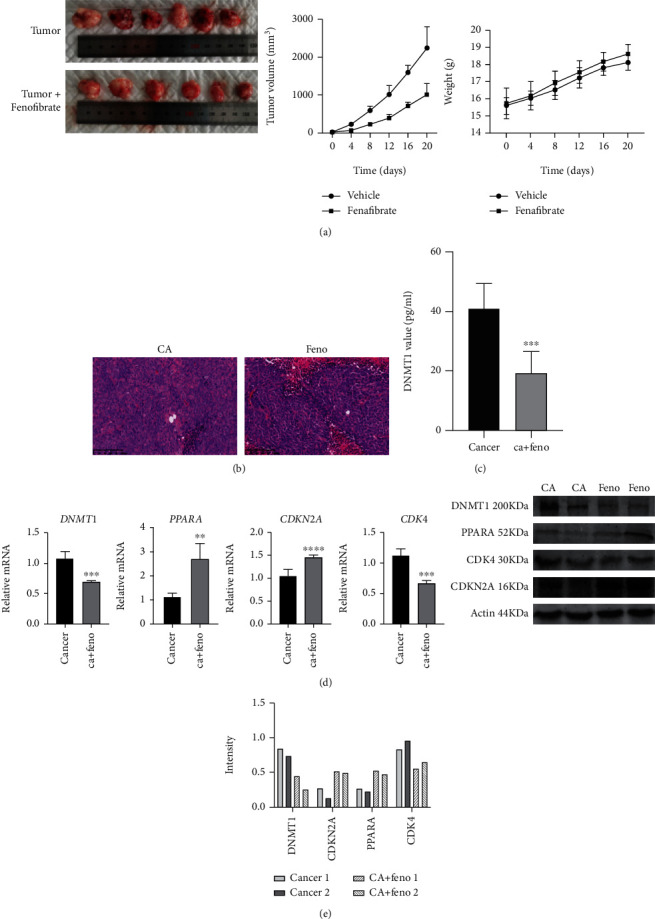
Peroxisome proliferator-activated receptor alpha (PPARA) is the molecular target of fibrates commonly used to treat dyslipidemia and diabetes. Recently, the potential role of PPARA in other pathological conditions, such as cancers, has been recognized. Here, using bioinformatics analysis, we found that PPARA was expressed at relatively low levels in pancancers, and Kaplan-Meier analyses revealed that high PPARA protein expression was correlated with better survival of patients with colon cancer. experiments showed that fenofibrate regulated cell cycle distribution, promoted apoptosis, and suppressed cell proliferation and epithelial mesenchymal transition by activating PPARA. PPARA activation inhibited DNMT1 activity and abolished methylation-mediated CDKN2A repression. Downregulation of cyclin-CDK complexes led to the restoration of CDKN2A, which caused cell cycle arrest in the G1 phase via regulation of the CDKN2A/RB/E2F pathway. Finally, we demonstrated that fenofibrate administration inhibited tumor growth and DNMT1 activity . The PPARA agonist, fenofibrate, might serve as an applicable agent for epigenetic therapy of colon cancer patients.
过氧化物酶体增殖物激活受体α(PPARA)是常用于治疗血脂异常和糖尿病的贝特类药物的分子靶点。最近,PPARA在其他病理状况如癌症中的潜在作用已得到认可。在此,通过生物信息学分析,我们发现PPARA在泛癌中表达水平相对较低, Kaplan-Meier分析显示PPARA蛋白高表达与结肠癌患者的更好生存相关。实验表明,非诺贝特通过激活PPARA调节细胞周期分布、促进细胞凋亡并抑制细胞增殖和上皮间质转化。PPARA激活抑制DNMT1活性并消除甲基化介导的CDKN2A抑制。细胞周期蛋白-CDK复合物的下调导致CDKN2A的恢复,其通过调节CDKN2A/RB/E2F途径使细胞周期停滞在G1期。最后,我们证明非诺贝特给药可抑制肿瘤生长和DNMT1活性。PPARA激动剂非诺贝特可能作为结肠癌患者表观遗传治疗的适用药物。