Department of Family Medicine, Oregon Health and Science University, Portland, Oregon, USA.
School of Public Health, Oregon Health & Science University, Portland, Oregon, USA.
J Am Geriatr Soc. 2021 Aug;69(8):2163-2175. doi: 10.1111/jgs.17194. Epub 2021 May 6.
BACKGROUND/OBJECTIVES: Limited knowledge exists regarding sex differences in prescribing potentially inappropriate medications (PIMs) for various multimorbidity patterns. This study sought to determine sex differences in PIM prescribing in older adults with cardiovascular-metabolic patterns.
Retrospective cohort study.
Health and Retirement Study (HRS) 2004-2014 interview data, linked to HRS-Medicare claims data annualized for 2005-2014.
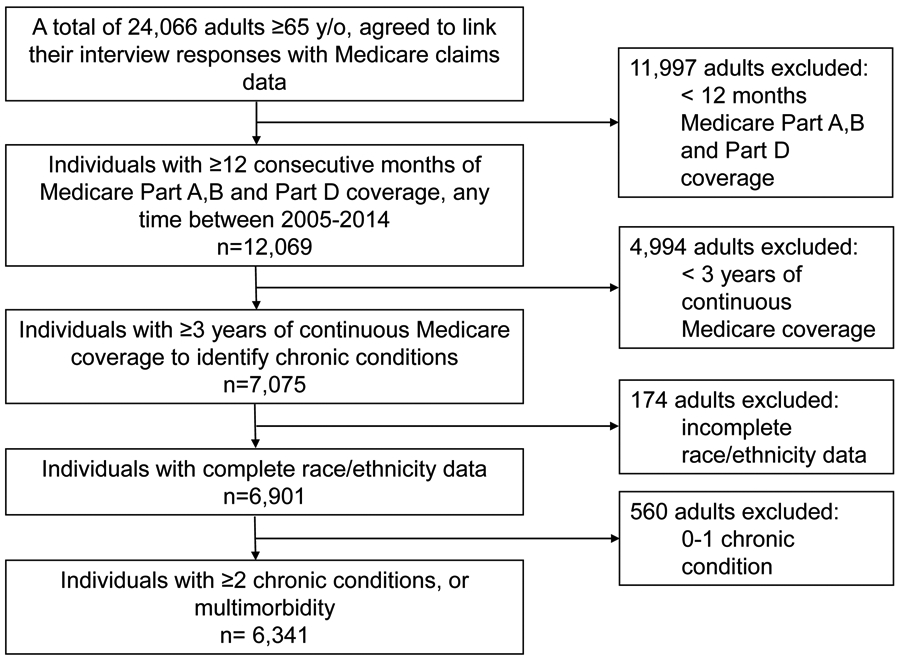
Six thousand three-hundred and forty-one HRS participants aged 65 and older with two and more chronic conditions.
PIM events were calculated using 2015 American Geriatrics Society Beers Criteria. Multimorbidity patterns included: "cardiovascular-metabolic only," "cardiovascular-metabolic plus other physical conditions," "cardiovascular-metabolic plus mental conditions," and "no cardiovascular-metabolic disease" patterns. Logistic regression models were used to determine the association between PIM and sex, including interaction between sex and multimorbidity categories in the model, for PIM overall and for each PIM drug class.
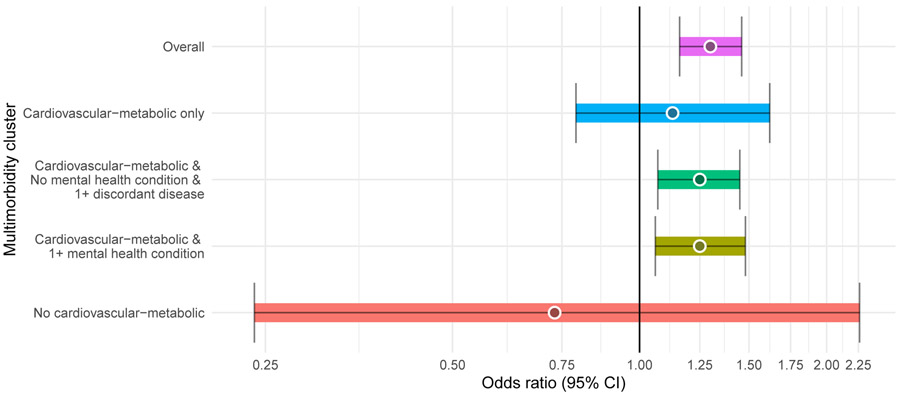
Women were prescribed PIMs more often than men (39.4% vs 32.8%). Overall, women had increased odds of PIM (Adj. odds ratio [OR] = 1.30, 95% confidence interval [CI]: 1.16-1.46). Women had higher odds of PIM than men with cardiovascular-metabolic plus physical patterns (Adj. OR = 1.25, 95% CI: 1.07-1.45) and cardiovascular-metabolic plus mental patterns (Adj. OR = 1.25, 95% CI: 1.06-1.48), and there were no sex differences in adults with a cardiovascular-metabolic only patterns (Adj. OR = 1.13, 95% CI: 0.79-1.62). Women had greater odds of being prescribed the following PIMs: anticholinergics, antidepressants, antispasmodics, benzodiazepines, skeletal muscle relaxants, and had lower odds of being prescribed pain drugs and sulfonylureas compared with men.
This study evaluated sex differences in PIM prescribing among adults with complex cardiovascular-metabolic multimorbidity patterns. The effect of sex varied across multimorbidity patterns and by different PIM drug classes. This study identified important opportunities for future interventions to improve medication prescribing among older adults at risk for PIM.
背景/目的:对于各种多种合并症模式下潜在不适当药物(PIMs)的处方,性别差异的相关知识有限。本研究旨在确定心血管代谢模式中老年患者 PIM 处方的性别差异。
回顾性队列研究。
健康与退休研究(HRS)2004-2014 年访谈数据,与 HRS-医疗保险索赔数据相关联,每年为 2005-2014 年进行汇总。
HRS 共有 6341 名年龄在 65 岁及以上、患有两种及以上慢性疾病的参与者。
使用 2015 年美国老年医学会 Beers 标准计算 PIM 事件。多种合并症模式包括:“心血管代谢仅”、“心血管代谢加其他身体状况”、“心血管代谢加精神状况”和“无心血管代谢疾病”模式。使用逻辑回归模型确定 PIM 与性别之间的关联,包括模型中性别与多种合并症类别的相互作用,用于整体 PIM 和每种 PIM 药物类别。
与男性相比,女性更常被开具 PIM(39.4% vs 32.8%)。总体而言,女性发生 PIM 的可能性更高(调整后的优势比 [OR] = 1.30,95%置信区间 [CI]:1.16-1.46)。与心血管代谢加物理模式(调整后的 OR = 1.25,95%CI:1.07-1.45)和心血管代谢加精神模式(调整后的 OR = 1.25,95%CI:1.06-1.48)相比,女性发生 PIM 的可能性高于男性,而在仅心血管代谢模式的成年人中,性别差异无统计学意义(调整后的 OR = 1.13,95%CI:0.79-1.62)。与男性相比,女性开具抗胆碱能药物、抗抑郁药、抗痉挛药、苯二氮䓬类药物和骨骼肌松弛剂的可能性更高,而开具止痛药和磺酰脲类药物的可能性更低。
本研究评估了在患有复杂心血管代谢多种合并症模式的成年人中 PIM 处方的性别差异。性别的影响因多种合并症模式而异,也因不同的 PIM 药物类别而异。本研究确定了未来干预措施的重要机会,以改善有 PIM 风险的老年患者的药物处方。