Department of Radiation Oncology, Rutgers Cancer Institute of New Jersey, Rutgers Robert Wood Johnson Medical School, Rutgers University, New Brunswick, NJ, USA.
Department of Biostatistics, School of Public Health, Rutgers University, Piscataway, NJ, USA.
Cancer Med. 2021 Jun;10(11):3575-3583. doi: 10.1002/cam4.3909. Epub 2021 May 7.
Increased risk of a second primary malignancy (SPM) before or after diagnosis of anal squamous cell carcinoma (ASCC) has been reported in a previous single-institution study. We hypothesize that patients diagnosed with ASCC are at increased risk for developing SPMs before or after the diagnosis of ASCC. The primary objective of this study was to identify the diagnoses of cancer most likely to occur as SPMs before or after ASCC.
This work employs the Surveillance, Epidemiology, and End Results (SEER) Program registry data to conduct a US-population-based study of patients diagnosed with ASCC between 1975 and 2016. In patients diagnosed with ASCC, we evaluated the risk of SPMs and the risk of developing ASCC as an SPM after another cancer using standardized incidence ratios (SIR) for all SPMs by calculating the ratio of observed events in the ASCC cohort compared to expected (O/E) events in a matched reference cohort of the general population.
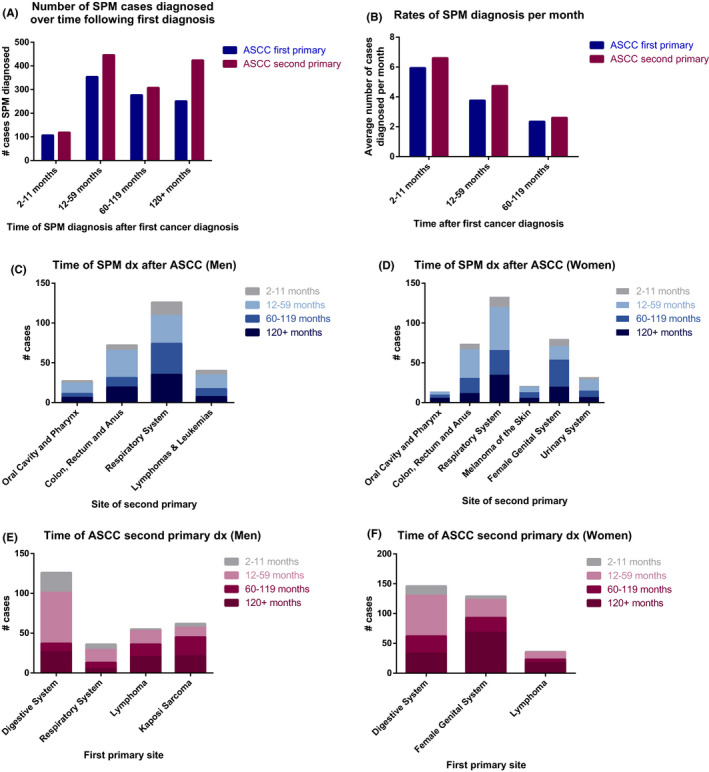
A total of 7,594 patients with primary ASCC were included. Patients with ASCC were at increased risk of the diagnosis of an SPM (SIR = 1.45), particularly cancers of the lung, vulva, oropharynx, or colon. Patients with ASCC had an increased rate of previous malignancy (SIR = 1.23), especially Kaposi sarcoma or vulvar cancer. Overall elevated incidence of SPMs was unrelated to prior radiation treatment. Radiation treatment was associated with increased risk for SPMs in the female genital system but appeared protective against prostate cancer as SPMs.
Our findings support increased surveillance and screening for second malignancies in patients with these diagnoses, as patients with ASCC are often either survivors of a prior cancer diagnosis or are at increased risk of developing later malignancies.
在之前的单中心研究中,曾报道过肛门鳞状细胞癌(ASCC)诊断前后发生第二原发恶性肿瘤(SPM)的风险增加。我们假设,诊断为 ASCC 的患者在诊断为 ASCC 之前或之后发生 SPM 的风险增加。本研究的主要目的是确定最有可能在 ASCC 之前或之后发生 SPM 的癌症诊断。
本研究利用监测、流行病学和最终结果(SEER)计划登记数据,对 1975 年至 2016 年间诊断为 ASCC 的患者进行了一项基于美国人群的研究。在诊断为 ASCC 的患者中,我们通过计算 ASCC 队列中观察到的事件与一般人群匹配参考队列中预期(O/E)事件的比值,评估 SPM 的风险以及在另一种癌症后发生 ASCC 作为 SPM 的风险,从而评估 SPM 的风险。
共纳入 7594 例原发性 ASCC 患者。ASCC 患者发生 SPM 的风险增加(SIR=1.45),尤其是肺癌、外阴、口咽或结肠癌。ASCC 患者先前恶性肿瘤的发生率升高(SIR=1.23),尤其是卡波西肉瘤或外阴癌。总体上 SPM 发生率升高与先前的放射治疗无关。放射治疗与女性生殖系统 SPM 的风险增加相关,但似乎可预防前列腺癌作为 SPM。
我们的研究结果支持对这些诊断患者进行第二恶性肿瘤的监测和筛查,因为 ASCC 患者通常是先前癌症诊断的幸存者,或者发生晚期恶性肿瘤的风险增加。