Department of Psychological Medicine, Division of Academic Psychiatry, Institute of Psychiatry, Psychology & Neuroscience, King's College London, London, UK; CIBER Epidemiology and Public Health, Madrid, Spain.
CIBER Epidemiology and Public Health, Madrid, Spain; Health Services Research Group, Hospital del Mar Medical Research Institute, Barcelona, Spain.
Lancet Public Health. 2021 Oct;6(10):e729-e738. doi: 10.1016/S2468-2667(21)00047-5. Epub 2021 May 4.
We aimed to estimate the prevalence of current depressive disorder in 27 European countries, and to explore differences in prevalence between European countries and by gender.
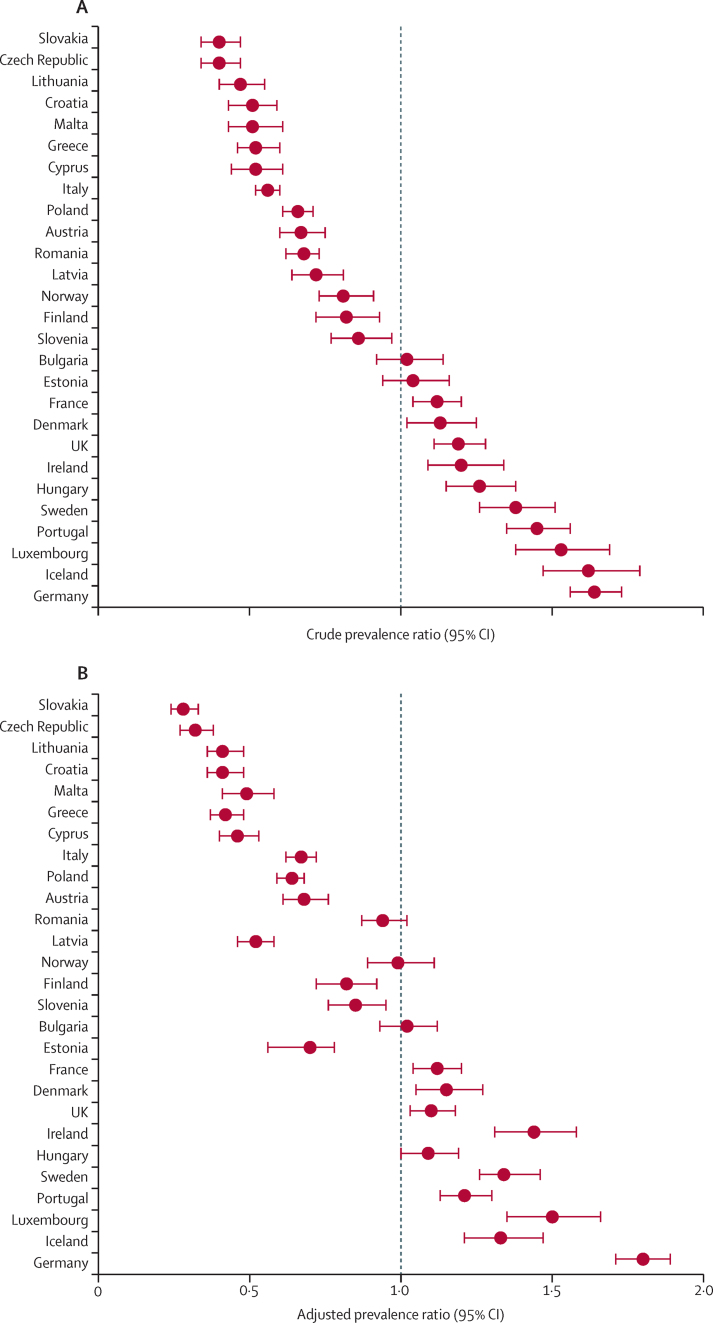
In this population-based study, we analysed data from respondents living in 27 European countries who were included in the second wave of the European Health Interview Survey, collected between 2013 and 2015. We assessed the prevalence of current depressive disorder using the eight-item Patient Health Questionnaire (PHQ-8), with depressive disorder defined as a PHQ-8 score of 10 or higher. Prevalence estimates and 95% CIs were calculated for all 27 countries overall and for each country individually. We assessed variation in prevalence (country vs the rest of Europe) using crude and adjusted prevalence ratios obtained from negative binomial regression models. We did all analyses for the total sample and stratified by gender.
Our analysis sample comprised 258 888 individuals, of whom 117 310 (weighted proportion 47·8%) were men and 141 578 (52·2%) were women. The overall prevalence of current depressive disorder was 6·38% (95% CI 6·24-6·52) with important variation across countries, ranging from 2·58% (2·14-3·02) in the Czech Republic to 10·33% (9·33-11·32) in Iceland. Prevalence was higher in women (7·74% [7·53-7·95]) than in men (4·89% [4·71-5·08]), with clear gender differences for all countries except Finland and Croatia. Compared with the other European countries in our sample, those with the highest adjusted prevalence ratios were Germany (1·80 [1·71-1·89]) and Luxembourg (1·50 [1·35-1·66]), and those with the lowest adjusted prevalence ratios were Slovakia (0·28 [0·24-0·33]) and the Czech Republic (0·32 [0·27-0·38]).
Depressive disorders, although common across Europe, vary substantially in prevalence between countries. These results could be a baseline for monitoring the prevalence of current depressive disorder both at a country level in Europe and for planning health-care resources and services.
UK Medical Research Council and CIBER Epidemiology and Public Health (CIBERESP).
本研究旨在评估 27 个欧洲国家目前抑郁症的患病率,并探讨欧洲国家之间及不同性别之间患病率的差异。
本基于人群的研究分析了欧洲健康访谈调查(EHIS)第二波调查中来自 27 个欧洲国家的受访者数据,该调查于 2013 年至 2015 年期间进行。我们使用包含 8 个项目的患者健康问卷(PHQ-8)来评估当前抑郁症的患病率,PHQ-8 评分≥10 定义为患有抑郁症。我们计算了所有 27 个国家的总体患病率和每个国家的个体患病率,并计算了 95%可信区间。我们使用来自负二项回归模型的未调整和调整后患病率比评估了患病率(国家与欧洲其他地区)的差异。我们对总样本和按性别分层的样本进行了所有分析。
我们的分析样本包括 258888 人,其中 117310 人(加权比例 47.8%)为男性,141578 人(52.2%)为女性。目前抑郁症的总体患病率为 6.38%(95%CI 6.24-6.52),各国之间存在显著差异,从捷克共和国的 2.58%(2.14-3.02)到冰岛的 10.33%(9.33-11.32)。女性(7.74%[7.53-7.95])的患病率高于男性(4.89%[4.71-5.08]),除芬兰和克罗地亚外,所有国家均存在明显的性别差异。与我们样本中的其他欧洲国家相比,德国(1.80[1.71-1.89])和卢森堡(1.50[1.35-1.66])的调整后患病率比值最高,而斯洛伐克(0.28[0.24-0.33])和捷克共和国(0.32[0.27-0.38])的调整后患病率比值最低。
尽管抑郁症在整个欧洲都很常见,但各国之间的患病率存在很大差异。这些结果可能是监测欧洲各国当前抑郁症患病率的基线,也可以为规划卫生保健资源和服务提供参考。
英国医学研究理事会和 CIBER 流行病学和公共卫生(CIBERESP)。