Department of Rheumatology and Clinical Immunology, Chinese Academy of Medical Sciences & Peking Union Medical College, Beijing, China.
National Clinical Research Center for Dermatologic and Immunologic Diseases, Ministry of Science & Technology, Beijing, China.
Arthritis Res Ther. 2021 May 8;23(1):138. doi: 10.1186/s13075-021-02515-w.
Several studies suggested that thrombotic and obstetric antiphospholipid syndromes could be independent identities, but few have systematically compared their clinical characteristics and prognosis.
The objective of this study is to identify key differences between thrombotic APS (tAPS) and obstetric APS (oAPS).
This single-center, prospective study included consecutive patients with primary antiphospholipid syndrome (APS) receiving treatment at the Peking Union Medical College Hospital during a period from 2013 to 2020.
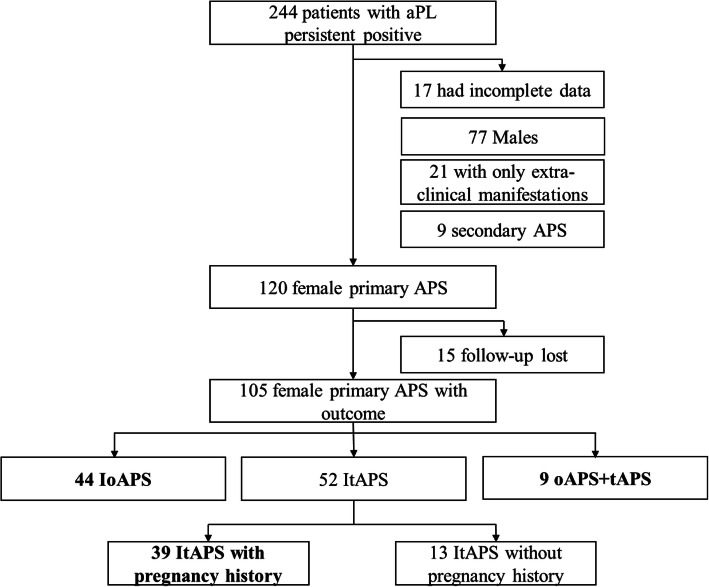
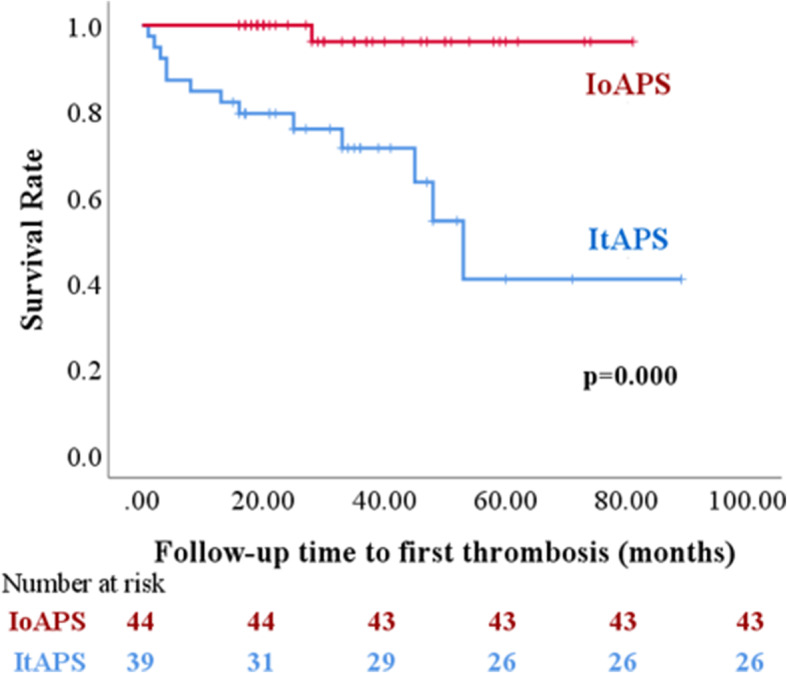
Screening of the database yielded a total of 244 women with positive antiphospholipid antibody (aPL). Among the 105 women with primary APS, 39 (37.14%) had isolated tAPS (ItAPS), 44 (41.90%) had isolated oAPS (IoAPS), and 9 (8.57%) had both tAPS and tAPS+oAPS. In comparison to those with IoAPS, patients with ItAPS had older age (41.92 ± 11.97 vs. 33.16 ± 4.22 years, P < 0.01), higher rate of cardiovascular risk (at least one positive of coronary heart disease, hypertension, obesity, diabetes, and hyperlipidemia) (41.03% vs. 6.82%, P < 0.01), and higher frequency of thrombocytopenia (43.59% vs. 20.45%, P < 0.05). Antibody profiles were generally similar among the groups, but isolated anti-β2GPI positivity was more common in patients with IoAPS (52.27% vs. 17.94% for ItAPS, P = 0.01). Triple aPL positivity was more common in patients with both tAPS and oAPS (66.67% vs. 46.15% for ItAPS vs. 25% for IoAPS, P = 0.022). Blood homocysteine was higher in patients with ItAPS (11.20 vs. 9.90 μmol/L for IoAPS, P < 0.05), but there were no differences in inflammatory markers or complements. Recurrence rate of thrombosis was higher in patients with ItAPS (33.33% vs. 2.27% for IoAPS, P ≤ 0.001) with a mean follow-up of 61 months.
Despite generally similar antibody and biochemical profiles, patients with ItAPS had much higher risk of recurrent thrombosis than IoAPS, supporting distinct mechanisms of pathogenesis.
多项研究表明血栓性和产科抗磷脂综合征可能是独立的实体,但很少有研究系统地比较它们的临床特征和预后。
本研究旨在确定血栓性抗磷脂综合征(tAPS)和产科抗磷脂综合征(oAPS)之间的关键差异。
这是一项单中心、前瞻性研究,纳入了 2013 年至 2020 年期间在北京协和医院接受治疗的原发性抗磷脂综合征(APS)患者。
数据库筛查共纳入 244 例抗磷脂抗体(aPL)阳性的女性。在 105 例原发性 APS 患者中,39 例(37.14%)为孤立性 tAPS(ItAPS),44 例(41.90%)为孤立性 oAPS(IoAPS),9 例(8.57%)为 tAPS 和 tAPS+oAPS 均阳性。与 IoAPS 患者相比,ItAPS 患者年龄更大(41.92±11.97 岁比 33.16±4.22 岁,P<0.01),心血管疾病风险更高(至少有一种阳性的冠心病、高血压、肥胖、糖尿病和高脂血症)(41.03%比 6.82%,P<0.01),血小板减少症发生率更高(43.59%比 20.45%,P<0.05)。各组抗体谱一般相似,但 IoAPS 患者中孤立性抗β2GPI 阳性更为常见(52.27%比 ItAPS 患者的 17.94%,P=0.01)。tAPS 和 oAPS 均阳性的患者三重 aPL 阳性更为常见(66.67%比 ItAPS 患者的 46.15%比 IoAPS 患者的 25%,P=0.022)。ItAPS 患者的血同型半胱氨酸水平较高(11.20μmol/L 比 IoAPS 患者的 9.90μmol/L,P<0.05),但炎症标志物和补体无差异。ItAPS 患者血栓复发率较高(33.33%比 IoAPS 患者的 2.27%,P≤0.001),平均随访时间为 61 个月。
尽管抗体和生化特征一般相似,但 ItAPS 患者血栓复发风险明显高于 IoAPS 患者,支持发病机制不同。