Department of Pediatrics, 70402Faculty of Kinesiology, University of Calgary, Calgary, Alberta, Canada.
Department of Pediatrics, Neurosciences Program, Alberta Children's Hospital, Calgary, Alberta, Canada.
J Child Neurol. 2021 Sep;36(10):867-874. doi: 10.1177/08830738211002946. Epub 2021 May 8.
The long-term consequences of pediatric concussion on brain structure are poorly understood. This study aimed to evaluate the presence and clinical significance of cerebral microbleeds several years after pediatric concussion.
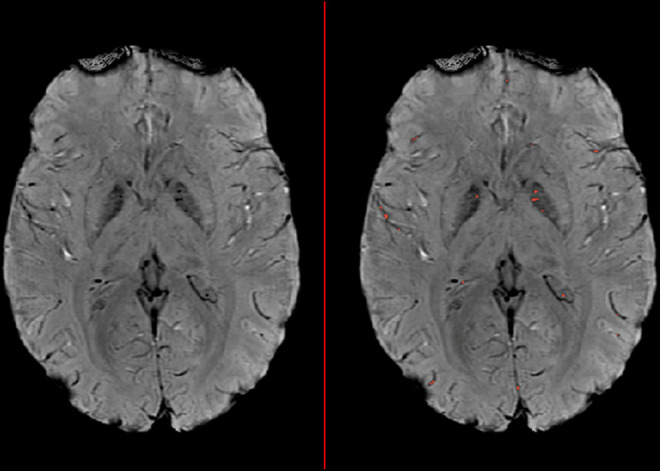
Children and adolescents 8-19 years of age with either a history of concussion (n = 35), or orthopedic injury (n = 20) participated. Mean time since injury for the sample was 30.4 months (SD = 19.6). Participants underwent susceptibility-weighted imaging, rated their depression and postconcussion symptoms, and completed cognitive testing. Parents of participants also completed symptom ratings for their child. Hypointensities in susceptibility-weighted images indicative of cerebral microbleeds were calculated as a measure of hypointensity burden.
Hypointensity burden did not differ significantly between participants with a history of concussion and those with a history of orthopedic injury. Depression ratings (self and parent report), postconcussion symptom ratings (self and parent report), and cognitive performance did not significantly correlate with hypointensity burden in the concussion group.
These findings suggest that at approximately 2.5 years postinjury, children and adolescents with prior concussion do not have a greater amount of cerebral microbleeds compared to those with orthopedic injury. Future research should use longitudinal study designs and investigate children with persistent postconcussive symptoms to gain better insight into the long-term effects of concussion on cerebral microbleeds.
小儿脑震荡后对大脑结构的长期影响知之甚少。本研究旨在评估小儿脑震荡后数年是否存在脑微出血,并探讨其临床意义。
本研究纳入了 8-19 岁的儿童和青少年,分为脑震荡组(n=35)和骨科损伤组(n=20)。样本的平均损伤后时间为 30.4 个月(SD=19.6)。所有参与者均接受了磁敏感加权成像检查,同时评估抑郁和脑震荡后症状,并完成认知测试。参与者的家长也对其孩子的症状进行了评分。磁敏感加权图像中的低信号强度提示脑微出血,可作为低信号强度负担的衡量指标。
脑震荡组和骨科损伤组的低信号强度负担无显著差异。脑震荡组中,抑郁评分(自我报告和家长报告)、脑震荡后症状评分(自我报告和家长报告)和认知表现与低信号强度负担无显著相关性。
这些发现表明,在损伤后约 2.5 年,与骨科损伤相比,既往有脑震荡的儿童和青少年脑微出血的数量并未增加。未来的研究应采用纵向研究设计,并调查持续存在脑震荡后症状的儿童,以更好地了解脑震荡对脑微出血的长期影响。