Jeong Jisu, Kim Jiyeon
Department of Medical Laboratory Science, School of Health Science, Dankook University, Cheonan, Korea.
Front Pharmacol. 2021 Mar 24;12:639095. doi: 10.3389/fphar.2021.639095. eCollection 2021.
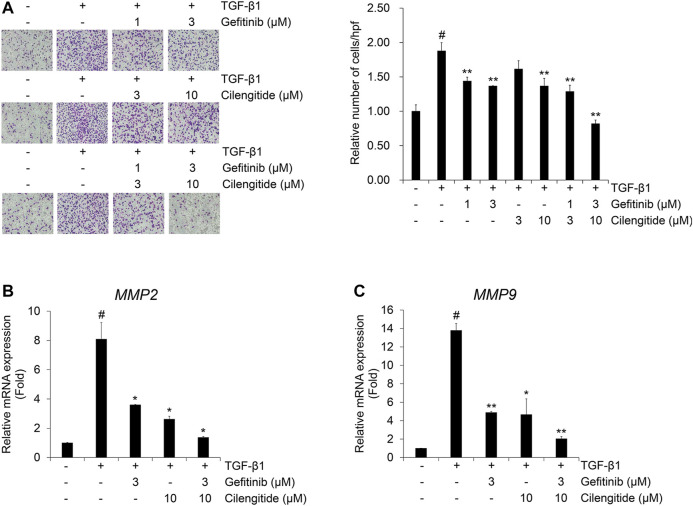
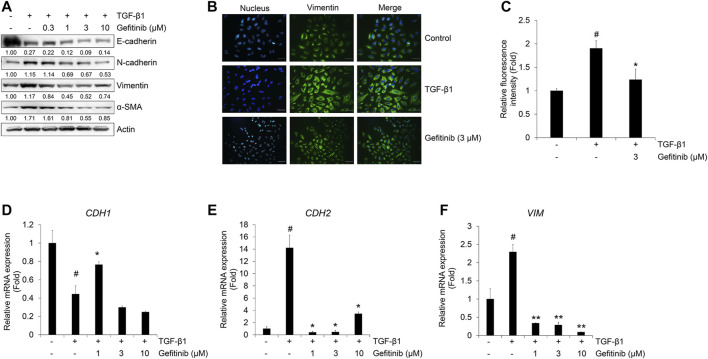
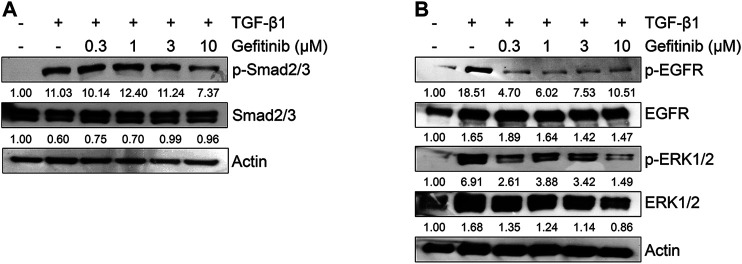
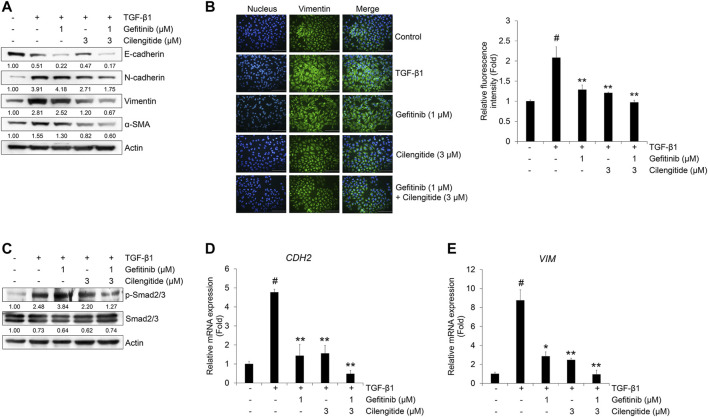
During non-small cell lung cancer (NSCLC) progression, transforming growth factor (TGF)-β mediated epithelial-to-mesenchymal transition (EMT) is an important process leading to high mortality and poor prognosis. The EMT is a fundamental process for morphogenesis characterized by the transformation of cancer cells into invasive forms that can be transferred to other organs during human lung cancer progression. Gefitinib, an epidermal growth factor receptor (EGFR) inhibitor, has shown anti-proliferative effects in EGFR-mutated NSCLC cells and an inhibitory effect on migration and invasion of NSCLC cells to other organs. In this study, we evaluated the combinatorial treatment effect of cilengitide, a cyclic RGD pentapeptide, on TGF-β1-induced EMT phenotype and invasion. Gefitinib suppressed the expression of TGF-β1-induced mesenchymal markers by inhibiting Smad and non-Smad signaling pathways. Cilengitide enhanced the inhibitory effect of gefitinib on TGF-β1-induced expression of mesenchymal markers, phosphorylation of Smad2/3, and invasion of NSCLC A549 cells. We suggested that the use of cilengitide can improve the efficacy of anti-cancer drugs in combination drug-based chemotherapy. These results provide an improved therapeutic strategy for treating and preventing EMT-related disorders, such as NSCLC, lung fibrosis, cancer metastasis, and relapse.
在非小细胞肺癌(NSCLC)进展过程中,转化生长因子(TGF)-β介导的上皮-间质转化(EMT)是导致高死亡率和不良预后的重要过程。EMT是形态发生的一个基本过程,其特征是癌细胞转化为侵袭性形式,在人类肺癌进展过程中可转移至其他器官。吉非替尼是一种表皮生长因子受体(EGFR)抑制剂,已显示出对EGFR突变的NSCLC细胞具有抗增殖作用,并对NSCLC细胞向其他器官的迁移和侵袭具有抑制作用。在本研究中,我们评估了环RGD五肽西仑吉肽对TGF-β1诱导的EMT表型和侵袭的联合治疗效果。吉非替尼通过抑制Smad和非Smad信号通路来抑制TGF-β1诱导的间充质标志物的表达。西仑吉肽增强了吉非替尼对TGF-β1诱导的间充质标志物表达、Smad2/3磷酸化以及NSCLC A549细胞侵袭的抑制作用。我们认为使用西仑吉肽可以提高基于联合药物化疗的抗癌药物疗效。这些结果为治疗和预防与EMT相关的疾病,如NSCLC、肺纤维化、癌症转移和复发,提供了一种改进的治疗策略。