Jiang Wenhong, Zhang Zhanman, Li Yaodong, Chen Chuanzhen, Yang Han, Lin Qiuning, Hu Ming, Qin Xiao
Department of Vascular Surgery, The First Affiliated Hospital of Guangxi Medical University, Nanning, China.
Front Cardiovasc Med. 2021 Apr 23;8:639740. doi: 10.3389/fcvm.2021.639740. eCollection 2021.
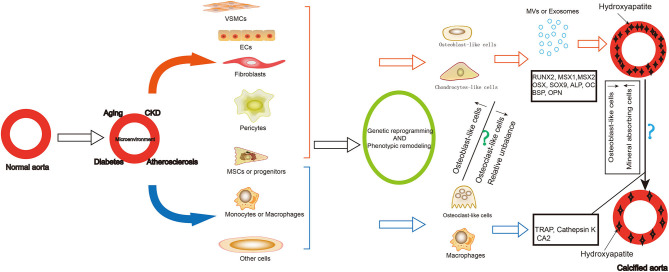
Arterial calcification refers to the abnormal deposition of calcium salts in the arterial wall, which results in vessel lumen stenosis and vascular remodeling. Studies increasingly show that arterial calcification is a cell mediated, reversible and active regulated process similar to physiological bone mineralization. The osteoblasts and chondrocytes-like cells are present in large numbers in the calcified lesions, and express osteogenic transcription factor and bone matrix proteins that are known to initiate and promote arterial calcification. In addition, osteoclast-like cells have also been detected in calcified arterial walls wherein they possibly inhibit vascular calcification, similar to the catabolic process of bone mineral resorption. Therefore, tilting the balance between osteoblast-like and osteoclast-like cells to the latter maybe a promising therapeutic strategy against vascular calcification. In this review, we have summarized the current findings on the origin and functions of osteoblast-like and osteoclast-like cells in the development and progression of vascular progression, and explored novel therapeutic possibilities.
动脉钙化是指钙盐在动脉壁的异常沉积,这会导致血管腔狭窄和血管重塑。越来越多的研究表明,动脉钙化是一个细胞介导的、可逆的且受主动调控的过程,类似于生理性骨矿化。成骨细胞和软骨样细胞大量存在于钙化病变中,并表达已知可启动和促进动脉钙化的成骨转录因子和骨基质蛋白。此外,在钙化的动脉壁中也检测到了破骨样细胞,它们可能抑制血管钙化,类似于骨矿物质吸收的分解代谢过程。因此,将成骨样细胞和破骨样细胞之间的平衡向后者倾斜可能是一种有前景的抗血管钙化治疗策略。在这篇综述中,我们总结了目前关于成骨样细胞和破骨样细胞在血管病变发生发展过程中的起源和功能的研究结果,并探索了新的治疗可能性。