Bartolome Fernando, Orive Gorka, Carro Eva
Network Center for Biomedical Research in Neurodegenerative Diseases (CIBERNED) Cordoba Spain.
Group of Neurodegenerative Diseases Hospital Universitario 12 de Octubre Research Institute (imas12) Madrid Spain.
Alzheimers Dement (Amst). 2021 May 2;13(1):e12173. doi: 10.1002/dad2.12173. eCollection 2021.
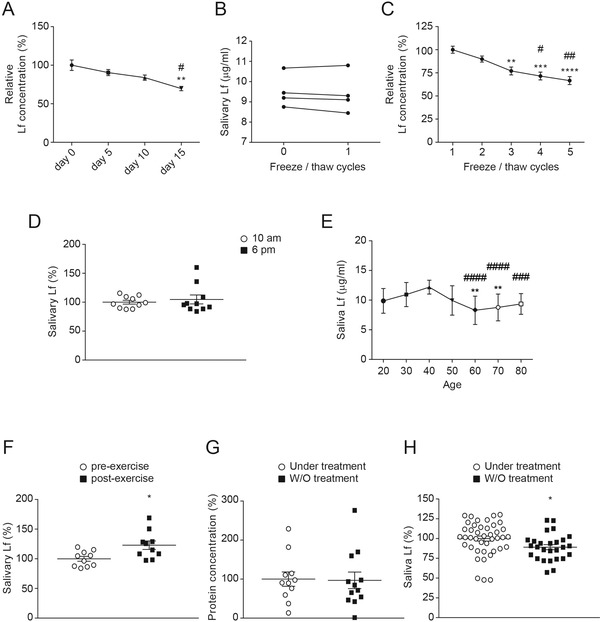
The search for new, robust, and reproducible biomarkers for Alzheimer's disease (AD) diagnosis is a challenge. We recently reported that salivary lactoferrin (Lf) could be presented as new biomarker candidate for AD, being both non-invasive and cost-effective, as well as having appropriate diagnostic performance for the clinical detection of AD subjects. Saliva is an attractive sample type for biomarker-based testing approaches for several other diseases; however, its composition may change under certain circumstances. It is therefore critical to maintain a consistent salivary handling protocol, considering possible extrinsic factors that may influence salivary Lf concentration. In this work, we analyzed salivary Lf concentration under different handling conditions and donor-dependent factors including age, inter-diurnal variations, physical activity, and pharmacological treatments. Our aim was to evaluate the influence of such conditions on salivary Lf concentration. In conclusion, we found that most of these extrinsic factors should be considered in the future when using Lf as a predictive biomarker for AD.
寻找用于阿尔茨海默病(AD)诊断的新型、可靠且可重复的生物标志物是一项挑战。我们最近报告称,唾液乳铁蛋白(Lf)可作为AD的新型生物标志物候选物,它既具有非侵入性和成本效益,又对AD患者的临床检测具有适当的诊断性能。对于其他几种疾病的基于生物标志物的检测方法而言,唾液是一种有吸引力的样本类型;然而,其成分在某些情况下可能会发生变化。因此,考虑到可能影响唾液Lf浓度的外在因素,保持一致的唾液处理方案至关重要。在这项工作中,我们分析了不同处理条件以及包括年龄、日间变化、体育活动和药物治疗在内的供体相关因素下的唾液Lf浓度。我们的目的是评估这些条件对唾液Lf浓度的影响。总之,我们发现未来在将Lf用作AD的预测生物标志物时应考虑大多数这些外在因素。