Unitat Trastorns Cognitius, Clinical Neuroscience Research, Santa Maria University Hospital, Rovira Roure n 44. 25198. IRBLleida, Lleida, Spain.
Faculty of Nursing and Phisiotherapy, Universitat de Lleida, IRBLleida, Lleida, Spain.
BMC Geriatr. 2021 May 10;21(1):302. doi: 10.1186/s12877-021-02230-w.
Alzheimer's disease (AD) is the most frequent cause of cognitive impairment. Community knowledge of the disease has proven to be a very important aspect of the development of interventions and the evaluation of their effectiveness. However, it is necessary to have standardized and recognized tools in different languages. The aim of the current study was to develop a cross-cultural adaptation of the Spanish Dementia Knowledge Assessment Scale (DKAS-S) and to assess their psychometric properties with cohorts of health students and professional and non-professional caregivers of AD patients from several regions of Spain.
We developed and translated the DKAS into Spanish following the forward-back-forward translation procedure. Then, we performed a cross-sectional study to assess the validity, reliability and feasibility of the DKAS-S. We also performed an analysis to obtain test-retest reliability measures. The study was performed in four medical centres across three regions in Spain. From May to September 2019, we administered the scale to students, professional and non-professional caregivers; including a subgroup of non-professional caregivers of patients with early-onset AD (< 65 years).
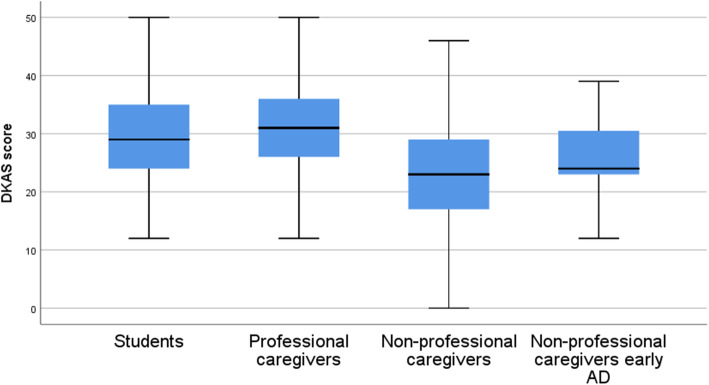
Eight hundred forty-six volunteer participants completed the DKAS-S: 233 students (mean age 26.3 ± 9.2 years), 270 professional caregivers (mean age 42.5 ± 11.7 years) and 343 non-professional caregivers of AD patients. (mean age was 56.4 ± 13.16). The DKAS-S showed good internal consistency (Cronbach's α = 0.819) and good test-retest reliability (time 1: 28.1 ± 8.09 vs time 2: 28.8 ± 7.96; t = - 1.379; p = 0.173). Sensitivity to change was also significant in a subgroup of 31 students who received education related to AD and dementias between each administration (time 1: 25.6 ± 6.03) to (time 2: 32.5 ± 7.12; t = - 5.252, p = 0.000). The validity of the construct was verified by confirmatory factor analysis, although there were challenges in the inclusion of some items in the original 4 factors.
The 25-item DKAS-S showed good psychometric properties for validity and reliability and the factorial analysis when it was administered to a population of students and professional and non-professional caregivers. It was a useful instrument for measuring levels of knowledge about dementia in Spanish population.
阿尔茨海默病(AD)是认知障碍最常见的原因。社区对该疾病的了解已被证明是干预措施发展和评估其有效性的一个非常重要的方面。然而,有必要在不同语言中使用标准化和公认的工具。本研究的目的是开发西班牙痴呆症知识评估量表(DKAS-S)的跨文化适应版本,并使用来自西班牙几个地区的健康学生、专业和非专业 AD 患者护理人员的队列评估其心理测量特性。
我们遵循正向-反向-正向翻译程序开发并翻译了 DKAS 到西班牙语。然后,我们进行了一项横断面研究,以评估 DKAS-S 的有效性、可靠性和可行性。我们还进行了分析以获得测试-重测可靠性测量值。该研究在西班牙三个地区的四个医疗中心进行。2019 年 5 月至 9 月,我们向学生、专业和非专业 AD 患者护理人员(包括一组早期发病 AD(<65 岁)患者的非专业护理人员)施测了该量表。
846 名志愿者完成了 DKAS-S:233 名学生(平均年龄 26.3±9.2 岁)、270 名专业护理人员(平均年龄 42.5±11.7 岁)和 343 名 AD 患者的非专业护理人员(平均年龄为 56.4±13.16 岁)。DKAS-S 显示出良好的内部一致性(Cronbach's α=0.819)和良好的测试-重测可靠性(时间 1:28.1±8.09 与时间 2:28.8±7.96;t=-1.379;p=0.173)。在一组 31 名学生中,接受 AD 和痴呆相关教育后,变化的敏感性也很显著,他们在每次施测之间(时间 1:25.6±6.03)至(时间 2:32.5±7.12;t=-5.252,p=0.000)。通过验证性因子分析验证了该结构的有效性,尽管在将一些项目纳入原 4 个因子时存在挑战。
当 DKAS-S 被施测于学生、专业和非专业护理人员群体时,25 项 DKAS-S 表现出良好的有效性和可靠性的心理测量特性,且因子分析也得到了验证。它是一种有用的工具,可以衡量西班牙人群对痴呆症知识的水平。