Department of Orthopaedic Surgery, Inje University Ilsan Paik Hospital, 170, Juhwa-ro, Ilsanseo-gu, Gyeonggi-do, Goyang-si, 10380, Republic of Korea.
Department of Orthopaedic Surgery, Korea University Guro Hospital, 148, Gurodong-ro, Guro-gu, Seoul, 08308, Republic of Korea.
BMC Musculoskelet Disord. 2021 May 10;22(1):430. doi: 10.1186/s12891-021-04300-x.
Few studies have reported the clinical outcomes of the medial reefing procedure and lateral release with arthroscopic control of medial retinacular tension in patients with recurrent patellar dislocation. The purpose of this study was to investigate the clinical, radiologic outcomes and complications of arthroscopy-controlled medial reefing and lateral release.
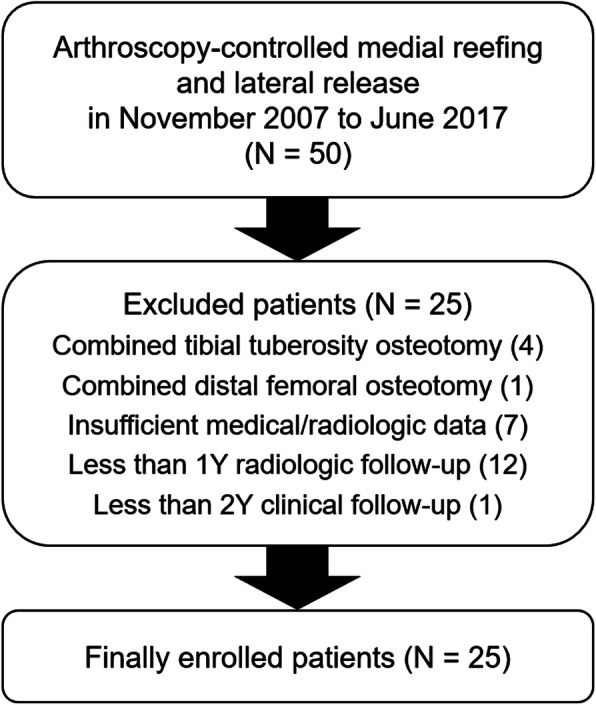
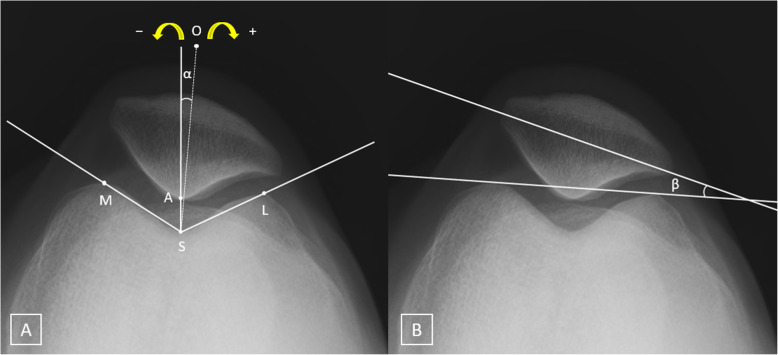
Patients who underwent arthroscopy-controlled medial reefing and lateral release for recurrent patellar dislocation between November 2007 and June 2017 were retrospectively evaluated. The clinical outcome (Kujala score), radiologic outcome (congruence and patellar tilt angles), and complications were evaluated at final follow-up. The results were also compared with literature-reported outcomes of other surgical procedures for patellar dislocation.
Twenty-five patients (mean age, 18.3 ± 4.8 years) were included in the study. The mean clinical follow-up period was 7.0 ± 2.5 (range, 3.8-12.2) years. The mean Kujala score was significantly improved from 54.7 ± 14.0 (range, 37-86) preoperatively to 91.0 ± 7.6 (range, 63-99) at a mean follow-up period of 7 years (P < 0.001). The radiologic results also significantly improved from 17.8° ± 5.9° to 6.8° ± 2.4° (P < 0.001) in the congruence angle and from 17.5° ± 8.2° to 5.6° ± 3.1° (P < 0.001) in the patella tilt angle at a mean follow-up period of 3.6 years. One patient developed a redislocation after a traumatic event, and two patients showed patellofemoral osteoarthritis progression.
Arthroscopy-controlled medial reefing and lateral release significantly improved the clinical and radiologic outcomes of the patients with recurrent patellar dislocation at a mean follow-up period of 7 years. The results of this study are comparable with the literature-reported outcomes of other surgical procedures for patellar dislocation.
Level IV, retrospective therapeutic case series.
鲜有研究报道过内侧紧缩术联合关节镜下外侧松解术治疗复发性髌骨脱位的临床效果,且该手术对内侧支持带张力的控制尚不明确。本研究旨在探讨关节镜控制下内侧紧缩术联合外侧松解术的临床、影像学效果及并发症。
回顾性分析 2007 年 11 月至 2017 年 6 月期间行关节镜控制下内侧紧缩术联合外侧松解术治疗复发性髌骨脱位的患者。末次随访时评估临床结果(Kujala 评分)、影像学结果(髌骨吻合角和倾斜角)及并发症。并将结果与其他髌骨脱位手术的文献报道结果进行比较。
本研究共纳入 25 例患者(平均年龄 18.3±4.8 岁)。平均临床随访时间为 7.0±2.5(3.8-12.2)年。Kujala 评分从术前的 54.7±14.0(37-86)分显著提高至 7 年时的 91.0±7.6(63-99)分(P<0.001)。影像学结果也从 17.8°±5.9°显著改善至 3.6 年时的 6.8°±2.4°(P<0.001),从 17.5°±8.2°显著改善至 5.6°±3.1°(P<0.001)。平均随访 7 年后,髌骨吻合角和倾斜角均有显著改善。1 例患者在创伤后复发,2 例患者出现髌股关节炎进展。
关节镜控制下内侧紧缩术联合外侧松解术可显著改善复发性髌骨脱位患者的临床和影像学结果,平均随访 7 年后效果良好。本研究结果与其他髌骨脱位手术的文献报道结果相当。
IV 级,回顾性治疗病例系列研究。