Davidson M K, Lindsey J R, Parker R F, Tully J G, Cassell G H
Department of Comparative Medicine, University of Alabama, Birmingham.
Infect Immun. 1988 Aug;56(8):2156-62. doi: 10.1128/iai.56.8.2156-2162.1988.
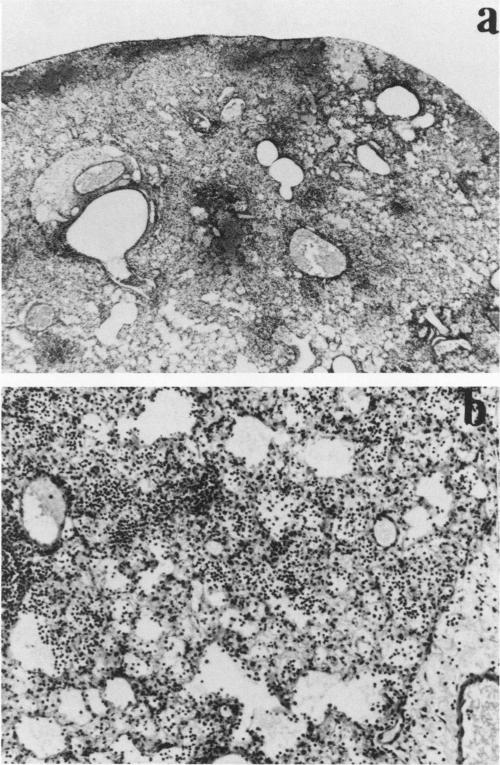
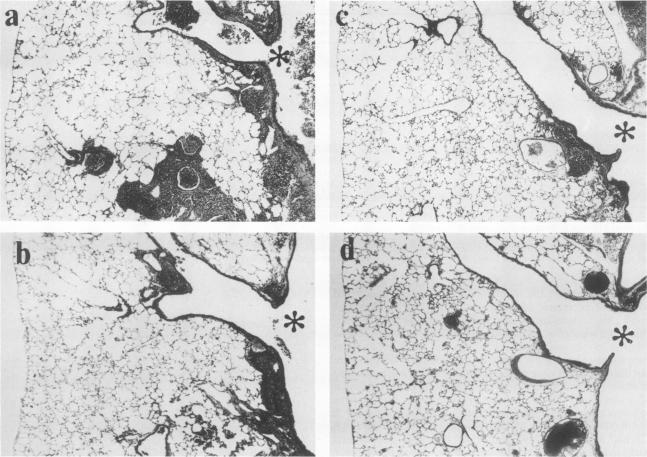
The mouse model of acute murine respiratory mycoplasmosis was used to screen 18 strains of Mycoplasma pulmonis for their ability to establish respiratory infections and produce gross lung lesions in the susceptible C3H/HeN mouse strain. All experiments were designed to minimize host, environmental, and microbial differences to ensure that experimental results would reflect differences in mycoplasmal virulence. There were differences in the 50% infectious dose (range, 3 X 10(2) to greater than 10(7) CFU) and the 50% gross pneumonia dose (range, 10(3) to greater than 10(7) CFU) among the 18 mycoplasmal strains. Only 10 strains (UAB CT, M1, UAB 5782C, UAB 6510, 66, UAB T, UAB 8145D, Nelson C, Peter C, and Negroni) established respiratory infections, and only 2 of the 10 strains (UAB CT and M1) produced gross lung lesions. Strains UAB CT, UAB T, M1, UAB 5782C, and PG34(ASH) were chosen for qualitative and quantitative evaluation of lung lesions in C3H/HeN and C57BL/6N mice. Lesion incidence and severity was dependent on the mycoplasmal strain and the mouse strain. Microscopic lesions varied among mycoplasmal strains and mouse strains in the amount of lymphoid infiltrate, neutrophilic exudate, and consolidation, as well as overall severity. The most virulent strain, UAB CT, produced acute pneumonitis in the 10(7) CFU dosage group and required a threshold dose of 10(3) CFU to consistently produce microscopic lung lesions. These results suggest that M. pulmonis virulence is multifactorial and different strains of mycoplasmas yield disease expressions that differ both qualitatively and quantitatively.
利用急性鼠呼吸道支原体病小鼠模型,对18株肺支原体菌株进行筛选,以评估它们在易感C3H/HeN小鼠品系中引发呼吸道感染及产生明显肺部病变的能力。所有实验均旨在尽量减少宿主、环境和微生物方面的差异,以确保实验结果能反映支原体毒力的差异。18株支原体菌株的半数感染剂量(范围为3×10²至大于10⁷CFU)和半数严重肺炎剂量(范围为10³至大于10⁷CFU)存在差异。只有10株菌株(UAB CT、M1、UAB 5782C、UAB 6510、66、UAB T、UAB 8145D、Nelson C、Peter C和Negroni)引发了呼吸道感染,其中只有2株(UAB CT和M1)产生了明显的肺部病变。选择UAB CT、UAB T、M1、UAB 5782C和PG34(ASH)菌株,对C3H/HeN和C57BL/6N小鼠的肺部病变进行定性和定量评估。病变发生率和严重程度取决于支原体菌株和小鼠品系。不同支原体菌株和小鼠品系的显微镜下病变在淋巴样浸润、嗜中性粒细胞渗出和实变的数量以及总体严重程度方面存在差异。毒性最强的菌株UAB CT在10⁷CFU剂量组引发了急性肺炎,且需要10³CFU的阈值剂量才能持续产生显微镜下的肺部病变。这些结果表明,肺支原体的毒力是多因素的,不同菌株的支原体产生的疾病表现存在定性和定量的差异。