Zhang Shu, Zhao Sha, Shang Weihao, Yan Zijuan, Wu Xiuyun, Li Yingjie, Chen Guanjun, Liu Xinli, Wang Lushan
State Key Laboratory of Microbial Technology, Institute of Microbial Technology, Shandong University, Qingdao, 266237, Shandong, China.
School of Life Sciences, Shandong University, Qingdao, 266237, Shandong, China.
Biotechnol Biofuels. 2021 May 10;14(1):118. doi: 10.1186/s13068-021-01967-1.
Xylan is the most abundant hemicellulose polysaccharide in nature, which can be converted into high value-added products. However, its recalcitrance to breakdown requires the synergistic action of multiple enzymes. Aspergillus niger, possessing numerous xylan degrading isozyme-encoding genes, are highly effective xylan degraders in xylan-rich habitats. Therefore, it is necessary to explore gene transcription, the mode of action and cooperation mechanism of different xylanase isozymes to further understand the efficient xylan-degradation by A. niger.
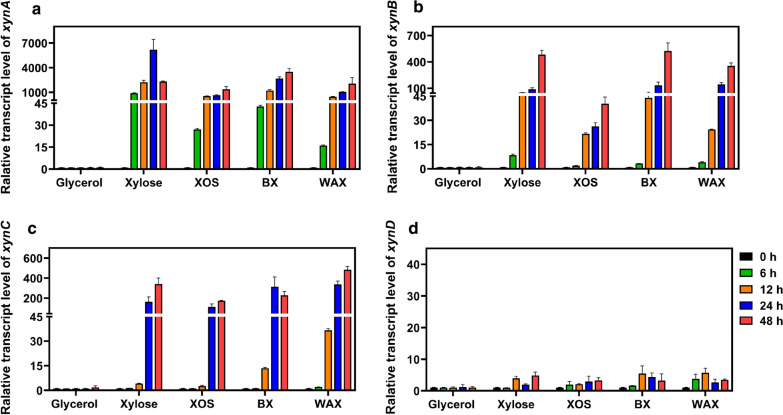
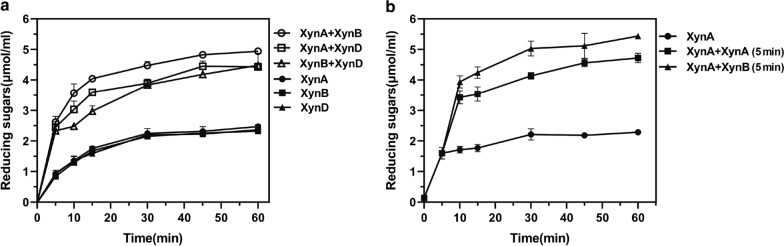
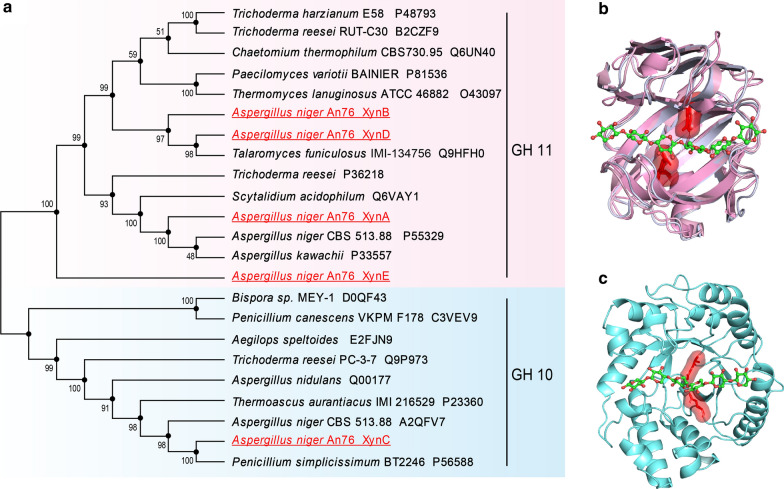
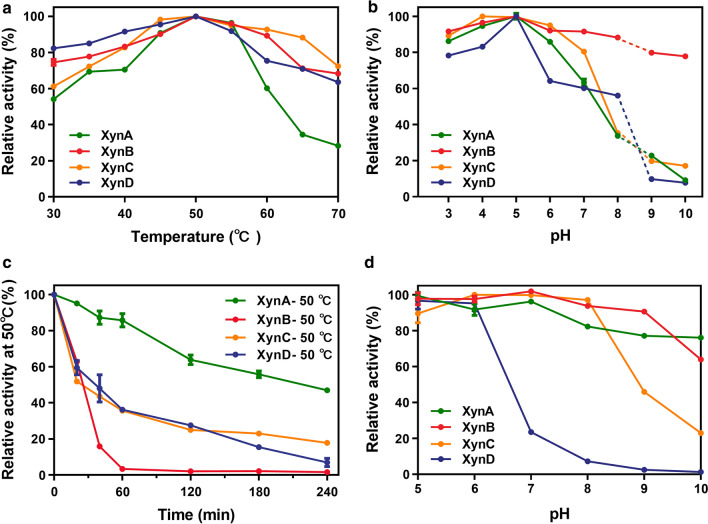
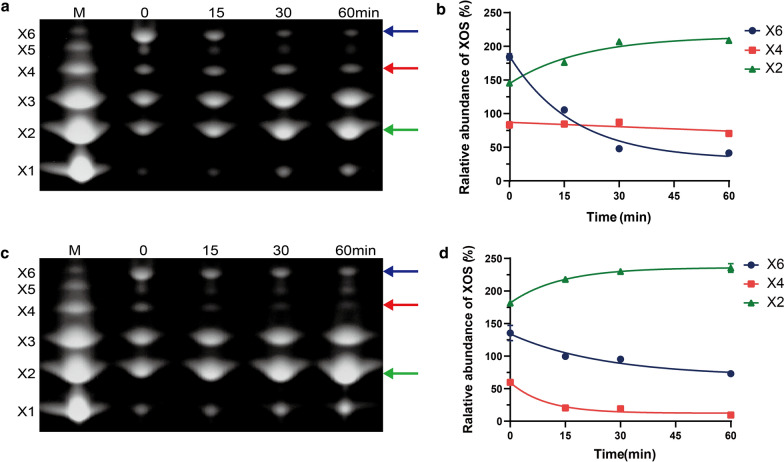
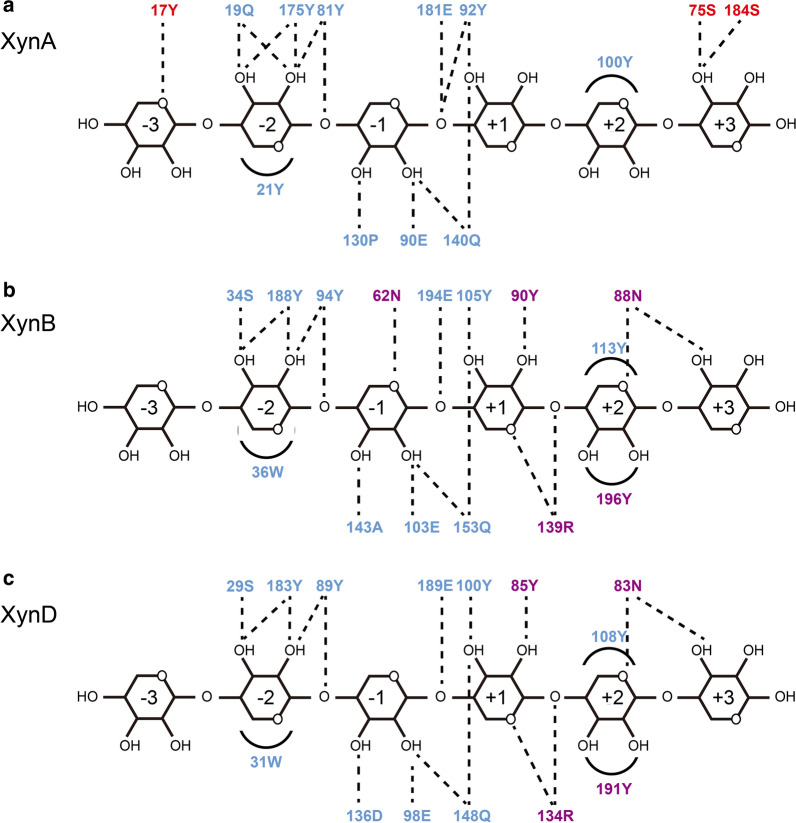
Aspergillus niger An76 encoded a comprehensive set of xylan-degrading enzymes, including five endo-xylanases (one GH10 and four GH11). Quantitative transcriptional analysis showed that three xylanase genes (xynA, xynB and xynC) were up-regulated by xylan substrates, and the order and amount of enzyme secretion differed. Specifically, GH11 xylanases XynA and XynB were initially secreted successively, followed by GH10 xylanase XynC. Biochemical analyses displayed that three GH11 xylanases (XynA, XynB and XynD) showed differences in catalytic performance and product profiles, possibly because of intricate hydrogen bonding between substrates and functional residues in the active site architectures impacted their binding capacity. Among these, XynB had the best performance in the degradation of xylan and XynE had no catalytic activity. Furthermore, XynA and XynB showed synergistic effects during xylan degradation.
The sequential secretion and different action modes of GH11 xylanases were essential for the efficient xylan degradation by A. niger An76. The elucidation of the degradation mechanisms of these xylanase isozymes further improved our understanding of GH-encoding genes amplification in filamentous fungi and may guide the design of the optimal enzyme cocktails in industrial applications.
木聚糖是自然界中含量最丰富的半纤维素多糖,可转化为高附加值产品。然而,其难以降解的特性需要多种酶的协同作用。黑曲霉拥有众多编码木聚糖降解同工酶的基因,是富含木聚糖生境中高效的木聚糖降解菌。因此,有必要探索不同木聚糖酶同工酶的基因转录、作用方式及协同机制,以进一步了解黑曲霉高效降解木聚糖的过程。
黑曲霉An76编码了一套完整的木聚糖降解酶,包括五种内切木聚糖酶(一种GH10和四种GH11)。定量转录分析表明,三个木聚糖酶基因(xynA、xynB和xynC)在木聚糖底物作用下上调,且酶分泌的顺序和量有所不同。具体而言,GH11木聚糖酶XynA和XynB最初相继分泌,随后是GH10木聚糖酶XynC。生化分析显示,三种GH11木聚糖酶(XynA、XynB和XynD)在催化性能和产物谱方面存在差异,这可能是由于底物与活性位点结构中的功能残基之间复杂的氢键影响了它们的结合能力。其中,XynB在木聚糖降解方面表现最佳,而XynE没有催化活性。此外,XynA和XynB在木聚糖降解过程中表现出协同作用。
GH11木聚糖酶的顺序分泌和不同作用模式对于黑曲霉An76高效降解木聚糖至关重要。对这些木聚糖酶同工酶降解机制的阐明进一步加深了我们对丝状真菌中GH编码基因扩增的理解,并可能指导工业应用中最佳酶混合物的设计。