NeuroCardioMetabol Group, Department of Clinical Science and Education, Södersjukhuset, Internal Medicine, Karolinska Institutet, Stockholm, Sweden.
Translational Neurology Group, Department of Clinical Sciences, Wallenberg Neuroscience Center, Wallenberg Center for Molecular Medicine, Lund University, Lund, Sweden.
Br J Pharmacol. 2022 Feb;179(4):677-694. doi: 10.1111/bph.15524. Epub 2021 Jun 16.
Glucagon-like peptide-1 (GLP-1) receptor activation decreases stroke risk in people with Type 2 diabetes (T2D), while animal studies have shown the efficacy of this strategy to counteract stroke-induced acute brain damage. However, whether GLP-1 receptor activation also improves recovery in the chronic phase after stroke is unknown. We investigated whether post-acute, chronic administration of the GLP-1 receptor agonist, exendin-4, improves post-stroke recovery and examined possible underlying mechanisms in T2D and non-T2D mice.
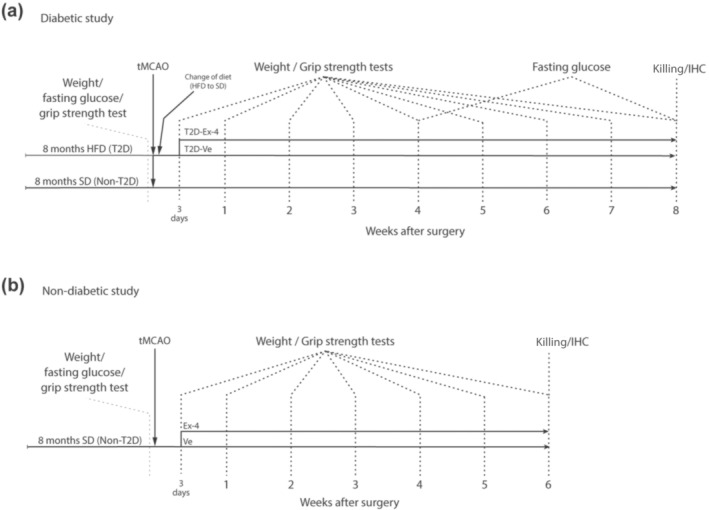
We induced stroke via transient middle cerebral artery occlusion (tMCAO) in T2D/obese mice (8 months of high-fat diet) and age-matched controls. Exendin-4 was administered for 8 weeks from Day 3 post-tMCAO. We assessed functional recovery by weekly upper-limb grip strength tests. Insulin sensitivity and glycaemia were evaluated at 4 and 8 weeks post-tMCAO. Neuronal survival, stroke-induced neurogenesis, neuroinflammation, atrophy of GABAergic parvalbumin+ interneurons, post-stroke vascular remodelling and fibrotic scar formation were investigated by immunohistochemistry.
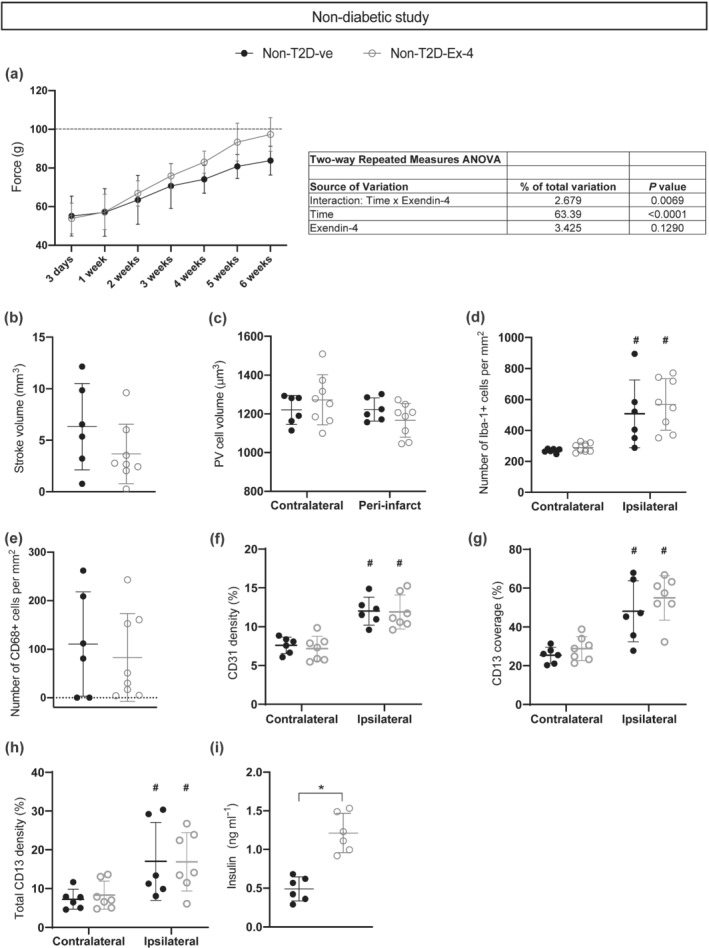
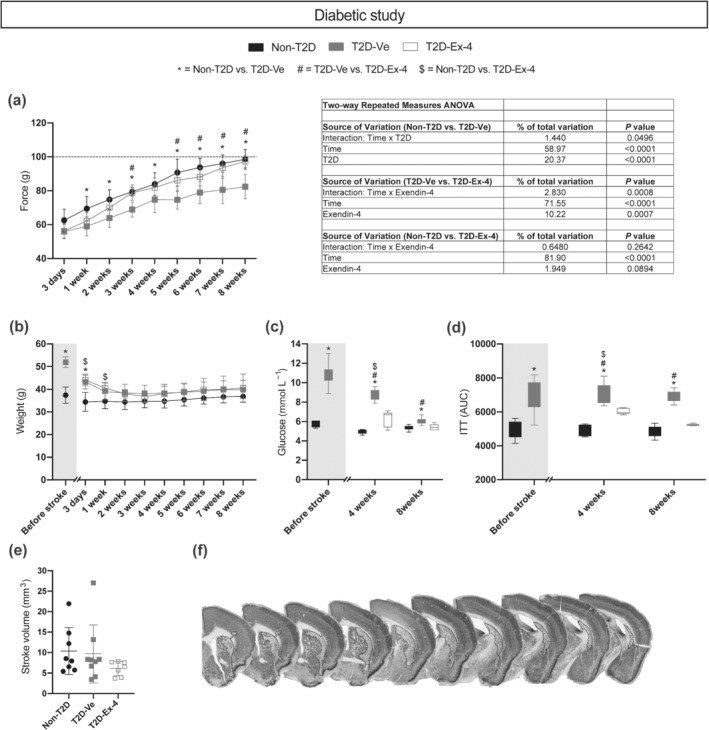
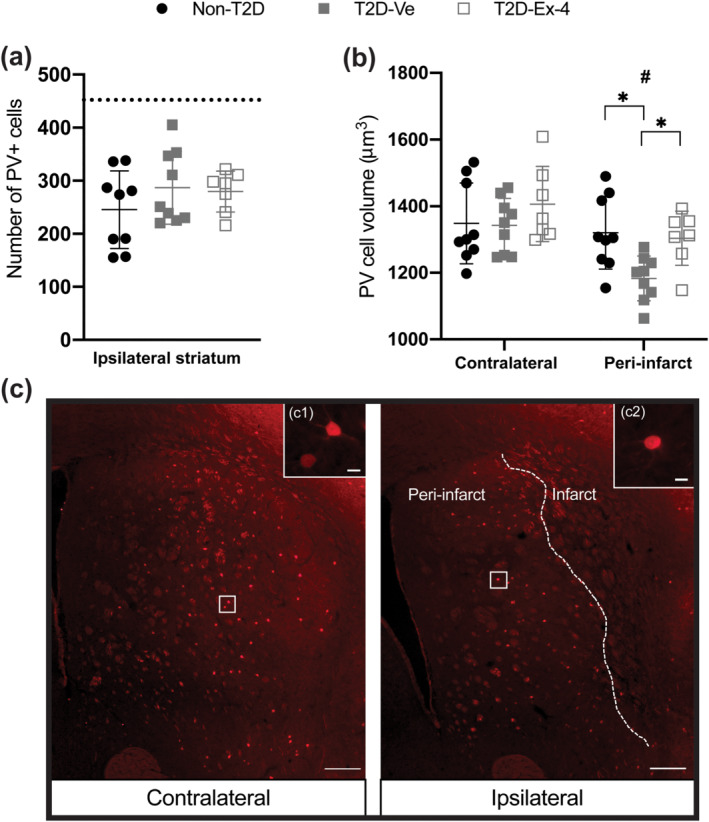
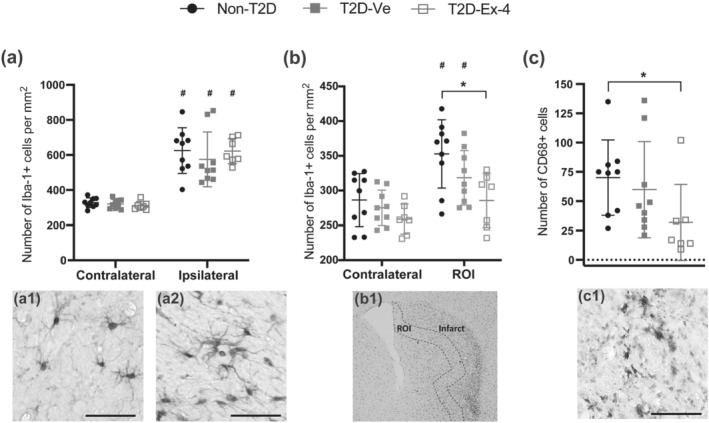
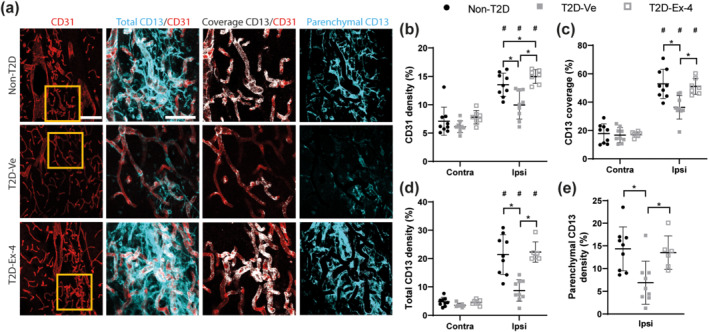
Exendin-4 normalised T2D-induced impairment of forepaw grip strength recovery in correlation with normalised glycaemia and insulin sensitivity. Moreover, exendin-4 counteracted T2D-induced atrophy of parvalbumin+ interneurons and decreased microglia activation. Finally, exendin-4 normalised density and pericyte coverage of micro-vessels and restored fibrotic scar formation in T2D mice. In non-T2D mice, the exendin-4-mediated recovery was minor.
Chronic GLP-1 receptor activation mediates post-stroke functional recovery in T2D mice by normalising glucose metabolism and improving neuroplasticity and vascular remodelling in the recovery phase. The results warrant clinical trial of GLP-1 receptor agonists for rehabilitation after stroke in T2D.
This article is part of a themed issue on GLP1 receptor ligands (BJP 75th Anniversary). To view the other articles in this section visit http://onlinelibrary.wiley.com/doi/10.1111/bph.v179.4/issuetoc.
胰高血糖素样肽-1(GLP-1)受体激动剂可降低 2 型糖尿病(T2D)患者的卒中风险,动物研究也表明该策略在对抗卒中诱导的急性脑损伤方面具有疗效。然而,GLP-1 受体激活是否也能改善卒中后慢性期的恢复尚不清楚。我们研究了在 T2D 和非 T2D 小鼠中,急性后、慢性给予 GLP-1 受体激动剂 exendin-4 是否能改善卒中后恢复,并探讨了可能的潜在机制。
我们通过短暂性大脑中动脉闭塞(tMCAO)在 T2D/肥胖小鼠(8 个月高脂肪饮食)和年龄匹配的对照小鼠中诱导卒中。从 tMCAO 后第 3 天开始,exendin-4 给药 8 周。我们通过每周的上肢握力测试评估功能恢复情况。在 tMCAO 后 4 周和 8 周时评估胰岛素敏感性和血糖。通过免疫组织化学法检测神经元存活、卒中诱导的神经发生、神经炎症、GABA 能神经元 parvalbumin+中间神经元的萎缩、卒中后血管重塑和纤维瘢痕形成。
exendin-4 使 T2D 诱导的前爪握力恢复受损正常化,与血糖和胰岛素敏感性正常化相关。此外,exendin-4 还能对抗 T2D 诱导的 parvalbumin+中间神经元萎缩和小胶质细胞激活。最后,exendin-4 使 T2D 小鼠微血管密度和周细胞覆盖正常化,并恢复纤维瘢痕形成。在非 T2D 小鼠中,exendin-4 介导的恢复程度较小。
慢性 GLP-1 受体激活通过正常化葡萄糖代谢和改善恢复期的神经可塑性和血管重塑,介导 T2D 小鼠卒中后的功能恢复。这些结果为 T2D 患者卒中后使用 GLP-1 受体激动剂进行康复治疗的临床试验提供了依据。
本文是 GLP1 受体配体专题的一部分(BJP 75 周年)。要查看本部分中的其他文章,请访问 http://onlinelibrary.wiley.com/doi/10.1111/bph.v179.4/issuetoc.