University of Tasmania, Hobart, Tasmania, Australia.
Murdoch Children's Research Institute, Melbourne, Victoria, Australia.
J Infect Dis. 2022 Apr 1;225(7):1266-1273. doi: 10.1093/infdis/jiab239.
No studies have explored the association between pneumococcal nasopharyngeal density and severe pneumonia using the World Health Organization (WHO) 2013 definition. In Lao People's Democratic Republic (Lao PDR), we determine the association between nasopharyngeal pneumococcal density and severe pneumonia in children.
A prospective observational study was undertaken at Mahosot Hospital, Vientiane, from 2014 to mid-2018. Children <5 years admitted with acute respiratory infections (ARIs) were included. Clinical and demographic data were collected alongside nasopharyngeal swabs for pneumococcal quantification by lytA real-time quantitative polymerase chain reaction. Severe pneumonia was defined using the 2013 WHO definition. For pneumococcal carriers, a logistic regression model examined the association between pneumococcal density and severe pneumonia, after adjusting for potential confounders including demographic and household factors, 13-valent pneumococcal conjugate vaccine status, respiratory syncytial virus co-detection, and preadmission antibiotics.
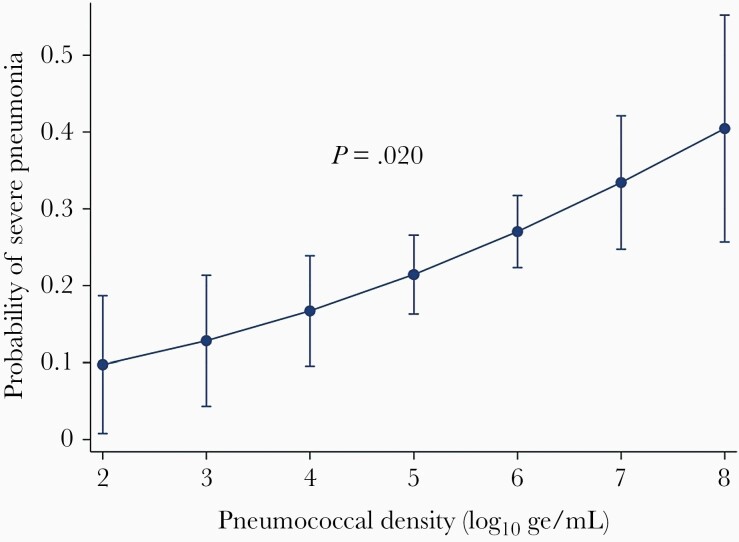
Of 1268 participants with ARI, 32.3% (n = 410) had severe pneumonia and 36.9% (n = 468) had pneumococcal carriage. For pneumococcal carriers, pneumococcal density was positively associated with severe pneumonia (adjusted odds ratio, 1.4 [95% confidence interval, 1.1-1.8]; P = .020).
Among children with ARIs and pneumococcal carriage, pneumococcal carriage density was positively associated with severe pneumonia in Lao PDR. Further studies may determine if pneumococcal density is a useful marker for pneumococcal conjugate vaccine impact on childhood pneumonia.
尚无研究使用世界卫生组织(WHO)2013 年的定义来探究肺炎球菌鼻咽密度与严重肺炎之间的关联。在老挝人民民主共和国(老挝),我们确定了鼻咽部肺炎球菌密度与儿童严重肺炎之间的关联。
2014 年至 2018 年中期,在万象的玛霍索医院进行了一项前瞻性观察性研究。纳入患有急性呼吸道感染(ARI)的<5 岁儿童。收集临床和人口统计学数据,并采集鼻咽拭子,通过 lytA 实时定量聚合酶链反应进行肺炎球菌定量。使用 2013 年 WHO 定义来定义严重肺炎。对于肺炎球菌携带者,使用逻辑回归模型,在调整了包括人口统计学和家庭因素、13 价肺炎球菌结合疫苗状况、呼吸道合胞病毒共检测和入院前抗生素在内的潜在混杂因素后,研究肺炎球菌密度与严重肺炎之间的关联。
在 1268 名患有 ARI 的参与者中,32.3%(n=410)患有严重肺炎,36.9%(n=468)患有肺炎球菌携带。对于肺炎球菌携带者,肺炎球菌密度与严重肺炎呈正相关(调整后的优势比,1.4 [95%置信区间,1.1-1.8];P=0.020)。
在患有 ARI 和肺炎球菌携带的儿童中,肺炎球菌携带密度与老挝的严重肺炎呈正相关。进一步的研究可能会确定肺炎球菌密度是否是肺炎球菌结合疫苗对儿童肺炎影响的有用标志物。