"Constantin Cosma" Radon Laboratory (LiRaCC), Faculty of Environmental Science and Engineering, "Babeş-Bolyai" University, Str. Fântânele 30, Cluj-Napoca, Romania.
Faculty of Civil Engineering, Technical University of Cluj-Napoca, Str. C. Daicoviciu 15, Cluj-Napoca, Romania.
Sci Rep. 2021 May 11;11(1):9925. doi: 10.1038/s41598-021-88904-2.
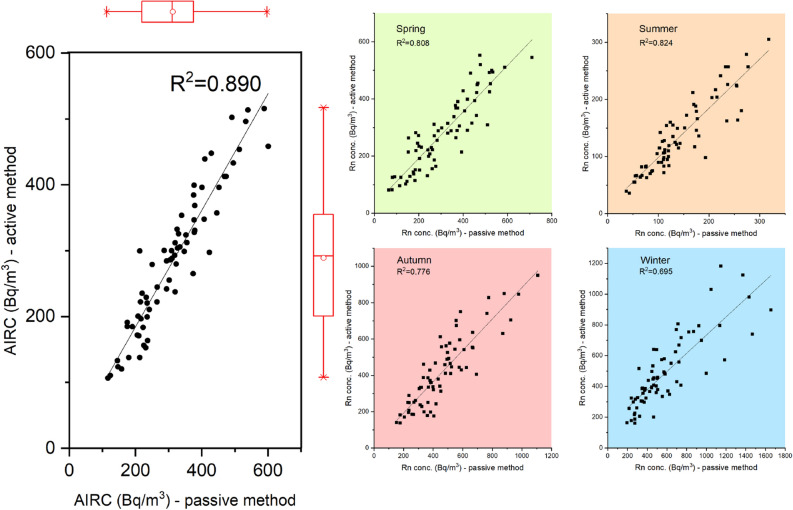
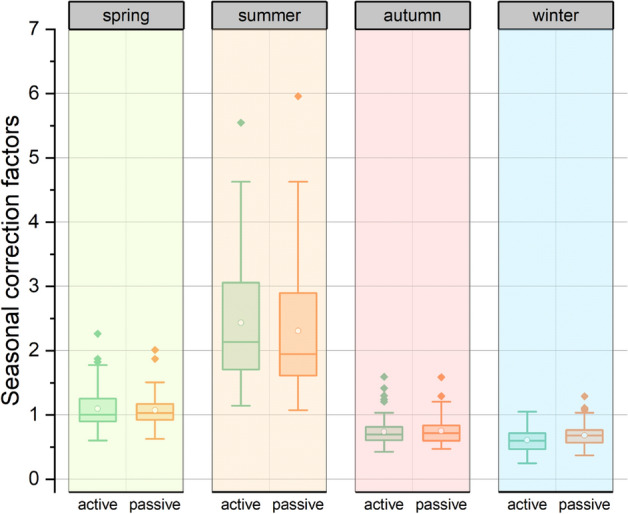
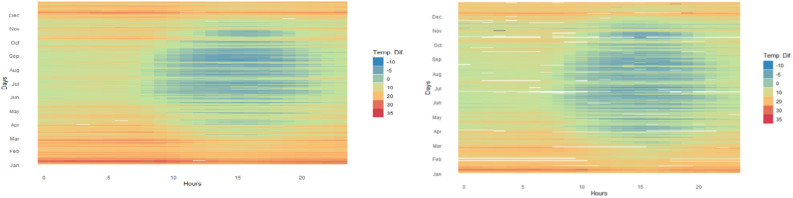
The present study aims to identify novel means of increasing the accuracy of the estimated annual indoor radon concentration based on the application of temporal correction factors to short-term radon measurements. The necessity of accurate and more reliable temporal correction factors is in high demand, in the present age of speed. In this sense, radon measurements were continuously carried out, using a newly developed smart device accompanied by CR-39 detectors, for one full year, in 71 residential buildings located in 5 Romanian cities. The coefficient of variation for the temporal correction factors calculated for combinations between the start month and the duration of the measurement presented a low value (less than 10%) for measurements longer than 7 months, while a variability close to 20% can be reached by measurements of up to 4 months. Results obtained by generalized estimating equations indicate that average temporal correction factors are positively associated with CO ratio, as well as the interaction between this parameter and the month in which the measurement took place. The impact of the indoor-outdoor temperature differences was statistically insignificant. The obtained results could represent a reference point in the elaboration of new strategies for calculating the temporal correction factors and, consequently, the reduction of the uncertainties related to the estimation of the annual indoor radon concentration.
本研究旨在通过应用时间校正因子来提高估计的年室内氡浓度的准确性,找到新的方法。在当今快节奏的时代,对准确和更可靠的时间校正因子的需求很高。为此,我们使用新开发的智能设备和 CR-39 探测器,连续一年对罗马尼亚 5 个城市的 71 座住宅建筑进行了氡测量。对于起始月份和测量持续时间之间的组合计算的时间校正因子的变异系数,对于测量时间超过 7 个月的测量值,其值较低(小于 10%),而对于测量时间长达 4 个月的测量值,其变化接近 20%。广义估计方程的结果表明,平均时间校正因子与 CO 比呈正相关,并且与测量发生的月份之间的相互作用也呈正相关。室内外温差的影响在统计学上并不显著。所得结果可以为制定新的时间校正因子计算策略提供参考点,并相应地减少与估计年室内氡浓度相关的不确定性。