Department of Endocrinology and Metabolism, Inonu University School of Medicine, Malatya, Turkey.
Department of İnternal Medicine, Yayladağ State Hospital, Hatay, Turkey.
Sci Rep. 2021 May 11;11(1):9932. doi: 10.1038/s41598-021-89403-0.
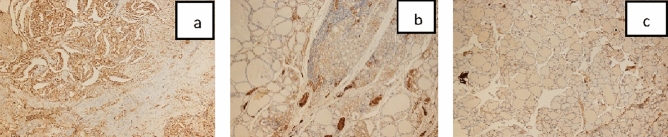
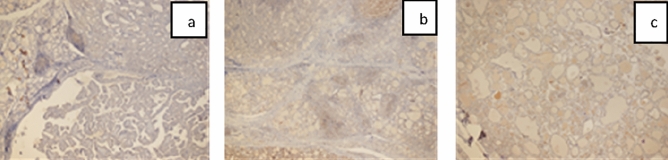
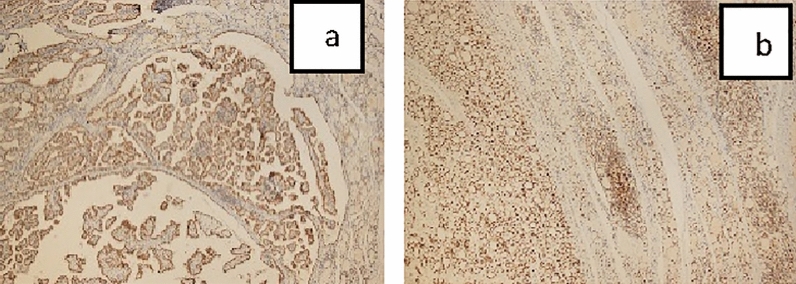
Malignant thyroid lesions are the most common malignancy of the endocrine glands with increasing rates in the last two decades. Papillary thyroid cancer is the most common thyroid malignancy. In our study, we aimed to quantitatively evaluate the levels of DNA repair proteins MSH2, MLH1, MGMT, which are representative blocks of patients diagnosed with papillary carcinoma, chronic thyroiditis, or colloidal goiter. Total or subtotal thyroidectomy material of 90 patients diagnosed with papillary carcinoma, nodular colloidal goiter, or chronic thyroiditis between 2009 and 2012 were retrospectively evaluated. Tissue samples obtained from paraffin blocks were stained with MGMT, MSH2, MLH1 proteins and their immunohistochemistry was evaluated. Prepared sections were examined qualitatively by an impartial pathologist and a clinician, taking into account the staining method under the trinocular light microscope. Although there was no statistically significant difference in MGMT, MSH2, MLH1, follicular cell positivity, staining intensity, and immunoreactivity values, papillary carcinoma cases showed a higher rate of follicular cell positivity, and this difference was more pronounced between papillary carcinoma and colloidal goiter. In the MSH2 follicular cell positivity evaluation, the difference between chronic thyroiditis and colloidal goiter was significant (p = 0.023). The difference between chronic thyroiditis and colloidal goiter was significant in the MSH2 staining intensity evaluation (p = 0.001). The difference between chronic thyroiditis and colloidal goiter was significant in MLH1 immunoreactivity evaluation (p = 0.012). Papillary carcinoma cases were demonstrated by nuclear staining only for MSH2 and MLH1 proteins as opposed to hyperplastic nodules. The higher levels of expression of DNA repair genes in malignant tumors compared to benign tumors are attributed to the functional activation of DNA repair genes. Further studies are needed for DNA repair proteins to be a potential test in the development and progression of thyroid cancer.
甲状腺恶性病变是内分泌腺体最常见的恶性肿瘤,在过去二十年中发病率不断上升。甲状腺癌中最常见的是甲状腺乳头状癌。在我们的研究中,我们旨在定量评估 MSH2、MLH1、MGMT 等 DNA 修复蛋白的水平,这些蛋白是诊断为甲状腺癌、慢性甲状腺炎或胶状甲状腺肿患者的代表性标志物。我们回顾性评估了 2009 年至 2012 年间诊断为甲状腺乳头状癌、结节性胶状甲状腺肿或慢性甲状腺炎的 90 例患者的全甲状腺或次全甲状腺切除术标本。从石蜡块中获取组织样本,用 MGMT、MSH2、MLH1 蛋白进行染色,并对其免疫组织化学进行评估。制备的切片由公正的病理学家和临床医生进行定性检查,同时考虑在三目显微镜下的染色方法。虽然 MGMT、MSH2、MLH1、滤泡细胞阳性、染色强度和免疫反应性值之间没有统计学上的显著差异,但甲状腺乳头状癌病例的滤泡细胞阳性率较高,且在甲状腺乳头状癌和胶状甲状腺肿之间的差异更为明显。在 MSH2 滤泡细胞阳性评估中,慢性甲状腺炎和胶状甲状腺肿之间的差异具有统计学意义(p=0.023)。在 MSH2 染色强度评估中,慢性甲状腺炎和胶状甲状腺肿之间的差异具有统计学意义(p=0.001)。在 MLH1 免疫反应性评估中,慢性甲状腺炎和胶状甲状腺肿之间的差异具有统计学意义(p=0.012)。与增生性结节不同,MSH2 和 MLH1 蛋白仅显示核染色的甲状腺乳头状癌病例。与良性肿瘤相比,恶性肿瘤中 DNA 修复基因的高表达水平归因于 DNA 修复基因的功能激活。需要进一步的研究来确定 DNA 修复蛋白是否可以成为甲状腺癌发展和进展的潜在检测手段。