Moon Da Hye, Kim Jeeyoung, Lim Myoung Nam, Bak So Hyen, Kim Woo Jin
Department of Internal Medicine, Kangwon National University Hospital, Chuncheon, Republic of Korea.
Department of Internal Medicine and Environmental Health Center, Kangwon National University School of Medicine, Chuncheon, Republic of Korea.
Tuberc Respir Dis (Seoul). 2021 Jul;84(3):188-199. doi: 10.4046/trd.2021.0015. Epub 2021 May 13.
Chronic obstructive pulmonary disease (COPD) is a common chronic respiratory disease with increased prevalence in the elderly. Telomeres are repetitive DNA sequences found at the end of the chromosome, which progressively shorten as cells divide. Telomere length is known to be a molecular marker of aging. This study aimed to assess the relationship between telomere length and the risk of COPD, lung function, respiratory symptoms, and emphysema index in Chronic Obstructive Pulmonary Disease in Dusty Areas (CODA) cohort.
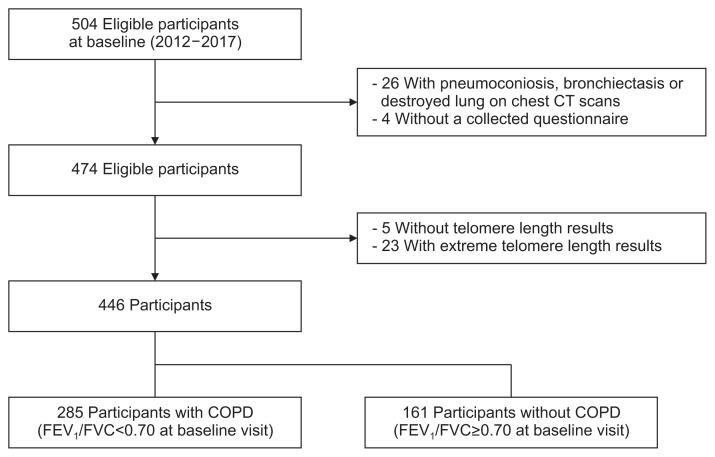
We extracted DNA from the peripheral blood samples of 446 participants, including 285 COPD patients and 161 control participants. We measured absolute telomere length using quantitative real-time polymerase chain reaction. All participants underwent spirometry and quantitative computed tomography scan. Questionnaires assessing respiratory symptoms and the COPD Assessment Test was filled by all the participants.
The mean age of participants at the baseline visit was 72.5±7.1 years. Males accounted for 72% (321 participants) of the all participants. The mean telomere length was lower in the COPD group compared to the non-COPD group (COPD, 16.81±13.90 kb; non-COPD, 21.97±14.43 kb). In COPD patients, 112 (75.7%) were distributed as tertile 1 (shortest), 91 (61.1%) as tertile 2 and 82 (55%) as tertile 3 (longest). We did not find significant associations between telomere length and lung function, exacerbation, airway wall thickness, and emphysema index after adjusting for sex, age, and smoking status.
In this study, the relationship between various COPD phenotypes and telomere length was analyzed, but no significant statistical associations were shown.
慢性阻塞性肺疾病(COPD)是一种常见的慢性呼吸道疾病,在老年人中的患病率呈上升趋势。端粒是位于染色体末端的重复DNA序列,随着细胞分裂会逐渐缩短。已知端粒长度是衰老的分子标志物。本研究旨在评估在尘肺地区慢性阻塞性肺疾病(CODA)队列中,端粒长度与COPD风险、肺功能、呼吸道症状和肺气肿指数之间的关系。
我们从446名参与者的外周血样本中提取DNA,其中包括285名COPD患者和161名对照参与者。我们使用定量实时聚合酶链反应测量绝对端粒长度。所有参与者均接受了肺功能测定和定量计算机断层扫描。所有参与者都填写了评估呼吸道症状的问卷和慢性阻塞性肺疾病评估测试问卷。
基线访视时参与者的平均年龄为72.5±7.1岁。男性占所有参与者的72%(321名参与者)。与非COPD组相比,COPD组的平均端粒长度较低(COPD组为16.81±13.90 kb;非COPD组为21.97±14.43 kb)。在COPD患者中,112名(75.7%)分布在三分位数1(最短),91名(61.1%)分布在三分位数2,82名(55%)分布在三分位数3(最长)。在调整性别、年龄和吸烟状况后,我们未发现端粒长度与肺功能、急性加重、气道壁厚度和肺气肿指数之间存在显著关联。
在本研究中,分析了各种COPD表型与端粒长度之间的关系,但未显示出显著的统计学关联。